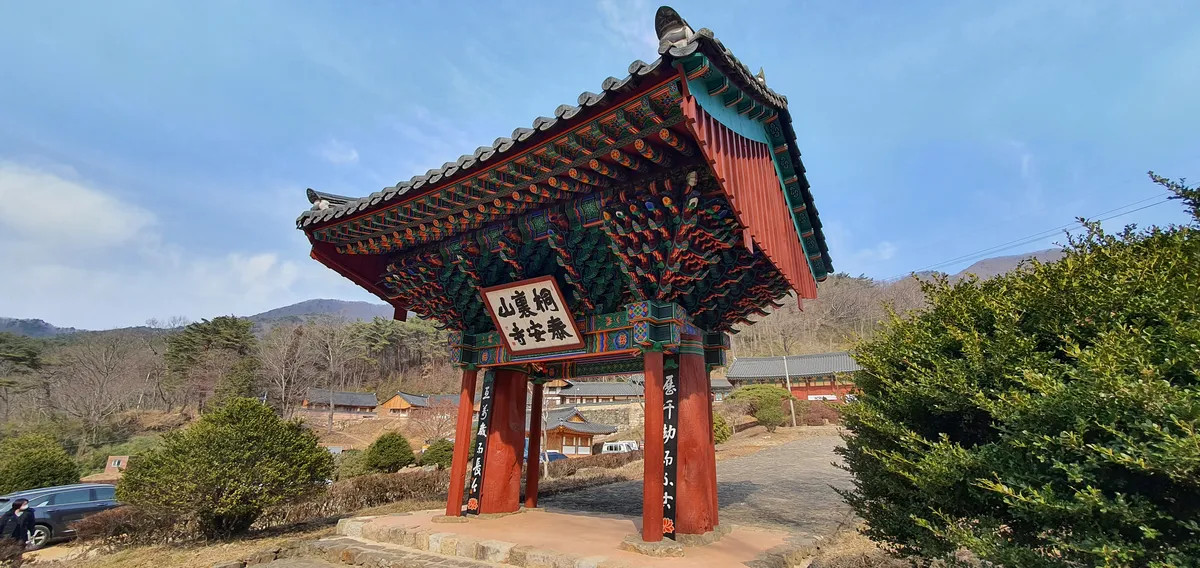
Taeansa Iljumun Gate, Gokseong
谷城 泰安寺 一柱門
전라남도 곡성군
Basic information
- Designation
- Treasure No.2234
- Category
- Architecture
- Era
- 조선시대
- Designated year
- 2023
- Location
- 곡성군, 전라남도— 전라남도 곡성군 태안로 622-215(죽곡면)
- Coordinates
- 35.131958, 127.386381Kakao address conversion
AI Docent
Coming soonAn AI-generated, friendly retelling of this heritage site is available in Korean. An English version is on our roadmap — for now, please see the official description below.
Description
Machine-translatedThis English description was machine-translated and may contain inaccuracies. Refer to the original Korean text for details.
Gokseong Taean Temple's Single-Pillar Gate (Iljumun), also documented as the Jogye Gate, underwent 2017 restoration work during which ridge-beam inscriptions confirmed its 1521 (Jungjong 16th year) construction as the "Jogye Gate" (Jogye-mun). The ridge inscription preserves a signature mark (su-gyeol) of Prince Hyoreung, the second son of King Taejong (1396-1486). During the Korean War, Taean Temple sustained extensive destruction, yet the single-pillar gate and Neungpa Hall survived among remaining structures. The gate displays frontal plaque reading "Mount Dongni Taean Temple" (Dongni-san Taean-sa) with rear plaque inscribed "Phoenix Gate" (Bongwhang-mun). Gokseong Taean Temple's Single-Pillar Gate comprises a single-bay gable-roof structure. The frontal curved-beam configuration supports five bracket members, with the overall structure incorporating twelve bracket members utilizing multiple-bracket system designs and double-eave overlapping roof configuration. Auxiliary columns reinforce the primary pillars at four cardinal locations: both lateral sides and front-and-rear curved-beam corners. The primary pillar upper section incorporates interior dragon-head ornamentation (yong-du), which displays elaborate three-dimensional articulation including horns, prominent eyes, eyebrows, widely gaping mouth with exposed teeth, and neck-mane details executed with refined naturalism and dramatic expressiveness. Taean Temple's single-pillar gate benefits from ridge-beam inscription documentation confirming its early-Joseon construction period and architectural technique preservation reflecting late-Joseon design methodology evident in bracket configuration and assembly, demonstrating sustained maintenance continuation following initial construction, conferring high historical and scholarly value.
Location
지도를 불러오는 중…
Have you visited this place?
Log in and verify your visit on-site via GPS to record a stamp in My Journey. (QR verification coming later.)
Images: KOGL (khs.go.kr) · Data source: Korea Heritage Service Open API (khs.go.kr)