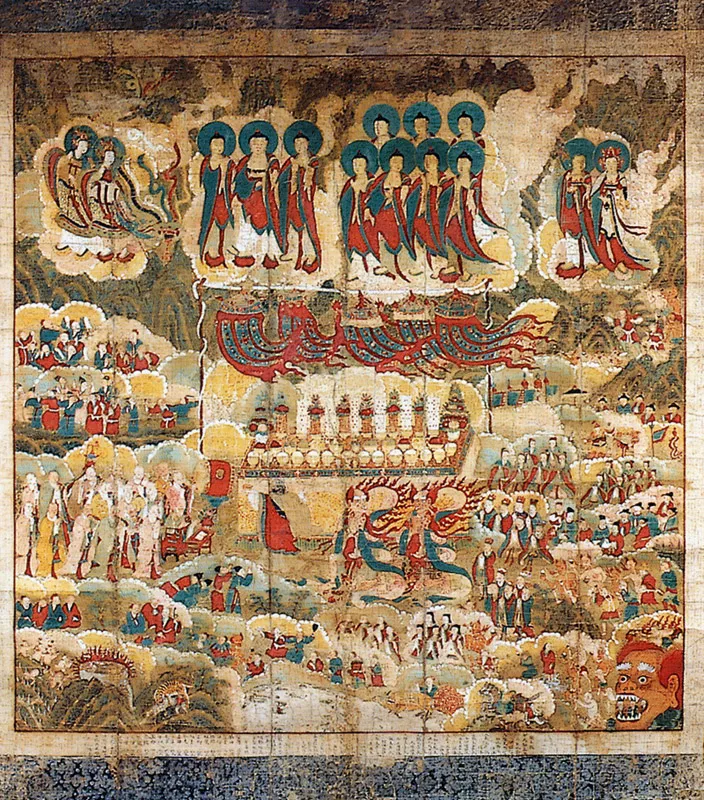
Gamrotaenghwa
甘露幀畵
서울특별시 종로구
Basic information
- Designation
- Treasure No.1239
- Category
- Painting
- Designated year
- 1996
- Location
- 종로구, 서울특별시— 서울특별시 종로구
- Coordinates
- 37.574773, 126.979614
AI Docent
Coming soonAn AI-generated, friendly retelling of this heritage site is available in Korean. An English version is on our roadmap — for now, please see the official description below.
Description
Taenghwa refers to a Buddhist painting painted on cloth or paper and hung on the wall after being framed. Gamno taenghwa (Painting of Buddha Giving a Sermon) refers to a kind of taenghwa, which is painted to pray for the dead and for their safe trip to the Pure Land. Many taenghwa drawn since the mid-Joseon Dynasty reflect the combination of Buddhism and Confucianism, particularly filial duty. This three-level painting has a landscape painting as its background. The top part depicts the ideal world where Buddha exists. The middle part portrays the scene of Buddhist ritual for a starving ghost and the table setting for the ritual. The lower part of the painting features the world of samsara and continuous cycle of life, death, and reincarnation, including hell and starving demon. The upper center part of the painting depicts three Buddhist gods (Sakyamuni, Vairocana Buddha, Nosana Buddha) as well as the seven Buddhist gods. Generally, the three Buddhist gods do not appear in Gamno taenghwa, but this painting depicts them under the influence of Hwaeomjong, a sect of Buddhism. The middle center part portrays the scene of monks holding a ritual as well as the starving ghosts under them. There is a specially set table for the ritual. Lightning and gold lines mark the sacred areas on the table. The colors of the robes of the monks leading the ritual and the drum and bells, which are portrayed in the painting, provide information about the rituals of that time. Made in the 7th year of the reign of King Sukjong (1681) of the Joseon Dynasty, this painting is the second oldest Gamno taenghwa in Korea, following the one in the National Museum of Korea, which was painted in 1649. The landscape background is typical among the Buddhist paintings in the Joseon Dynasty. The painting provides important information in studying Gamno taenghwa paintings from the mid- and late Joseon Dynasty.
Location
지도를 불러오는 중…
Have you visited this place?
Log in and verify your visit on-site via GPS to record a stamp in My Journey. (QR verification coming later.)
Images: KOGL (khs.go.kr) · Data source: Korea Heritage Service Open API (khs.go.kr)