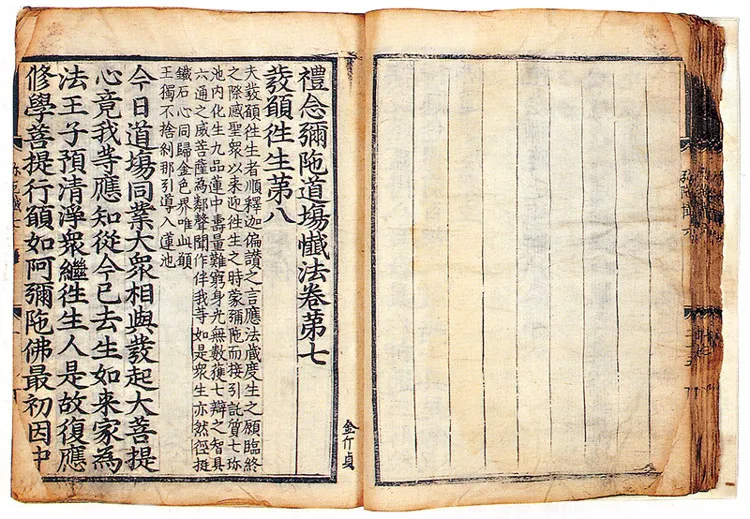
Yenyeommitadoryangchambeop Gwon6~10(1996)
禮念彌陀道場懺法 卷六~十(1996)
경상북도 김천시
Basic information
- Designation
- Treasure No.1241
- Category
- Books & Records
- Era
- 조선 연산군 년간 16세기초
- Designated year
- 1996
- Location
- 김천시, 경상북도— 경북 김천시 대항면 북암길 89, 직지사 성보박물관 (운수리)
- Coordinates
- 36.116772, 128.004077
AI Docent
Coming soonAn AI-generated, friendly retelling of this heritage site is available in Korean. An English version is on our roadmap — for now, please see the official description below.
Description
These books record the procedure of a Buddhist ritual to repent of one’s sin and pray for one’s easy passage to the Pure Land while worshipping Amitabha Buddha. Printed from woodblocks, Volumes 6 to 10 are bound into one book. The exact publication date of this book is not known because of the absence of publication record. Nonetheless, it is believed to have been printed from the same woodblocks as Yenyeom mita doryang chambeop volumes 1-5, 6-10 (Treasure No. 949) because of the similarity between the two books in terms of the style of woodblocks. According to the record written by Kim Su-on at the end of the book, Queen Jeonghui, who was Queen Consort to King Sejo in the Joseon Dynasty, published the book in the 5th year of King Seongjong’s reign (1474) to pray for the repose of late Kings and Queens of the past; the best printing experts and respected monks were mobilized for the printing of the book at that time. The only difference between this book and Yenyeom mita doryang chambeop, which is designated as Treasure No. 949, is that this book has a record about engravers. There are a few books that have a record of the engravers like this book. According to the epilogue of those books, the second woodblocks were engraved at Haeinsa Temple in the 9th year of King Yeonsangun’s reign (1503) based on the original one, which had been engraved in the 5th year of the reign of King Seongjong of the Joseon Dynasty. This book was printed with the second woodblocks at Haeinsa Temple in the early 16th century. Note, however, that the printing and engraving condition is as good as that of the first ones. This book is considered valuable since the record of engravers provides a clue in estimating the publication date of the books, which seem to have been published in the same period. It also provides important information in studying bibliography as well as the history of Buddhist culture in Korea.
Location
지도를 불러오는 중…
Have you visited this place?
Log in and verify your visit on-site via GPS to record a stamp in My Journey. (QR verification coming later.)
Images: KOGL (khs.go.kr) · Data source: Korea Heritage Service Open API (khs.go.kr)