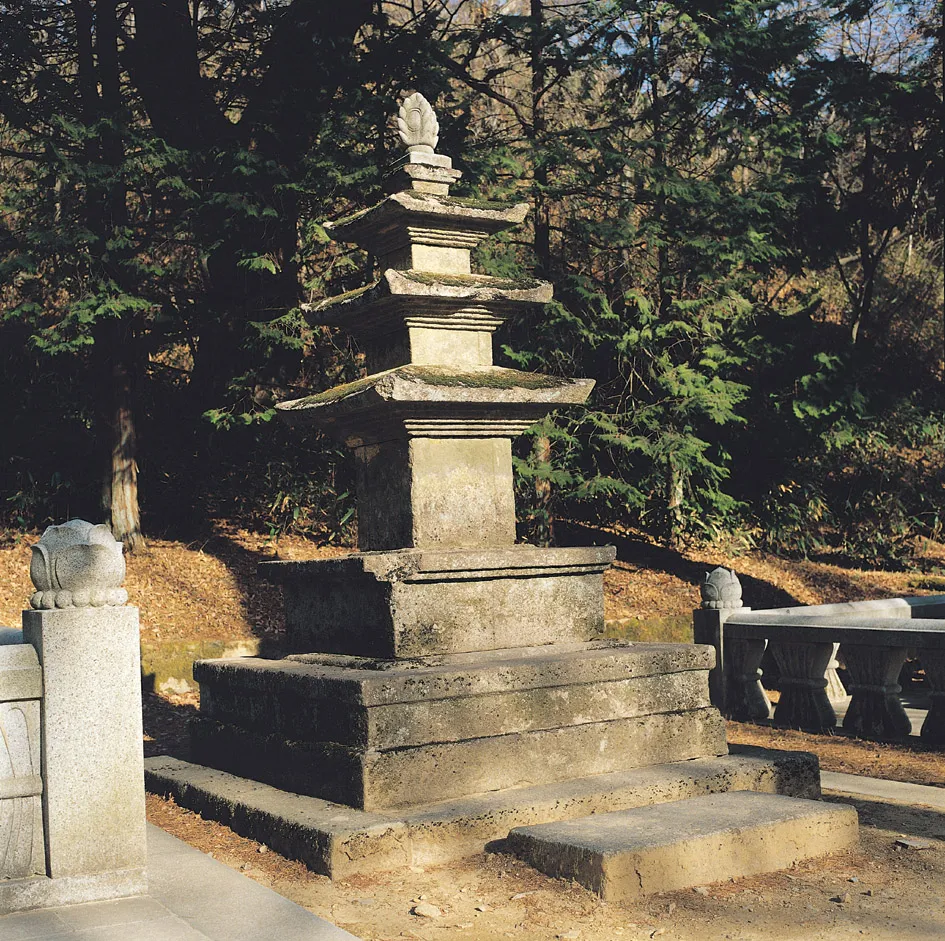
Haeinsa Gilsangtap, Hapcheon
陜川 海印寺 吉祥塔
경상남도 합천군
Basic information
- Designation
- Treasure No.1242
- Category
- Sites & Pagodas
- Era
- 통일신라 진성여왕 9년(895)
- Designated year
- 1996
- Location
- 합천군, 경상남도— 경남 합천군 가야면 해인사길 85, 해인사 (치인리)
- Coordinates
- 35.799180, 128.096533
AI Docent
Coming soonAn AI-generated, friendly retelling of this heritage site is available in Korean. An English version is on our roadmap — for now, please see the official description below.
Description
This pagoda is located near Iljumun Gate of Haeinsa Temple. It is placed at a roadside, independently of the arrangement of buildings at the temple. It consists of a 2-story stylobate and a 3-story body, showing a typical pagoda feature of the Unified Silla Dynasty. The lower-story stylobate is placed on the ground stone, and the upper-story stylobate, on top after inserting thin pile stones between the two stylobates. The upper-story stylobate is made of one piece of stone that cannot be seen in other pagodas. In the pagoda body, the size of the 1st story is bigger than the combined size of the 2nd and 3rd stories. Each story has a 5-tier support under the roof stone. The eaves of the roof stone are stretched upward sharply at the four corners, giving an overall nimble feel. Most of the head decoration on the apex of the pagoda is gone except the four-cornered support stone. On the upper side of the support stone is a hole through which a steel bar was inserted. The National Museum of Korea is keeping the artifacts discovered from this Pagoda. Among the artifacts, 157 pagoda miniatures were found. At least 19 pieces seem to be missing because pagodas usually consisted of 99 pieces and 77 pieces. Another important artifact about this pagoda is the 4-page pagoda record written by Choe Chi-won, a great writer in the late Unified Silla Dynasty. According to the record, this pagoda was built in the 8th year of the reign of Queen Jinseong of the Silla Dynasty (895) to comfort the souls of the Buddhist monks who were killed while protecting the treasures of the temple during the period of disorder in the later years of the Unified Silla Dynasty. This pagoda is a typical small pagoda in the late Unified Silla Dynasty, showing elegant yet simple beauty. The record of this pagoda provides an important clue as to the social and economic situation at that time.
Location
지도를 불러오는 중…
Have you visited this place?
Log in and verify your visit on-site via GPS to record a stamp in My Journey. (QR verification coming later.)
Images: KOGL (khs.go.kr) · Data source: Korea Heritage Service Open API (khs.go.kr)