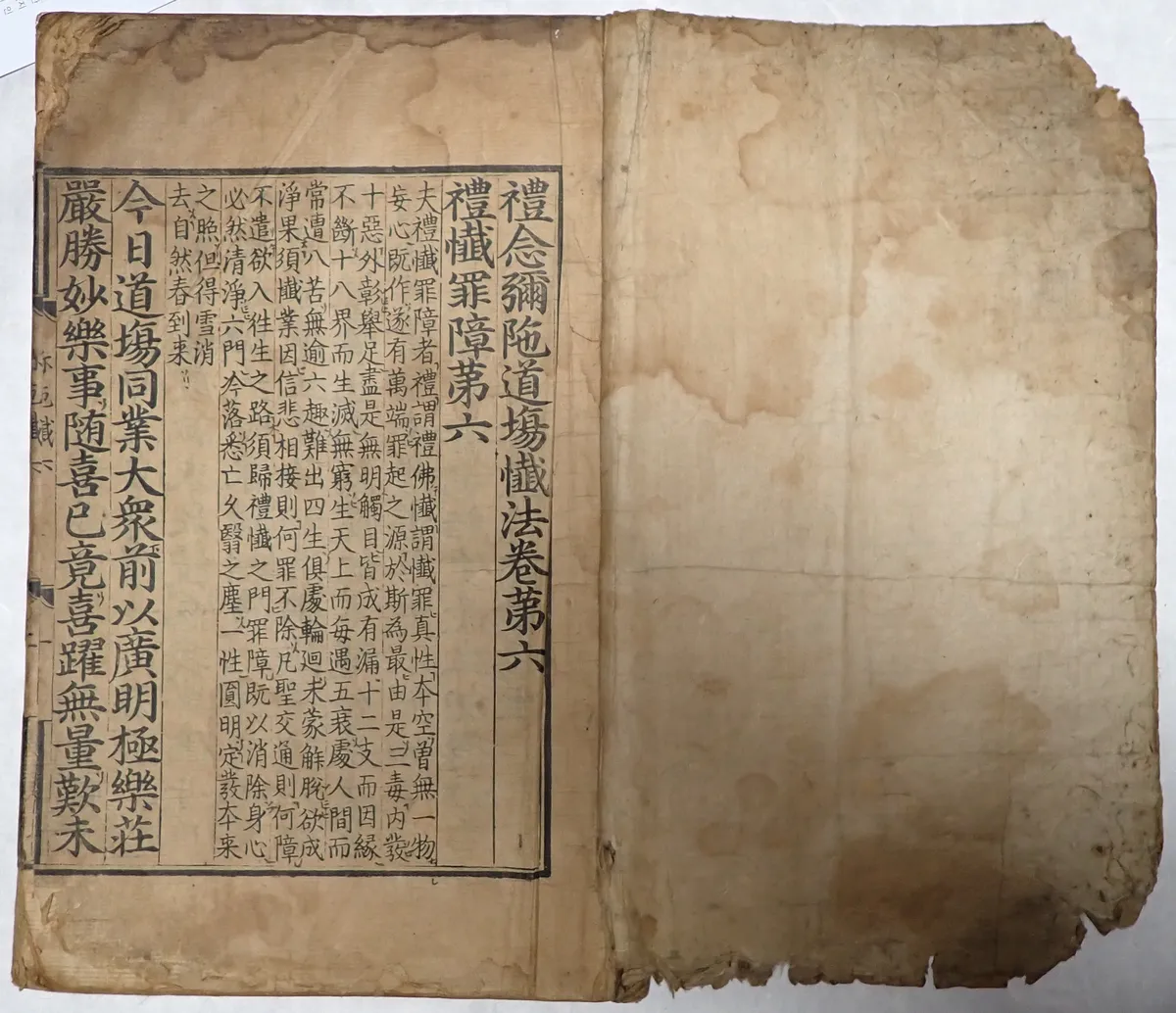
Yenyeommitadoryangchambeop Gwon6∼10
禮念彌陀道場懺法 卷六∼十
부산광역시 사상구
Basic information
- Designation
- Treasure No.2247
- Category
- Books & Records
- Era
- 1474년(조선 성종 5) 판각, 1483년(조선 성종 14) 인출
- Designated year
- 2024
- Location
- 사상구, 부산광역시— 부산광역시 사상구 백양대로804번길 42-123 (덕포동) 선광사
- Coordinates
- 35.177256, 128.995396Kakao address conversion
AI Docent
Coming soonAn AI-generated, friendly retelling of this heritage site is available in Korean. An English version is on our roadmap — for now, please see the official description below.
Description
Machine-translatedThis English description was machine-translated and may contain inaccuracies. Refer to the original Korean text for details.
The 'Ritual Manual for Amitabha Buddha Assembly and Repentance' (禮念彌陀道場懺法) comprises a ten-fascicle Buddhist ritual manual containing thirteen ceremonial procedures for seeking rebirth in the Pure Land while repenting karmic transgressions through Amitabha Buddha devotion, including sections on 'Taking Refuge in the Three Jewels of the Western Direction' (歸依西方三寶), 'Adornments of the Pure Land' (極樂莊嚴), and 'Vow for Rebirth' (發願往生). Compiled by Wang Zicheng (王子成), it is variously abbreviated as 'Mituo Chan' (彌陀懺) or called 'Pure Land Text' (淨土文). The Seonlgwang-sa copy's cover underwent later rebinding, with the title 'Great Mituo Repentance Scripture' (大彌陀懺經) and the fascicle title/ending title as 'Ritual Manual for Amitabha Buddha Assembly and Repentance.' The main text throughout features inscribed gugyeol reading marks, with Deungok Scholar Hakjo's (燈谷學祖) postscript in initial Gapinja type (初鑄甲寅字) at the end of Fascicle 10. The inscription establishes that in March 1483 (King Seongjong 14), upon Queen Jeong-hee's (King Sejo's consort) death, her daughter-in-law Queen So-hae (Deokjong's consort) sponsored printing of the 'Lotus Sutra,' 'Six Sutras,' and 'Ksitigarbha' texts with thirty copies each for Queen Jeong-hee's heavenly deliverance, with this copy representing one of the works printed from blocks already created by 1474 (King Seongjong 5) at the Printing Office under Queen Jeong-hee's sponsorship. The designated item represents materials revealing Joseon's King Seongjong period history and printing culture, possessing particular documentary value as a printed copy with postscript executed in the most refined metal movable type of early Joseon (Choshu Gapinja type). With royal sponsorship status and serving as base manuscript for later temple prints of the 'Ritual Manual for Amitabha Buddha Assembly,' it holds important scholarly value for Buddhist studies and Printing Office edition research.
Location
지도를 불러오는 중…
Have you visited this place?
Log in and verify your visit on-site via GPS to record a stamp in My Journey. (QR verification coming later.)
Images: KOGL (khs.go.kr) · Data source: Korea Heritage Service Open API (khs.go.kr)