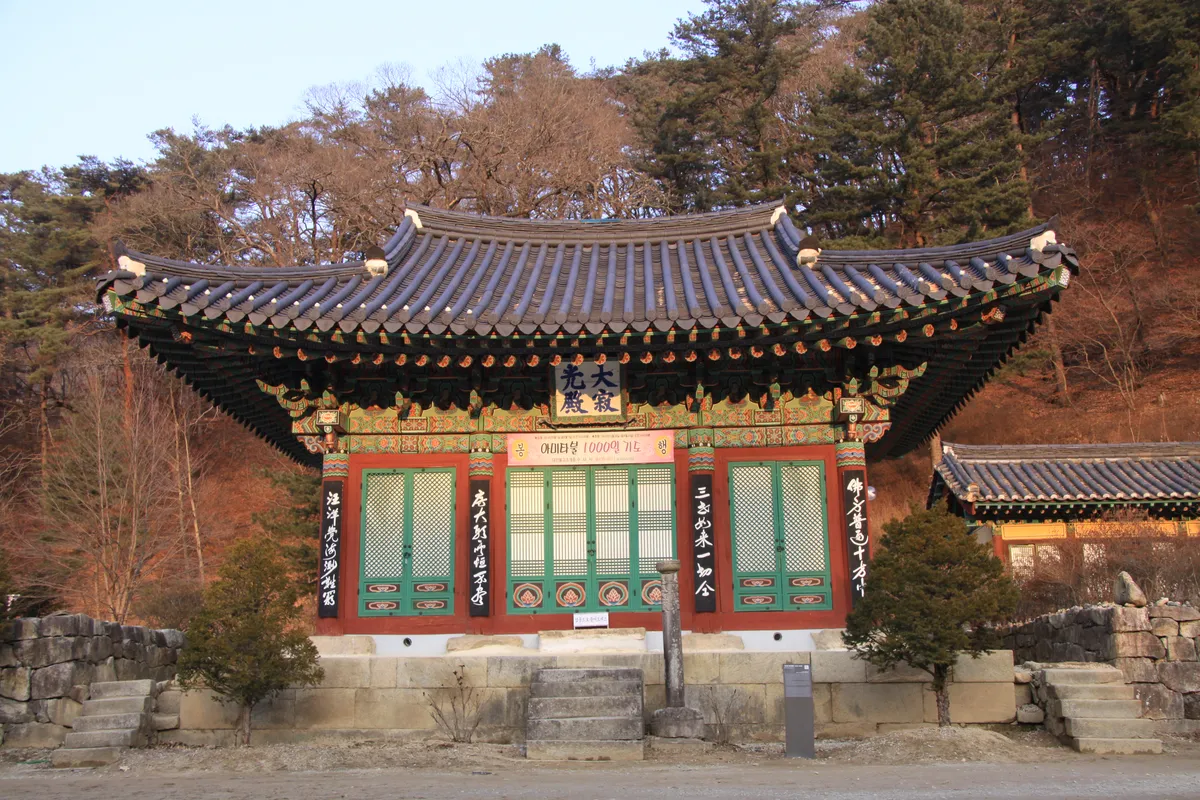
Sutasa Daejeokgwangjeon Hall, Hongcheon
洪川 壽陀寺 大寂光殿
강원특별자치도 홍천군
Basic information
- Designation
- Treasure No.2250
- Category
- Architecture
- Era
- 조선시대
- Designated year
- 2024
- Location
- 홍천군, 강원특별자치도— 강원특별자치도 홍천군 수타사로 473 (영귀미면)
- Coordinates
- 37.698384, 127.959211Kakao address conversion
AI Docent
Coming soonAn AI-generated, friendly retelling of this heritage site is available in Korean. An English version is on our roadmap — for now, please see the official description below.
Description
Machine-translatedThis English description was machine-translated and may contain inaccuracies. Refer to the original Korean text for details.
Hongcheon Suta Temple was originally established as follows according to seventeenth-century temple historical records including "Historical Record of Hongcheon District Eastern Peacock Mountain Suta Temple" (Hongcheon-hyeon Donggongjaeksan Suta-sa Sagjeok) and "Historical Record of Geonbong Temple and Subsidiary Geonbong Temples" (Geonbong-sa Geubjip Geonbong-sa Malsa Sagjeok): Buddhist Patriarch Wonhyo established Ilwol Temple on Mount Usseok during the Silla period. In 1569 (Seonjo 2nd year), the temple relocated to its present Mount Gongjak location, adopting the name Suta Temple. Following the Imjin War (1592), temple buildings were entirely destroyed by fire. Subsequently, Buddhist Master Kong-jam undertook temple reconstruction in 1636 (Injo 14th year), establishing the temple's continuous existence to the present era. *According to the "Historical Record of Geonbong Temple and Subsidiary Temples," the temple underwent name-change to Suta Temple (Susa-sa), emphasizing Amitabha Buddha's infinite lifespan symbolism, in 1811. Hongcheon Suta Temple's Dajikgwang Hall (Hall of Great Illumination) comprises a 3-bay-front, 3-bay-side structure utilizing double-eave overlapping-roof multiple-bracket-system hip-and-gable-roof design, preserving late-Joseon architectural styling characteristics. Though modest in scale, the Dajikgwang Hall demonstrates well-balanced proportional relationships among component sections, manifesting high artistic refinement characteristic of late-Joseon Buddhist temple architecture. Notably, the central Buddha altar enshrines Vairochana Buddha (Biroja-na-bul), the cosmic Buddha form, with portions of the bracket system and curved-beam components preserving mid-Joseon architectural characteristics, demonstrating significant architectural-historical value. Additionally, following Buddhist Master Kong-jam's 1636 reconstruction, detailed historical documentation supports repair and renovation activities, conferring high historical and scholarly value. *Vairochana Buddha (Biroja-na-bul) temple halls enshrine Vairochana Buddha as the principal deity, with wall-mounted posterior-altar paintings depicting the "Assembly on Vulture Peak" (Yeongsan-hwesang-do) (Gangwon Region-Designated Cultural Asset) functioning as the painted Buddha-form backdrop.
Location
지도를 불러오는 중…
Have you visited this place?
Log in and verify your visit on-site via GPS to record a stamp in My Journey. (QR verification coming later.)
Images: KOGL (khs.go.kr) · Data source: Korea Heritage Service Open API (khs.go.kr)