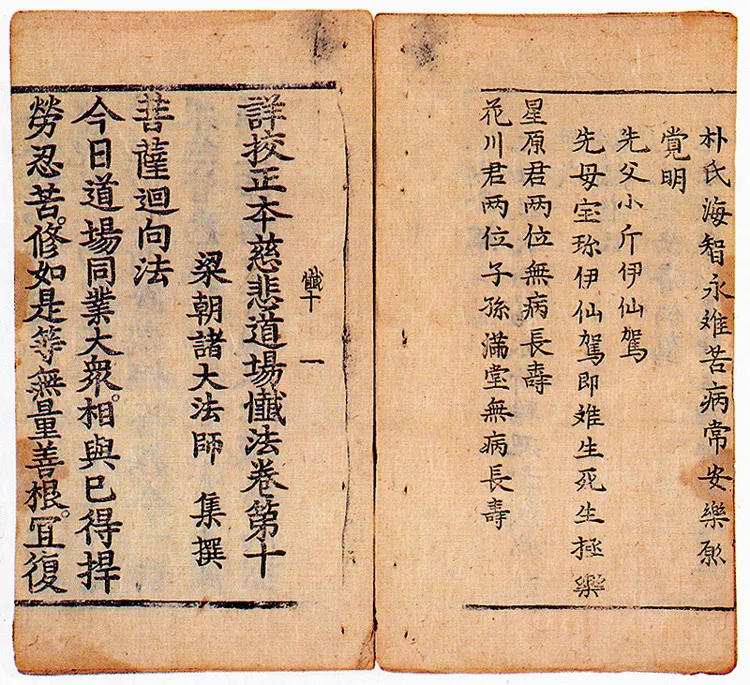
Sanggyojeongbonjabidoryangchambeop Gwon9~10(1997)
詳校正本慈悲道場懺法 卷九~十(1997)
전라남도 장흥군
Basic information
- Designation
- Treasure No.1252
- Category
- Books & Records
- Era
- 조선 세조 8년(1462년)
- Designated year
- 1997
- Location
- 장흥군, 전라남도— 전남 장흥군 유치면 봉덕리 45번지
- Coordinates
- 34.807578, 126.896515
AI Docent
Coming soonAn AI-generated, friendly retelling of this heritage site is available in Korean. An English version is on our roadmap — for now, please see the official description below.
Description
As a book on Buddhism rituals, Jabi doryang chambeop teaches people to read Buddhist scriptures and repent of their sins. It tells people that their sins are forgiven, and that they will be blessed by doing so. The book also intends to save the spirits of the dead and lead them to paradise. Sanggyojeongbon jabi doryang chambeop was published by learned monks in an effort to have people interpret the content of its original version correctly. It originally consisted of 10 volumes, but only Volumes 9 and 10 (compiled in a woodblock-printed book) are left today. At first, the woodblock-printed version was made by a son and a daughter of Kim Gu-deok, a high-ranking official, in 1447 (the 29th year of King Sejong’s reign) to pray for the souls of the following dead people: their parents, King Taejong (King Sejong’s father), his wife Queen Wongyeong, and Queen So-heon (King Sejong’s wife). In 1462 (the 8th year of King Sejo’s reign), the book stated in the subject was reprinted by Gangyeongdogam [office established to interpret Buddhist scriptures in Hangeul and publish them in 1461 (the 7th year of King Sejo’s reign)] in 1462. Researchers find this book valuable since it helps them estimate the years of publication for similar woodblock-printed books and see how Buddhist rites were held in the early Joseon Period (1392-1910) and what Gangyeongdogam did.
Location
지도를 불러오는 중…
Have you visited this place?
Log in and verify your visit on-site via GPS to record a stamp in My Journey. (QR verification coming later.)
Images: KOGL (khs.go.kr) · Data source: Korea Heritage Service Open API (khs.go.kr)