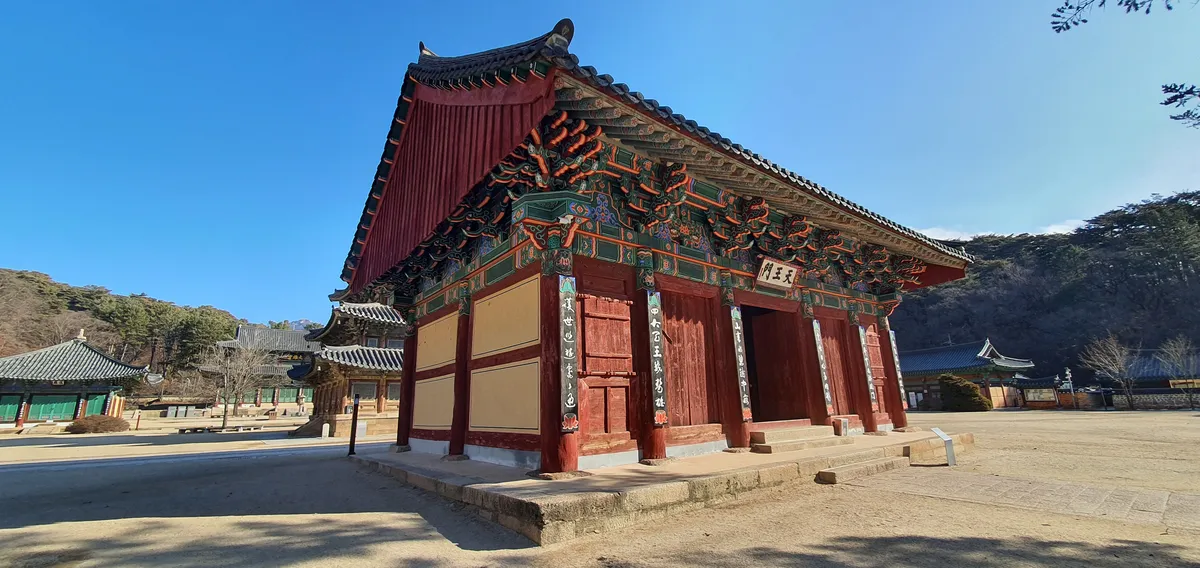
Beopjusa Cheonwang Gate, Boeun
報恩 法住寺 天王門
충청북도 보은군
Basic information
- Designation
- Treasure No.2252
- Category
- Architecture
- Era
- 조선시대
- Designated year
- 2024
- Location
- 보은군, 충청북도— 충청북도 보은군 법주사로 405 (속리산면, 법주사)
- Coordinates
- 36.541731, 127.832854Kakao address conversion
AI Docent
Coming soonAn AI-generated, friendly retelling of this heritage site is available in Korean. An English version is on our roadmap — for now, please see the official description below.
Description
Machine-translatedThis English description was machine-translated and may contain inaccuracies. Refer to the original Korean text for details.
The Four Heavenly Kings Gate (Cheonwangmun) of Beopjusa Temple in Boeun has no confirmed founding date, but is believed to have been built in the early seventeenth century during the reconstruction of Beopjusa Temple following the Second Japanese Invasion of Korea (1597). Dendrochronological analysis of the gate's pillars and the clay Four Heavenly Kings statues conducted in 2018 yielded construction dates converging on 1619 and 1620, corroborating its high historical significance. The building measures 5 bays in the front and 2 bays in depth, making it the largest surviving Cheonwangmun gate in Korea. The left and right side bays and the eave bays each enshrine two of the four clay Four Heavenly Kings statues - a total of four figures - which are the largest clay statues in Korea and were designated as a Treasure on October 26, 2023. The roof-framing structure is a single interior column, seven-purlin type, in which structural members including the chobangs, deoknyangs, and seungdus are ingeniously integrated into a precise and elaborate unified frame. The bracket system is a multiple-bracket gable-roof type with two exterior cantilevers and three interior cantilevers; unusually for a gable-roof building, bracket sets are installed on the front and rear faces as well as on both side faces. The corner bracket sets at the tops of the corner pillars follow the hip-roof corner bracket form - normally found only in hip-and-gable roof buildings - further enhancing the gate's artistic and scholarly value. The use of intermediate bracket arms at the first interior cantilever is a feature shared by other major halls of Beopjusa Temple reconstructed after the Second Invasion.
Location
지도를 불러오는 중…
Have you visited this place?
Log in and verify your visit on-site via GPS to record a stamp in My Journey. (QR verification coming later.)
Images: KOGL (khs.go.kr) · Data source: Korea Heritage Service Open API (khs.go.kr)