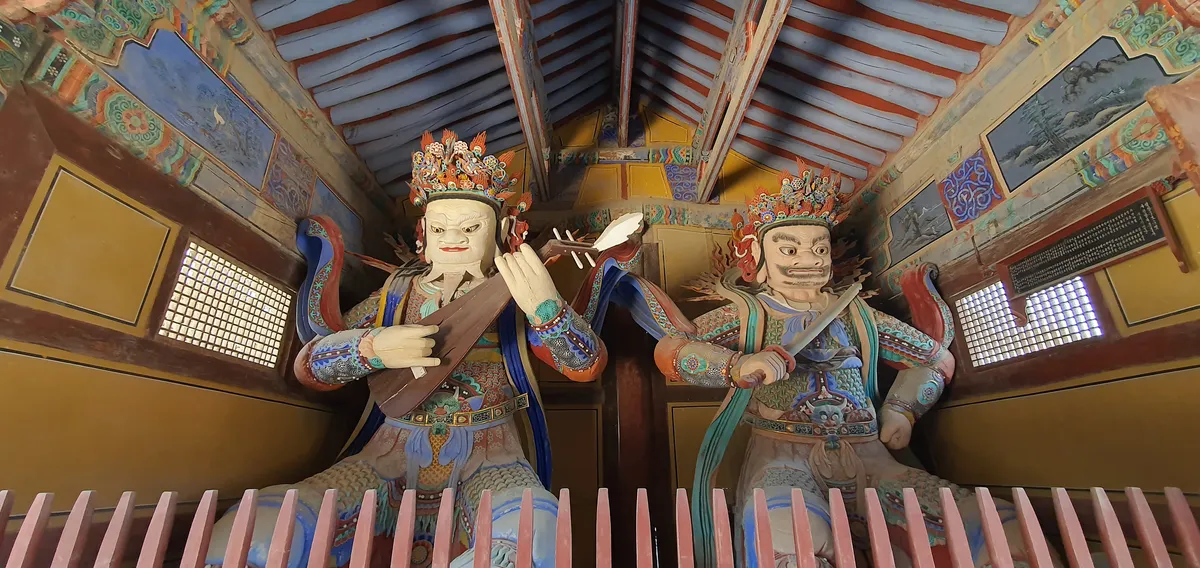
Tongdosa Cheonwang Gate, Yangsan
梁山 通度寺 天王門
경상남도 양산시
Basic information
- Designation
- Treasure No.2253
- Category
- Architecture
- Era
- 조선시대
- Designated year
- 2024
- Location
- 양산시, 경상남도— 경상남도 양산시 통도사로 108 (하북면)
- Coordinates
- 35.487780, 129.065288Kakao address conversion
AI Docent
Coming soonAn AI-generated, friendly retelling of this heritage site is available in Korean. An English version is on our roadmap — for now, please see the official description below.
Description
Machine-translatedThis English description was machine-translated and may contain inaccuracies. Refer to the original Korean text for details.
Yangsan Tongdo Temple's Four Heavenly Kings Gate underwent fire destruction in 1713 (Sukjong 39th year) and subsequent reconstruction in 1714, as documented in the record <Record of Duality-of-Worlds Hall Four Heavenly Kings Gate Reconstruction and Calligraphic Inscription (Yeongsandeon Cheonwangmun Yangung Changryeok Gyeongjip, 1716)>. Interior Four Heavenly Kings sculptures bear dated ink-inscriptions confirming creation in 1718 (Sukjong 44th year), exemplifying a rare temple mountain gate allowing precise historical documentation. The structure measures 3 bays on the front and 2 bays on the side with gable-roof configuration. The left and right flanking bays house two Four Heavenly Kings sculptures each, with the central bay functioning as a processional passage. The upper structural frame comprises two-tiered beam configuration employing a five-rafter structural system. The central and secondary roof-support members utilize carved decorative roof-floret bracket members (pa-ryeon-daegong) featuring upward-curved blade forms, with intervening ceiling-framework sections incorporating suspended curved roof-beams and row-aligned bracket members for structural reinforcement. *Roof-floret decorative bracket member (pa-ryeon-daegong): decorative carved horizontal beam component positioned above secondary roof-beam to carry central roof-beam **Row-aligned bracket member (haenggang chim-cha): short bracket member supporting the intermediate roof-beam and roof-support member extension The bracket system comprises one-bay exterior outset with upward-curved roof-support forms. The primary bracket members at the base feature lotus-flower upward-curved blade forms, while secondary bracket members employ lotus-bud upward-curved blade configurations. The upper roof-support form employs a simplified three-part-carved head-ornament design preserving old-style techniques. The bracket cantilevers represent non-standard wing-bracket forms employing shortened multi-bracket-style primary-level bracket members embellished with carved flower and lotus motifs, exemplifying the transitional period as wing-bracket systems progressively simplified from column-head bracket and multiple-bracket configurations. This architectural transitional-form evidence and time-period bracket-system stylistic characteristics demonstrate high scholarly and artistic value.
Location
지도를 불러오는 중…
Have you visited this place?
Log in and verify your visit on-site via GPS to record a stamp in My Journey. (QR verification coming later.)
Images: KOGL (khs.go.kr) · Data source: Korea Heritage Service Open API (khs.go.kr)