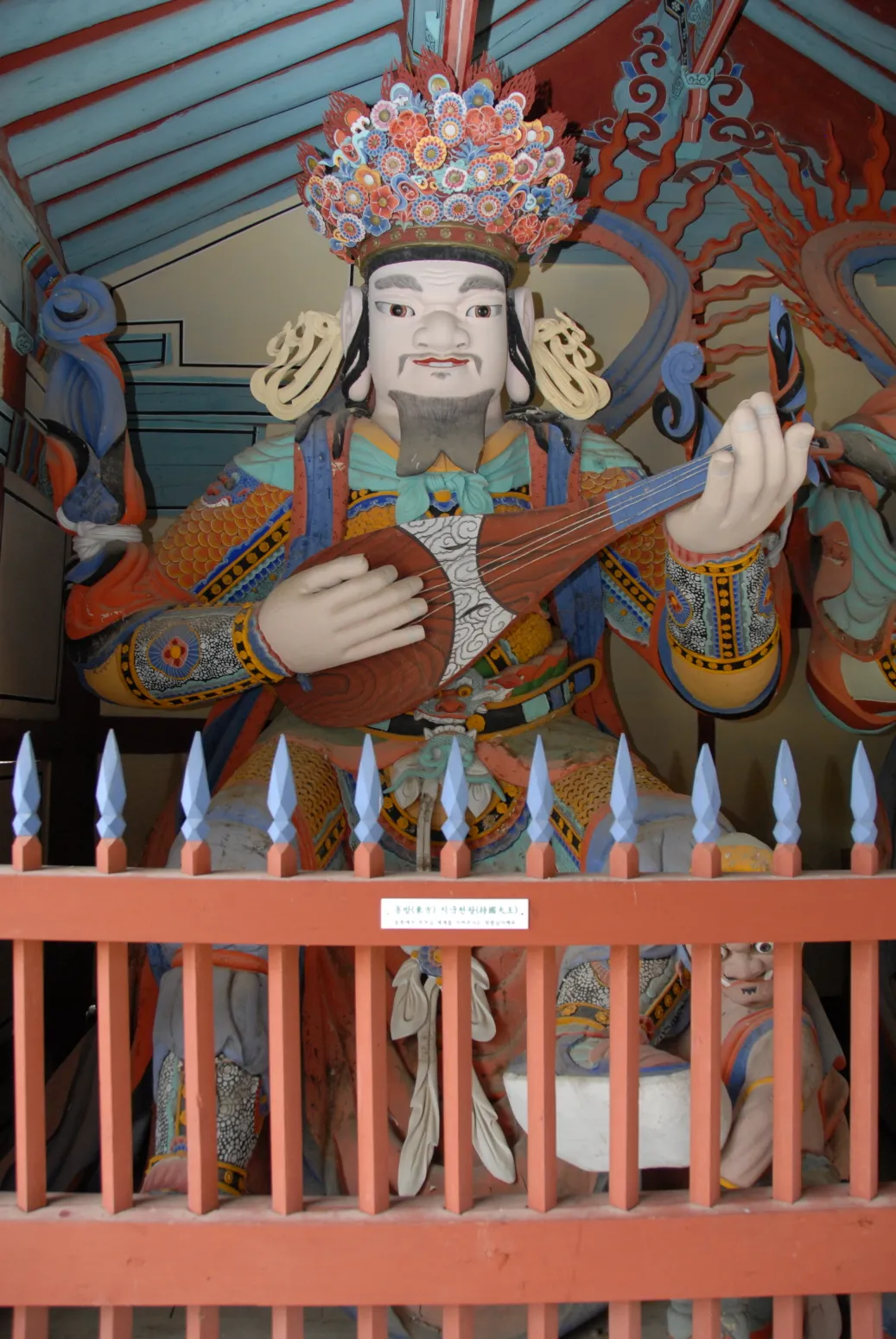
Borimsa Mokjosacheonwangsang, Jangheung
長興 寶林寺 木造四天王像
전라남도 장흥군
Basic information
- Designation
- Treasure No.1254
- Category
- Sculpture
- Era
- 조선 중종 10년(1515년)
- Designated year
- 1997
- Location
- 장흥군, 전라남도— 전남 장흥군 유치면 봉덕리 45번지 보림사
- Coordinates
- 34.807578, 126.896515
AI Docent
Coming soonAn AI-generated, friendly retelling of this heritage site is available in Korean. An English version is on our roadmap — for now, please see the official description below.
Description
The statues of the Four Guardian Kings in the shape of warriors in armor first appeared in the early Unified Silla Period (676 – 935) as those ruling over the four directions. In the Korean Peninsula, the Gate of the Four Guardian Kings came to be built at the entrance of temples during the Joseon Period (1392-1910). Dhattrattha (ruling over the east) and Vaisravana (north) are on the right, with Virudhak (south) and Virupaksa (west) on the left. Dhattrattha wears a gorgeously adorned jeweled crown. He wears a heavenly robe beneath the armor, his face showing anger. He has a robust physique, with the right hand holding the sword handle and the left hand holding up the sword tip. Vaisravana wears a high jeweled crown and a benevolent simile, reminding one of the gentle image of a scholar. He also holds a lute. A devil kneeling down holds up his left foot, his facial expression showing that it feels painful under the king’s weight. Virudhak has a tightly closed mouth and a stern facial expression, holding a knife in the right hand. Overall, he displays an imposing figure of a guardian. Virupaksa has glaring eyes, looking as if he is yelling at someone. He holds a flag on the right hand. The statues of Four Guardian Kings made during the Joseon Period (1392-1910) are in Chinese-style armor, each holding symbolical objects different from each other in the hands. They have diverse appearances, wearing facial expressions ranging from anger to benevolence and heavenly robe or armor. The images kept at Borimsa Temple are superior to those kept at the other temples, thereby occupying an important position in the history of Buddhist sculptures. The wooden tablet hung nearby and the relevant records say that the statues were made in 1515 (the 10th year of King Jungjong’s reign) and repaired on two occasions. They are the oldest ones of their kind in the country and the only ones made before the Japanese Invasion of Korea in 1592, displaying the exquisite skills of craftsmen.
Location
지도를 불러오는 중…
Have you visited this place?
Log in and verify your visit on-site via GPS to record a stamp in My Journey. (QR verification coming later.)
Images: KOGL (khs.go.kr) · Data source: Korea Heritage Service Open API (khs.go.kr)