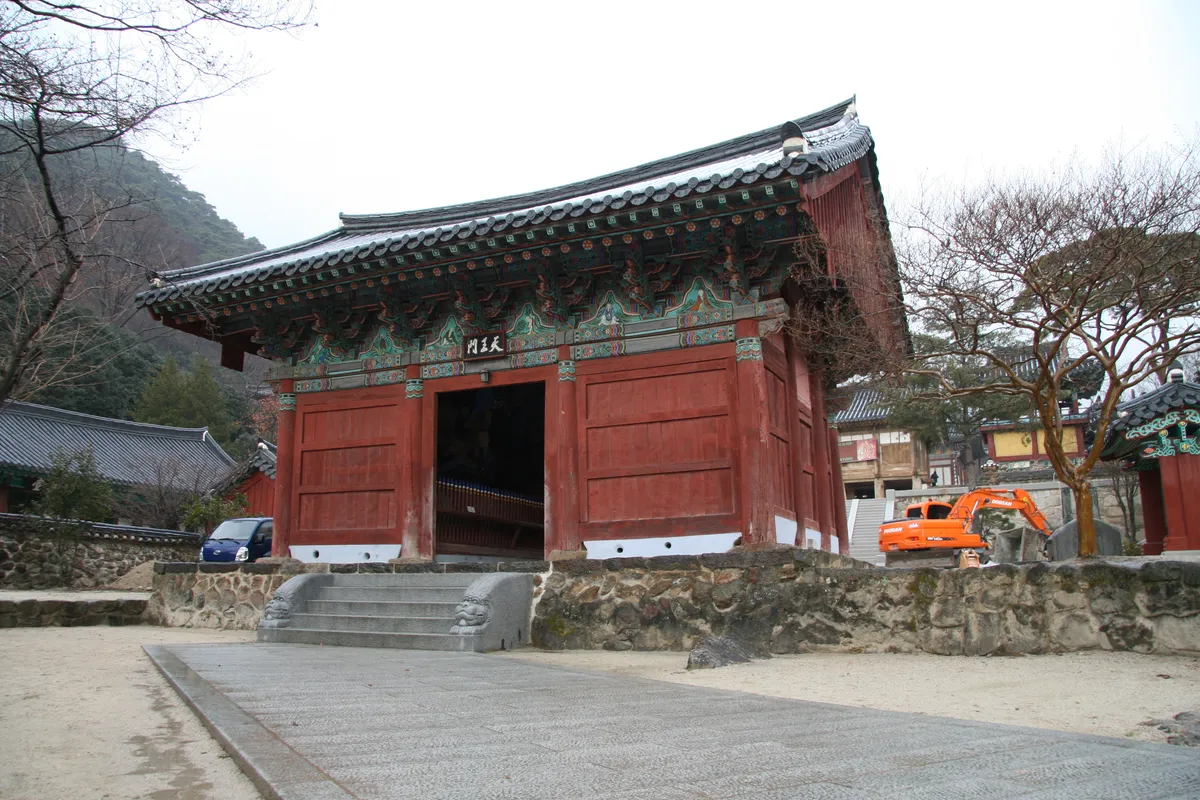
Hwaeomsa Cheonwang Gate, Gurye
求禮 華嚴寺 天王門
전라남도 구례군
Basic information
- Designation
- Treasure No.2255
- Category
- Architecture
- Era
- 조선시대
- Designated year
- 2024
- Location
- 구례군, 전라남도— 전라남도 구례군 화엄사로 539 (마산면)
- Coordinates
- 35.256370, 127.497509Kakao address conversion
AI Docent
Coming soonAn AI-generated, friendly retelling of this heritage site is available in Korean. An English version is on our roadmap — for now, please see the official description below.
Description
Machine-translatedThis English description was machine-translated and may contain inaccuracies. Refer to the original Korean text for details.
Guryeo Hwaaom Temple's Four Heavenly Kings Gate is estimated to have been initially constructed during the Goryeo period, with documented destruction during the Imjin War. Buddhist Master Byeogam Gakseong (1575-1660) undertook reconstruction in 1636 (Injo 14th year), as confirmed through <Historical Record of Honam Province Guryeo District Jirisan Mount Great Hwaaom Temple (Honam-do Guryeo-hyeon Jirisan Daehwaaom-sa Sagjeok, 1636)>. The sequential gate-arrangement comprising single-pillar gate (iljumun), Vajra Gate (Geumgang-mun), and Four Heavenly Kings Gate (Sacheonwang-mun) reflects contemporary era characteristics while demonstrating universal symbolic representation of boundary and entrance demarcation in medieval Korean monastic complex design, exemplifying significant historical value. The structure measures 3 bays on the front and 3 bays on the side with double-eave gable-roof configuration. The left and right flanking bays accommodate wooden-platform positioned clay Four Heavenly Kings sculptures designated as national-level heritage in October 2023, dating to the 1630s-era estimated creation. The foundation platform and central-bay processional passage feature stone-paving installation with mixed wooden-panel wall and lime-mortar wall construction representing distinctive wall configuration technique. The bracket system comprises internal and external two-bay outsets in multiple-bracket design. Notably, among existing Four Heavenly Kings Gates, only three structures—Sunwon Songkwang Temple, Gimcheon Jikji Temple, and Boeun Beopju Temple—employ multiple-bracket-system Four Heavenly Kings Gate architecture, conferring exceptional architectural-historical significance. The structural connection methodology between major beams and roof-support extensions differs between external-outset upper roof-support installation, which employs beam-end groove-accommodation insertion technique, versus internal two-bay-outset upper roof-support and major beam assembly, which omits structural connection methodology. This construction technique appears exclusively in contemporary seventeenth-eighteenth-century structures including the temple precinct's principal Buddhist hall and individual Buddha pavilions, providing valuable historical-dating documentation resource. Additionally, the frontal and rear eave-base configurations employ old-style unified raised-roof-support treatment, establishing clear historical-dating indicators for Hwaaom Temple's Four Heavenly Kings Gate construction period. Hwaaom Temple's Four Heavenly Kings Gate represents post-Imjin War Four Heavenly Kings Gate structures with notably elaborate decorative characteristics, employing multiple-bracket system design while housing Four Heavenly Kings sculptures requiring specialized support structures and adjusted ceiling heights for sculptural concealment. These characteristics demonstrate high scholarly and artistic value.
Location
지도를 불러오는 중…
Have you visited this place?
Log in and verify your visit on-site via GPS to record a stamp in My Journey. (QR verification coming later.)
Images: KOGL (khs.go.kr) · Data source: Korea Heritage Service Open API (khs.go.kr)