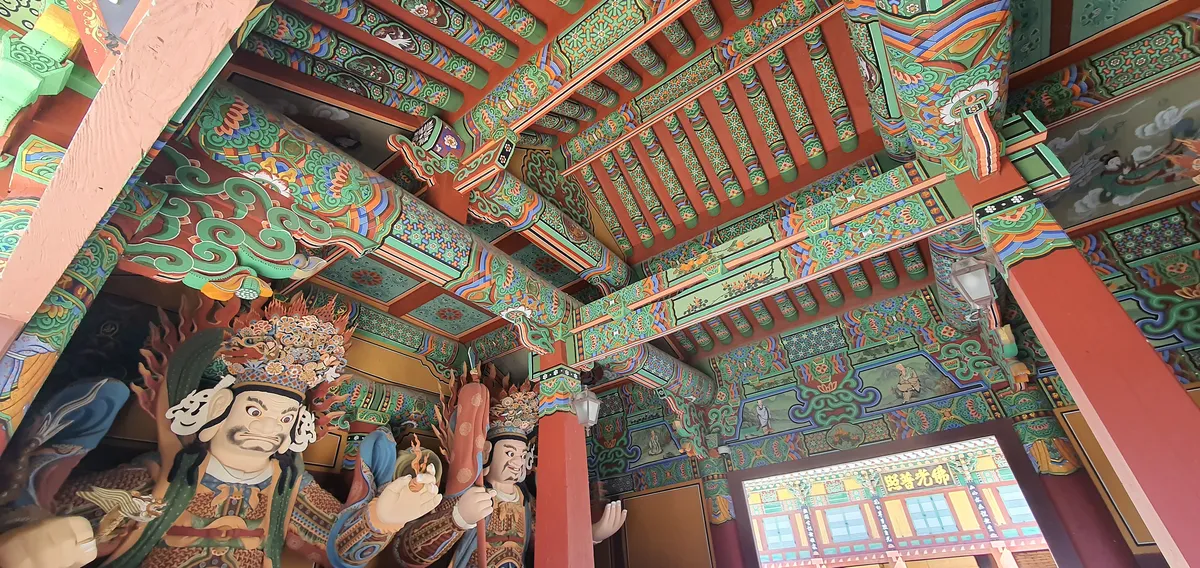
Bulgapsa Cheonwang Gate, Yeonggwang
靈光 佛甲寺 天王門
전라남도 영광군
Basic information
- Designation
- Treasure No.2256
- Category
- Architecture
- Era
- 조선시대
- Designated year
- 2024
- Location
- 영광군, 전라남도— 전라남도 영광군 불갑사로 450 (불갑면)
- Coordinates
- 35.200654, 126.550184Kakao address conversion
AI Docent
Coming soonAn AI-generated, friendly retelling of this heritage site is available in Korean. An English version is on our roadmap — for now, please see the official description below.
Description
Machine-translatedThis English description was machine-translated and may contain inaccuracies. Refer to the original Korean text for details.
Yeongkwang Bulgap Temple's Four Heavenly Kings Gate lacks precise documented creation date. However, historical records including <Record of Mount Moeak Bulgap Temple (Moeak-san Bulgap-sa-gi, 1725)> establish pre-1725 construction confirmation. Subsequently, in 1876 (Gojong 13th year), Four Heavenly Kings sculptures relocated from the site of Yeonjigsa Temple on Mount Soyo in Gochang were transferred to Bulgap Temple for installation. The gate's original location shifted approximately ten meters northward, while remaining evidence of multiple repairs and relocations demonstrates preservation of original architectural form and design. The structure measures 3 bays on the front and 2 bays on the side with five-rafter configuration, double-eave overlapping-roof gable-roof design, with wooden-platform flooring in the flanking bays accommodating Four Heavenly Kings sculpture installation. The major beam (daeryang) comprises two-jointed beam construction utilizing metal corner-braces for reinforcement, with supporting interior pillars providing foundational support underneath. This structural technique represents unique construction methodology unavailable in other temple gates, demonstrating exceptional scholarly value. The bracket system employs two-bay exterior outset with three-wing-bracket configuration. The primary bracket members employ cross-cut primary level formation, with secondary bracket members featuring upward-curved blade design and tertiary bracket members employing upward-curved roof-support configuration. The secondary bracket primary-level interior surface features a full-bloom lotus-flower sculptural design, while secondary bracket surface displays upward-pointing lotus-bud carving. These decorative characteristics exemplify post-seventeenth-century southwestern coastal-region Buddhist temple architectural ornamentation trends, demonstrating high scholarly and artistic value through exemplification of gradual decorative elaboration tendencies extending throughout the southwest maritime-region temple architecture development.
Location
지도를 불러오는 중…
Have you visited this place?
Log in and verify your visit on-site via GPS to record a stamp in My Journey. (QR verification coming later.)
Images: KOGL (khs.go.kr) · Data source: Korea Heritage Service Open API (khs.go.kr)