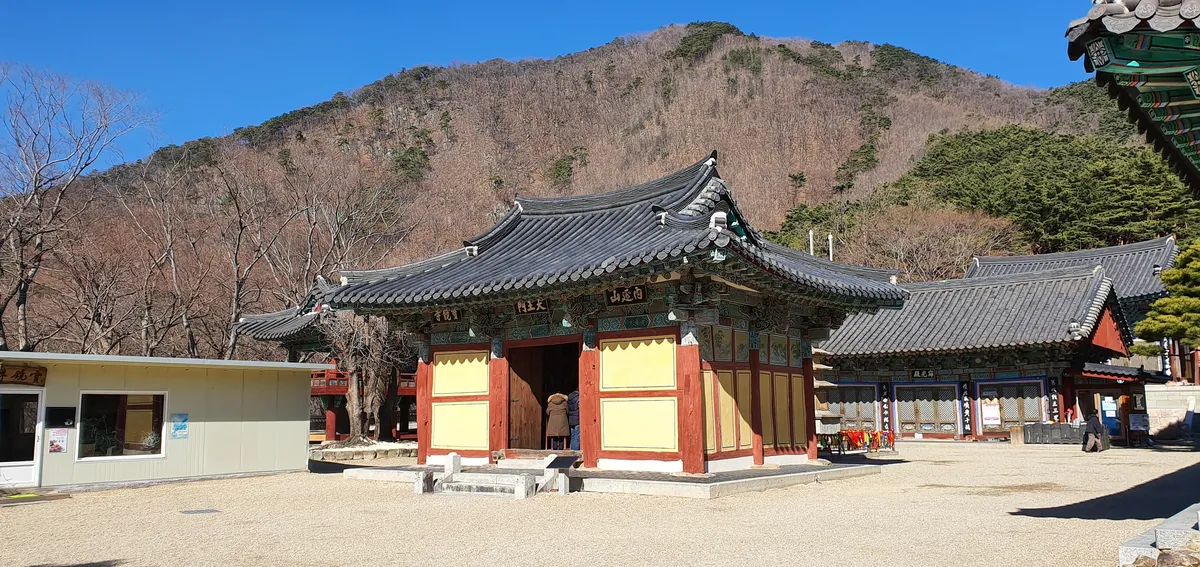
Bogyeongsa Cheonwang Gate, Pohang
浦項 寶鏡寺 天王門
경상북도 포항시
Basic information
- Designation
- Treasure No.2257
- Category
- Architecture
- Era
- 조선시대
- Designated year
- 2024
- Location
- 포항시, 경상북도— 경상북도 포항시 북구 보경로 523 (송라면, 보경사)
- Coordinates
- 36.252035, 129.317771Kakao address conversion
AI Docent
Coming soonAn AI-generated, friendly retelling of this heritage site is available in Korean. An English version is on our roadmap — for now, please see the official description below.
Description
Machine-translatedThis English description was machine-translated and may contain inaccuracies. Refer to the original Korean text for details.
Pohang Bogyeong Temple's Four Heavenly Kings Gate (Sacheonwang-mun) lacks documented creation records. However, historical documentation including <Record of Four Heavenly Kings Gate Reconstruction Ridge-Beam Inscription (Cheonwangmun Jung-chang Sangryangmun), 1761> authored by Buddhist Master Uimun and <Record of Bogyeong Temple Four Heavenly Kings Gate Reconstruction (Bogyeong-sa Sacheonwangmun Jung-geon-gi), 1767> composed by Yi Jong-yeong confirm two-phased construction: initial 1679 (Sukjong 5th year) reconstruction and subsequent 1761-1767 (Yeongjo 37-43rd year) reconstruction, exemplifying the temporal developmental characteristics of post-seventeenth-century Buddhist temple Four Heavenly Kings Gate development. The structural design measures 3 bays on the front and 2 bays on the side in single-story hip-and-gable-roof configuration. The central bay functions as processional passage with double-hinged sliding-bar wooden-plank door installation. Rather than conventional temple-entrance mountain-gate (sanmun) designation, the gate functions as a principal entrance to the central Buddha precinct, serving ceremonial significance. The left and right flanking bays house Four Heavenly Kings sculptures created in 1980. The lower-section frontal primary pillar position incorporates sculptural lion-form carved support-beam elements (sin-bangmok) demonstrating design similarity to Bogyeong Temple's Jeokgwang Hall (national-level heritage designation), representing a domestic-unique Four Heavenly Kings Gate sculptural example of exceptional scholarly and artistic value. *Support-beam elements (shin-bangmok): horizontal wooden reinforcement members installed beneath door-pillar structural components The bracket system comprises one-bay exterior outset with two-wing-bracket configuration. The primary wing-bracket external terminal features upward-curved blade form decorated with lotus-flower carving, while the internal section maintains simplified initial-style carving. The secondary wing-bracket external terminal displays upward-curved blade form with lotus-bud decoration above the major beam. The wing-bracket terminal configuration employs pentagonal faceted geometric shape through rectangular-cut form, exemplifying seventeenth-century post-architectural phenomenon of integrating multiple-bracket-system design elements into wing-bracket-style architecture. The corner bracket system employs full-angle bracket configuration typically found in multiple-bracket systems rather than wing-bracket or column-head bracket system architecture, demonstrating exceptional scholarly value through distinctive architectural design principles.
Location
지도를 불러오는 중…
Have you visited this place?
Log in and verify your visit on-site via GPS to record a stamp in My Journey. (QR verification coming later.)
Images: KOGL (khs.go.kr) · Data source: Korea Heritage Service Open API (khs.go.kr)