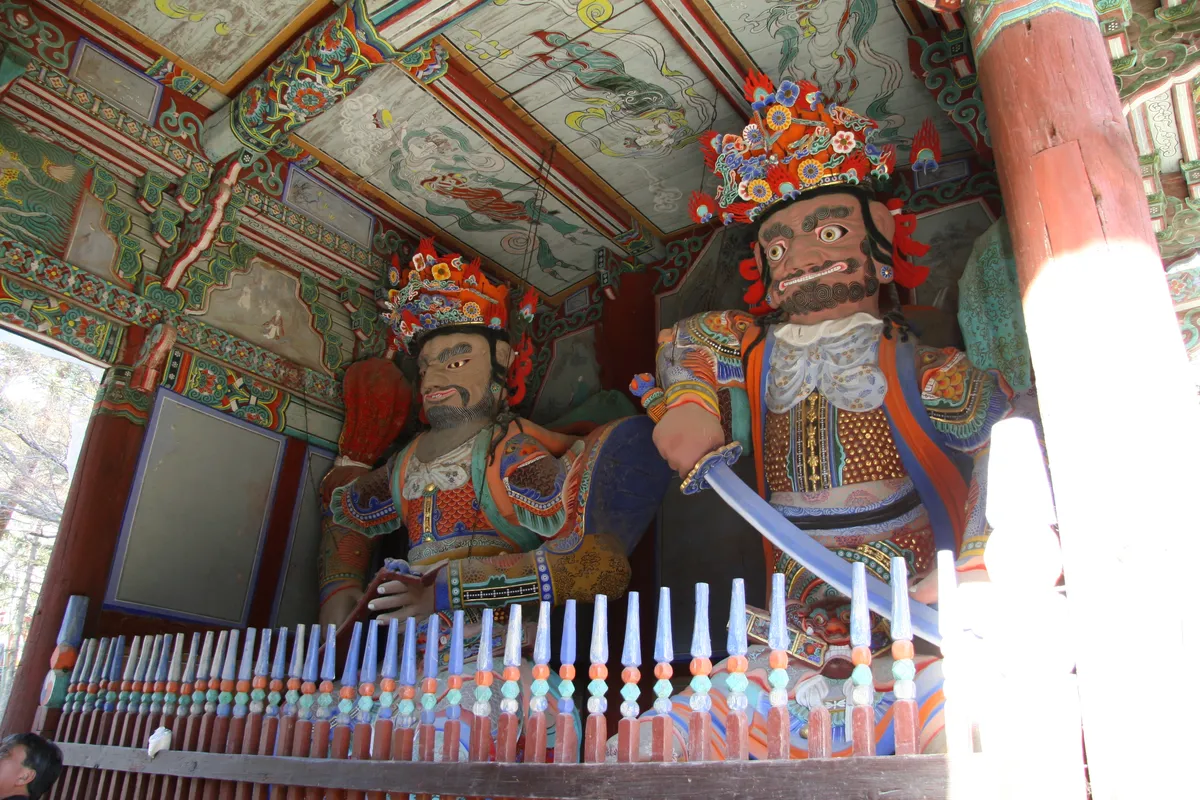
Jikjisa Cheonwang Gate, Gimcheon
金泉 直指寺 天王門
경상북도 김천시
Basic information
- Designation
- Treasure No.2258
- Category
- Architecture
- Era
- 조선시대
- Designated year
- 2024
- Location
- 김천시, 경상북도— 경상북도 김천시 직지사길 95 (대항면)
- Coordinates
- 36.116213, 128.004738Kakao address conversion
AI Docent
Coming soonAn AI-generated, friendly retelling of this heritage site is available in Korean. An English version is on our roadmap — for now, please see the official description below.
Description
Machine-translatedThis English description was machine-translated and may contain inaccuracies. Refer to the original Korean text for details.
Gimcheon Jikji Temple's Four Heavenly Kings Gate is estimated to have been established during the Goryeo-end and early-Joseon period. During the 1596 Imjin War, Jikji Temple's complete structures underwent fire destruction by Japanese forces. However, the gate, along with Cheonbul Hall and Self-Realm Gate (Jahae-mun), survived the destruction and continued maintenance to the present period. The structure is estimated to have undergone 1665 (Hyeonjong 6th year) reconstruction prior to the Four Heavenly Kings sculpture creation. The gate measures 3 bays on the front and 3 bays on the side, representing the second-largest scale among Four Heavenly Kings Gate structures following Boeun Beopju Temple's gate. The central bay functions as processional passage, while left and right flanking bays accommodate clay Four Heavenly Kings sculptures created by Songkwang Temple Buddhist artist-craftsmen in 1665 (Hyeonjong 6th year), designated as national-level heritage in October 2023. The roof structural framework employs two interior columns with a seven-rafter structural configuration proportionally corresponding to the clay Four Heavenly Kings sculpture scale and architectural dimension determination. The roof structure presents a form with proportionally elevated body height relative to eave dimensions. The bracket system comprises internal and external two-bay outsets in multiple-bracket design. The frontal and rear flanking-bay configuration incorporates column-head bracket and inter-column bracket components in one-group multiple-bracket-form assembly, while the central bay employs column-head bracket with decorative floret substitution in place of inter-column bracket, exemplifying transitional-period architectural evolution from seventeenth-century multiple-bracket system toward eighteenth-century wing-bracket system configuration. The central-bay primary-structure interior bracket component employs ornamental roof-support integration technique historically documented in early-seventeenth-century royal palace architecture (gung-gwal Geon-chuk), representing exceptional historical and scholarly value. *Ornamental roof-support (an-cho-gong): roof-support member inserted into beam-joining apertures at the primary pillar apex to support bracket system members
Location
지도를 불러오는 중…
Have you visited this place?
Log in and verify your visit on-site via GPS to record a stamp in My Journey. (QR verification coming later.)
Images: KOGL (khs.go.kr) · Data source: Korea Heritage Service Open API (khs.go.kr)