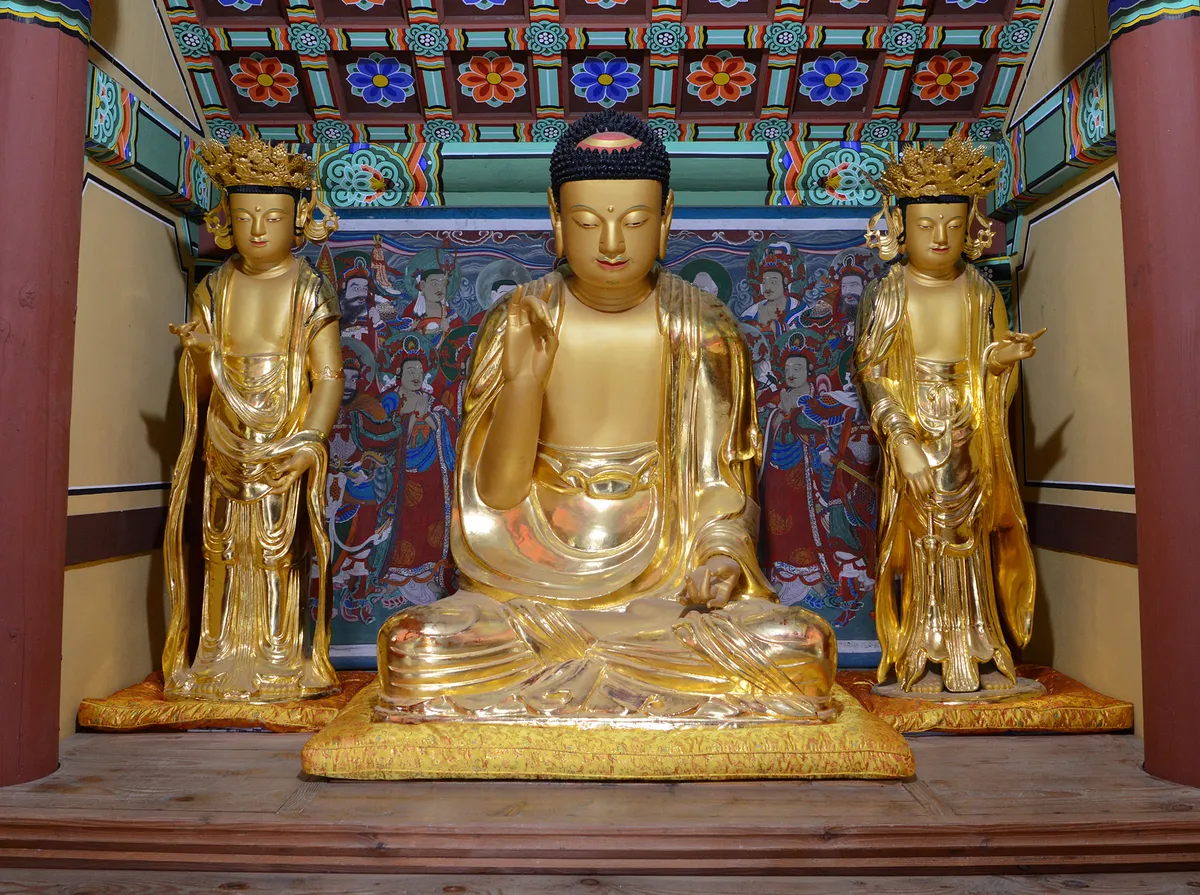
Moguam Mokjoamitayeoraesamjonsang, Muan
務安 牧牛庵 木造阿彌陀如來三尊像
전라남도 무안군
Basic information
- Designation
- Treasure No.2265
- Category
- Sculpture
- Era
- 1614년(조선 광해군 6)
- Designated year
- 2024
- Location
- 무안군, 전라남도— 전라남도 무안군 법천길 482-85 (몽탄면, 목우암)
- Coordinates
- 34.917848, 126.454513Kakao address conversion
AI Docent
Coming soonAn AI-generated, friendly retelling of this heritage site is available in Korean. An English version is on our roadmap — for now, please see the official description below.
Description
Machine-translatedThis English description was machine-translated and may contain inaccuracies. Refer to the original Korean text for details.
The wooden trinity of Amitabha Buddha from Mogwooam Hermitage in Muan represents three gilt-wood Buddhist images—Amitabha Buddha (Amitayus), Avalokiteshvara Bodhisattva, and Mahasthamaprapta Bodhisattva—created in 1614 as documented by inscriptions on the base of the central Buddha figure. The sculptor Gakshim and other carvers are identified through this inscription, providing essential information for the study of 17th-century Buddhist sculpture. The central Buddha figure reaches 186 centimeters in height, representing a monumental sculpture executed with dynamic and vigorous modeling that reflects the religious renaissance following the Japanese invasions. The work exemplifies exceptional 17th-century sculptural artistry through its austere and religiously expressive facial features, elongated and proportionate body forms, and sophisticated three-dimensional carving technique that separates the torso from the mandorla as distinct sculptural elements. This trinity is historically significant as one of the earliest dated Amitabha trinitied compositions from the early 17th century, and notably rare in its combination of seated and standing forms. The work documents the sculptural activities of Gakshim and his workshop during the formative period of monastic sculptor lineages, illustrating the collaborative and interdependent relationships among sculptors of the period. The apprentices Eungwon and Inggyun documented here later developed independent sculptural lineages that became substantial schools in late Joseon Buddhist sculpture, with their artistic lineage traceable to Gakshim through this work.
Location
지도를 불러오는 중…
Have you visited this place?
Log in and verify your visit on-site via GPS to record a stamp in My Journey. (QR verification coming later.)
Images: KOGL (khs.go.kr) · Data source: Korea Heritage Service Open API (khs.go.kr)