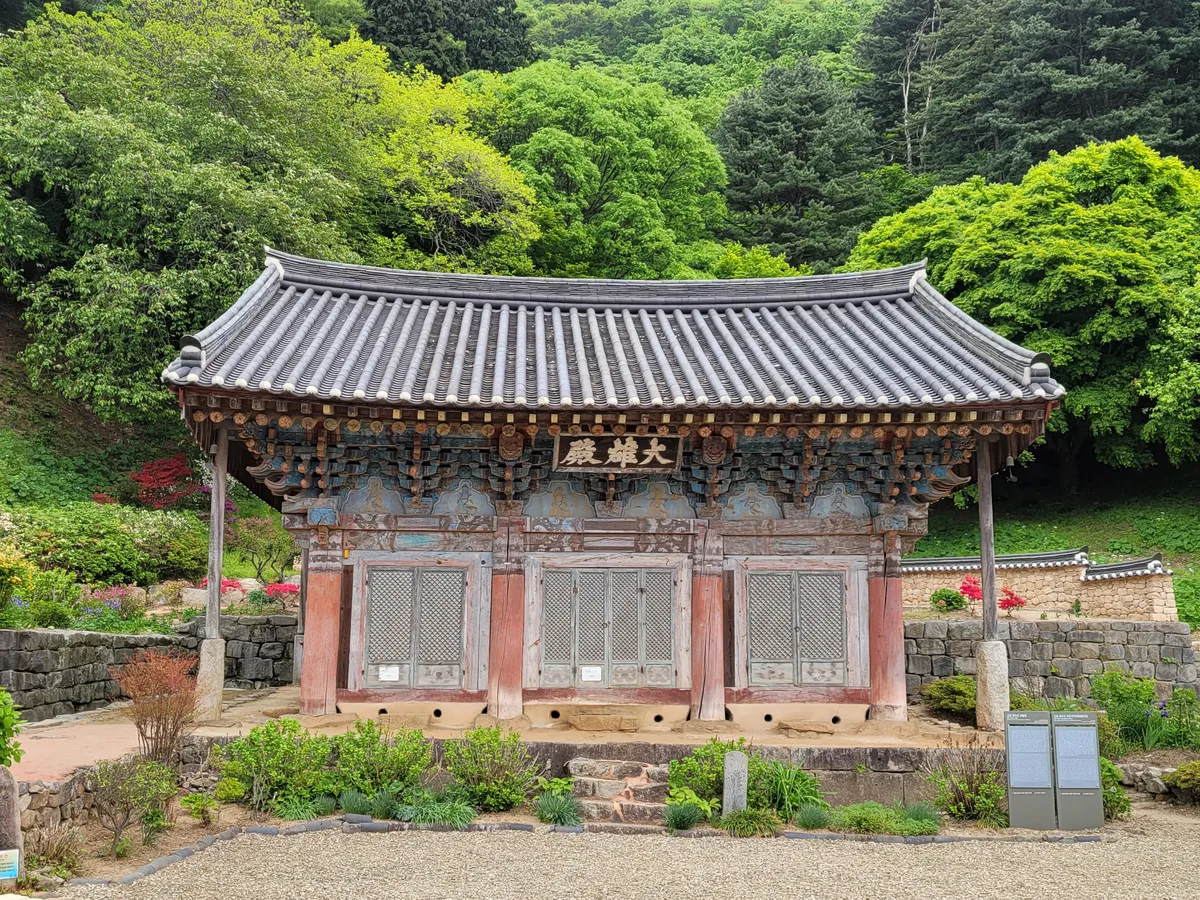
Munsusa Daeungjeon Hall, Gochang
高敞 文殊寺 大雄殿
전북특별자치도 고창군
Basic information
- Designation
- Treasure No.2266
- Category
- Architecture
- Era
- 조선시대
- Designated year
- 2024
- Location
- 고창군, 전북특별자치도— 전북특별자치도 고창군 칠성길 135 (고수면, 문수사)
- Coordinates
- 35.380775, 126.726244Kakao address conversion
AI Docent
Coming soonAn AI-generated, friendly retelling of this heritage site is available in Korean. An English version is on our roadmap — for now, please see the official description below.
Description
Machine-translatedThis English description was machine-translated and may contain inaccuracies. Refer to the original Korean text for details.
The Daeungbojeon (Great Hero Hall) of Munsuса Buddhist Temple in Gochang is a 3-bay front, 2-bay side Buddhist hall with bracket-work composed of three tiers of projecting brackets in both interior and exterior, exhibiting stylistic characteristics of early to mid-Joseon period construction combined with regional Jeolla province features. The temple is the branch temple of Seonunsa Temple in the Jogye Order of Korean Buddhism. Though tradition attributes the temple's founding to 644, the temple was actually rebuilt in 1607 following the Imjin War, and historical records indicate major reconstruction occurred around 1653-1654 under the direction of the monk Hoijok, with the Buddhist trinity statues and Kings of Hell figures carved in 1654. The hip-and-gable roof structure employs crossbeams and movable posts to address the characteristic hip-roof design, though the roof form has been subsequently altered to a gable configuration. Despite this modification, the multiple-bracket gable roof maintains faithful application of traditional bracket-work techniques and styling. The temple's original decorative painted patterns employ traditional mineral pigments and animal-glue binding media, preserving ancient techniques. These features collectively demonstrate substantial academic and artistic value, with the Great Hero Hall preserving significant 17th-century architectural elements and construction techniques that merit recognition as a national treasure.
Location
지도를 불러오는 중…
Have you visited this place?
Log in and verify your visit on-site via GPS to record a stamp in My Journey. (QR verification coming later.)
Images: KOGL (khs.go.kr) · Data source: Korea Heritage Service Open API (khs.go.kr)