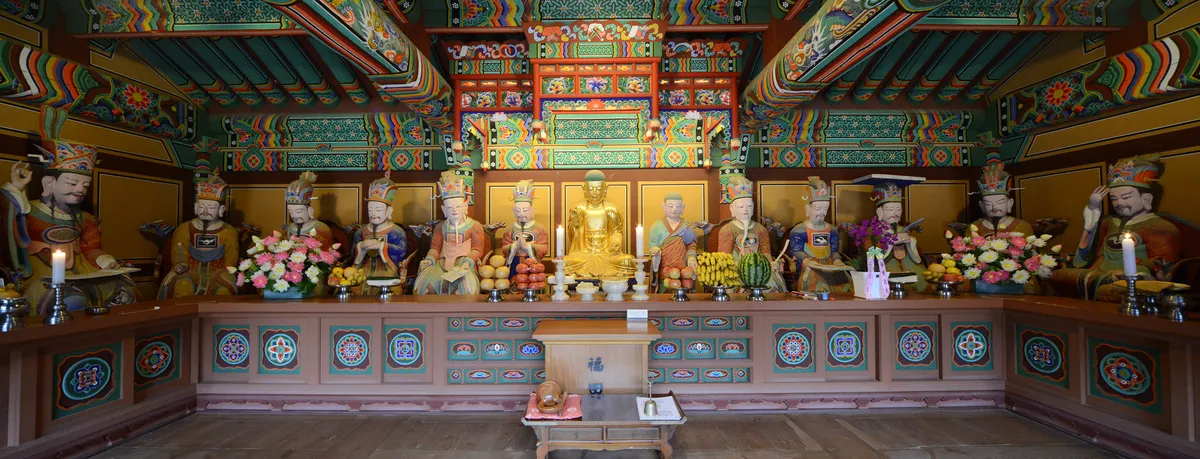
Bulgapsa Mokjojijangbosalsamjonsang・siwangsang Ilgwal Mit Reliquary Objects, Yeonggwang
靈光 佛甲寺 木造地藏菩薩三尊像・十王像 一括 및 腹藏遺物
전라남도 영광군
Basic information
- Designation
- Treasure No.2270
- Category
- Sculpture
- Era
- 존상-1654년(조선 효종5) 복장전적-고려시대~조선시대
- Designated year
- 2024
- Location
- 영광군, 전라남도— 전라남도 영광군 불갑사로 450 (불갑면)
- Coordinates
- 35.200654, 126.550184Kakao address conversion
AI Docent
Coming soonAn AI-generated, friendly retelling of this heritage site is available in Korean. An English version is on our roadmap — for now, please see the official description below.
Description
Machine-translatedThis English description was machine-translated and may contain inaccuracies. Refer to the original Korean text for details.
The gilt-wood Jizang Bodhisattva trinity and Kings of Hell ensemble from Bulgapsa Temple in Yeonggwang, together with its consecration relics, was completed in 1654 by lead sculptor Muyeom and sculptors Jeonghyeon and Haeshim, comprising a complete set of 27 deities including Bodhisattva Jizang, the Kings of the Underworld, and their attendants. The dedicatory inscription confirms the creation of all 27 figures, and their complete preservation without loss provides crucial comparative material for understanding late Joseon period sculptural practices of the underworld realm. The sculptural composition demonstrates the Muyeom school's characteristic style while exhibiting Haeshim's distinctive individual artistic qualities. The dedicatory inscription reveals the hierarchical relationship within the Muyeom workshop, identifying Muyeom as the founding teacher, Jeonghyeon as senior associate, and Haeshim as the principal sculptor, thereby clarifying the transmission of the Muyeom sculptural lineage. Consequently, these figures serve as meaningful materials for comprehending the formation and transmission of the Muyeom school and its significance in late Joseon sculptural history. The ensemble's preservation in its original temple setting without loss or alteration of composition further contributes essential historical significance. Among the 27 figures, 16 contain consecration documents, with 15 previously included in the designated Buddhist temple relic documents of Bulgapsa. The integration of consecration relics with sculptural ensembles ensures comprehensive preservation and scholarly management of both religious and artistic dimensions, warranting designation as a national treasure alongside previously designated relic documents.
Location
지도를 불러오는 중…
Have you visited this place?
Log in and verify your visit on-site via GPS to record a stamp in My Journey. (QR verification coming later.)
Images: KOGL (khs.go.kr) · Data source: Korea Heritage Service Open API (khs.go.kr)