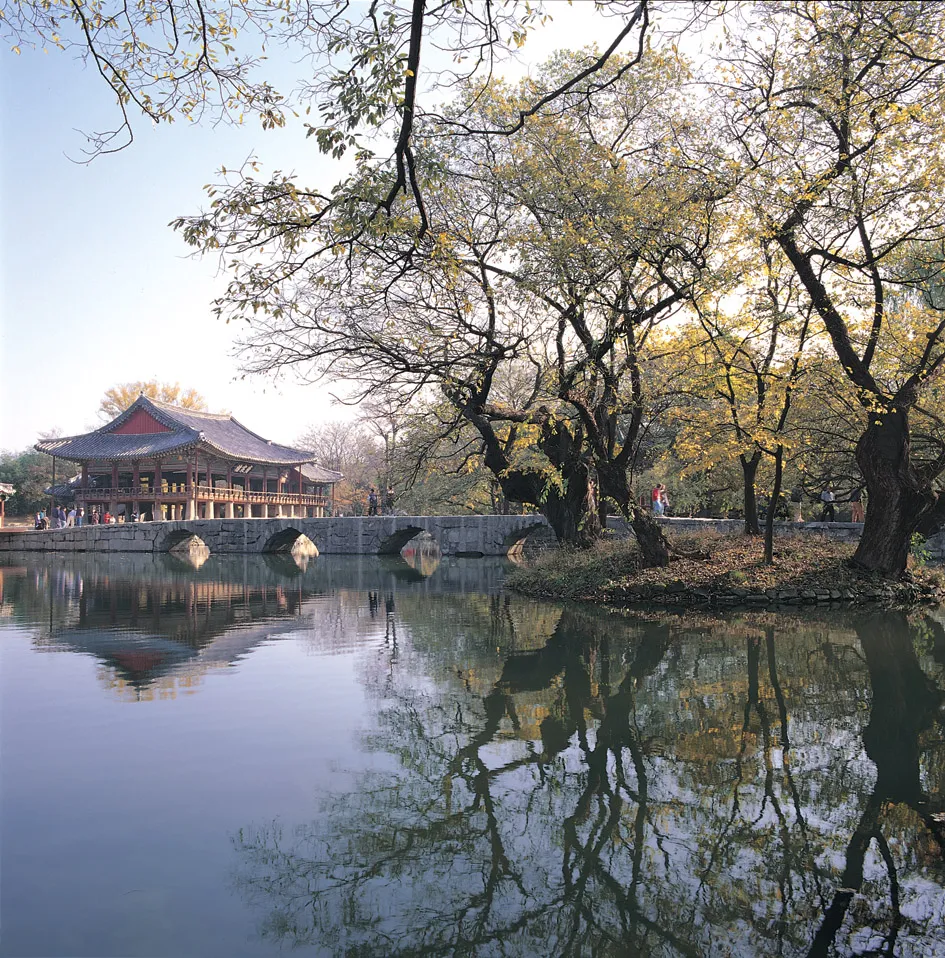
Gwanghallu Pavilion, Namwon
南原 廣寒樓
전북특별자치도 남원시
Basic information
- Designation
- Treasure No.281
- Category
- Architecture
- Era
- 조선 세종 16년(1434)
- Designated year
- 1963
- Location
- 남원시, 전북특별자치도— 전북 남원시 천거동 75번지
- Coordinates
- 35.403955, 127.379771
AI Docent
Coming soonAn AI-generated, friendly retelling of this heritage site is available in Korean. An English version is on our roadmap — for now, please see the official description below.
Description
In Korea, pavilions refer to any open structures with a raised floor built in places of scenic beauty. Originally called Gwangtongnu Pavilion, this pavilion was built when a famous Prime Minister of Joseon named Hwang Hui was exiled. It was renamed to Gwanghallu Pavilion by another scholar official named Jeong In-ji in 1434 (the 16th year of King Sejong’s reign). The original building was burnt down during the Second Japanese Invasion of Korea and was rebuilt in 1638 (the 16th year of King Injo’s reign). The annex was built during the reign of King Jeongjo. It measures 5 kan (a unit of measurement referring to the distance between two columns) at the front and 4 kan at the sides under a hip and gable roof. The handrail surrounds the pavilion floor and the doors are hinged to all four sides between pillars. In summer, the doors can be folded inward to make the pavilion look open when seen from outside. The annex building to the east is surrounded by a handrail and porch and the inside is floor heated. The stairs located in the center of rear side were made in the late Joseon Dynasty. Sitting in the middle of a large man-made garden that adds to the beautiful natural scenery, this classic Korean style pavilion is widely known as the background of a Korean romance novel titled Chunhyangjeon.
Location
지도를 불러오는 중…
Have you visited this place?
Log in and verify your visit on-site via GPS to record a stamp in My Journey. (QR verification coming later.)
Images: KOGL (khs.go.kr) · Data source: Korea Heritage Service Open API (khs.go.kr)