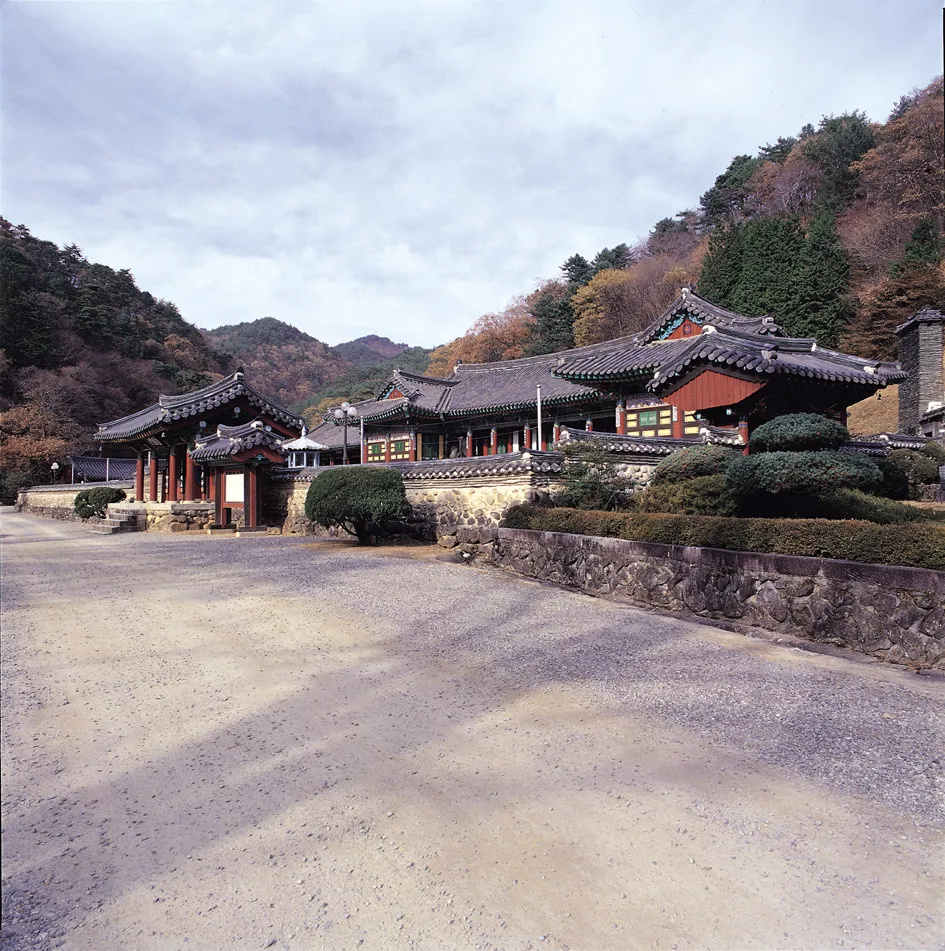
Haeinsa Hongjeam, Hapcheon
陜川 海印寺 弘濟庵
경상남도 합천군
Basic information
- Designation
- Treasure No.1300
- Category
- Architecture
- Era
- 조선 후기
- Designated year
- 2000
- Location
- 합천군, 경상남도— 경남 합천군 가야면 해인사길 154, 홍제암 (치인리)
- Coordinates
- 35.802557, 128.095169
AI Docent
Coming soonAn AI-generated, friendly retelling of this heritage site is available in Korean. An English version is on our roadmap — for now, please see the official description below.
Description
This Buddhist hermitage belonging to Haeinsa Temple is famous as the place where the Monk Samyeong who made a heroic contribution in defending Joseon from the invading Japanese during the late 16th century, leading his monk army, spent his final days. The name “Hongjeam” derives from ‘Jatong Hongje Jonja,’ the posthumous title bestowed on Monk Samyeong after his death by King Gwanghaegun. The hermitage was constructed in 1614 (the 6th year of King Gwanghaegun’s reign), on the initiative of Monk Hyegu, in homage to Monk Samyeong and to house a portrait of his. The hermitage was disassembled and rebuilt in October 1979. The hermitage consists of a single building which doubles as the place of worship and living quarters for monks. This building has a special floor plan in which all Samyeong-related rooms are located together in one area. In a floor plan in the shape of the letter H lying on one side, the worship room occupies the center with other rooms distributed around it, including Josajeon Hall, Yeonggak Hall, Honggak Hall, Josil Hall and Sijasil Hall. All rooms communicate with one another through a long wooden balcony that runs along the full length of the building. In this building constructed on a slanted ground, two end units – Honggak Hall and Jijangjeon Hall – rest on wooden pilotis and are slightly projected forward, while the worship room and other areas are directly at the ground level. Meanwhile, the brackets used to support the roof eaves vary in style, in a manner to reflect the hierarchy that exists between different spaces making up the building. The size of the kan, the unit of measurement referring to the distance between two columns, also varies depending on the function of each space. Also interesting is the fact that columns that are exposed are round in cross-section, while hidden columns are square in cross-section. As a site associated with Samyeong with a stupa and a stele dedicated to him (Treasure No. 1301) and his portrait, Hongjeam Hermitage of Haeinsa Temple is also remarkable for its original plan accommodating spaces with different functions within a single building and the structural and architectural details varying according to the hierarchical status of a given space. Hongjeam Hermitage is, therefore, as significant architecturally as it is significant historically.
Location
지도를 불러오는 중…
Have you visited this place?
Log in and verify your visit on-site via GPS to record a stamp in My Journey. (QR verification coming later.)
Images: KOGL (khs.go.kr) · Data source: Korea Heritage Service Open API (khs.go.kr)