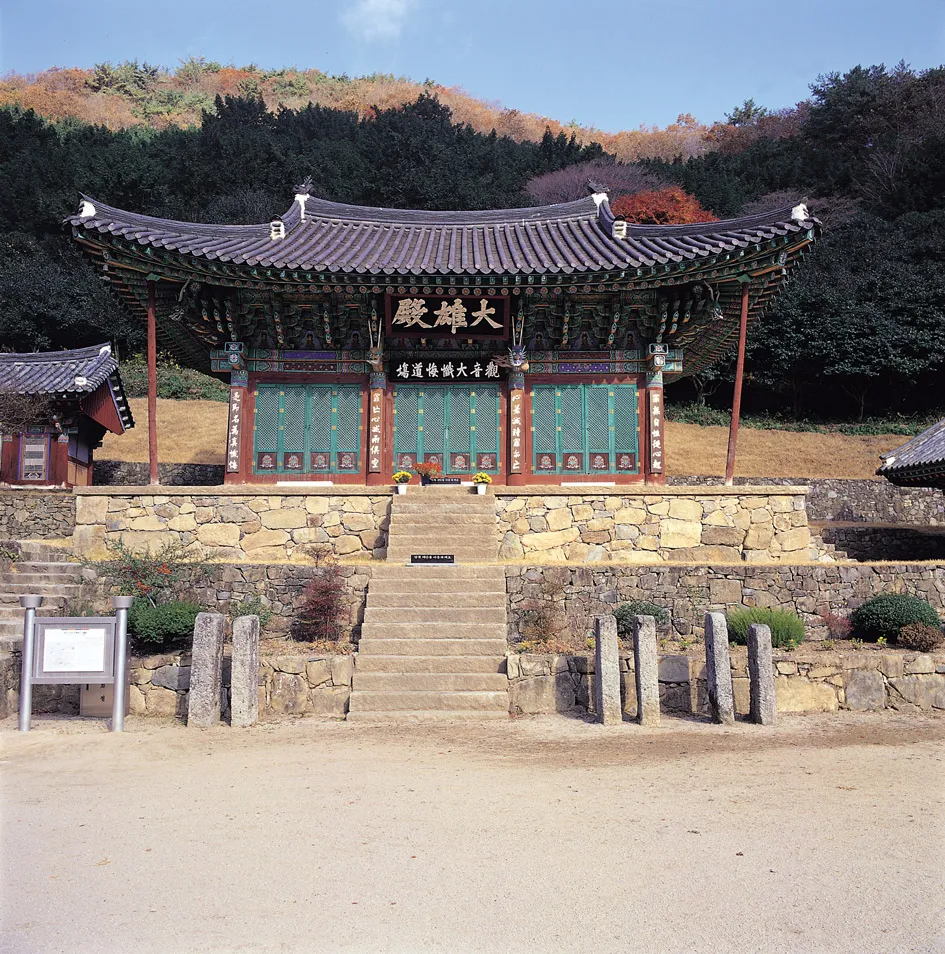
Bulhoesa Daeungjeon Hall, Naju
羅州 佛會寺 大雄殿
전라남도 나주시
Basic information
- Designation
- Treasure No.1310
- Category
- Architecture
- Era
- 조선시대 후기
- Designated year
- 2001
- Location
- 나주시, 전라남도— 전남 나주시 다도면 다도로 1224-142 (마산리) / (지번)전남 나주시 다도면 마산리 999
- Coordinates
- 34.908757, 126.823477
AI Docent
Coming soonAn AI-generated, friendly retelling of this heritage site is available in Korean. An English version is on our roadmap — for now, please see the official description below.
Description
According to Sangnyangmun (piece of remarks written on a ridge beam of a newly built building) as well as the techniques used, the building (measuring 3 kan* by 3 kan) was renovated in 1799 (the 23rd year of King Jeongjo’s reign). It is a well-embellished building with a liberally bracketed structure. With a hip and gable roof, the building is set up on a platform made with natural stones. The columns, which adopt the minheullim technique (a column narrower at the top than at the base), are all supported by large-sized natural cornerstones. The lintel and the upper lintel are placed at the top of the columns the way liberally bracketed structures (dapogye) are generally built. The system consists of three bracket arms projecting outward and four arms pointing inward. The ends of the outward bracket arms are sharply curved, and those of the inward arms are finished with carved lotus buds. The base blocks of the brackets (anchogong) on the columns forming the central bay are decorated with a carved dragon head powerfully projecting outward. Two transverse beams that start from the central column of the side walls are connected to the main cross beam within the building, their ends carved with a dragon head-shaped embellishment. This technique of jointing transverse beams to the main cross beam was commonly used in the mid-Joseon Period (1392-1910) and thereafter. The ceiling is a combination of slanted and coffered parts. The slanted parts of the ceilings are decorated with exquisite engravings of fish and lotus flowers. The building follows a general technique of dapogye (liberally bracketed structure) by stacking the lintel, upper lintel, and bracket system on the tops of the columns. The two dragon-shaped embellishments carved on the two central columns look unique. The heads of the dragons are made to stick outward, with the tails inserted into the bottom of the main cross beam. The two dragons are made to face each other, and the interior of the building is beautifully decorated with lotus buds. A similar technique is also found in nearby temples on the Byeonsan Peninsula, including the Daeungbojeon Hall of Naesosa Temple, Buan. Thus, this building in Bulhoesa Temple is an important material for those studying the architecture of the late Joseon Period. (*kan: a unit of measurement referring to the distance between two columns)
Location
지도를 불러오는 중…
Have you visited this place?
Log in and verify your visit on-site via GPS to record a stamp in My Journey. (QR verification coming later.)
Images: KOGL (khs.go.kr) · Data source: Korea Heritage Service Open API (khs.go.kr)