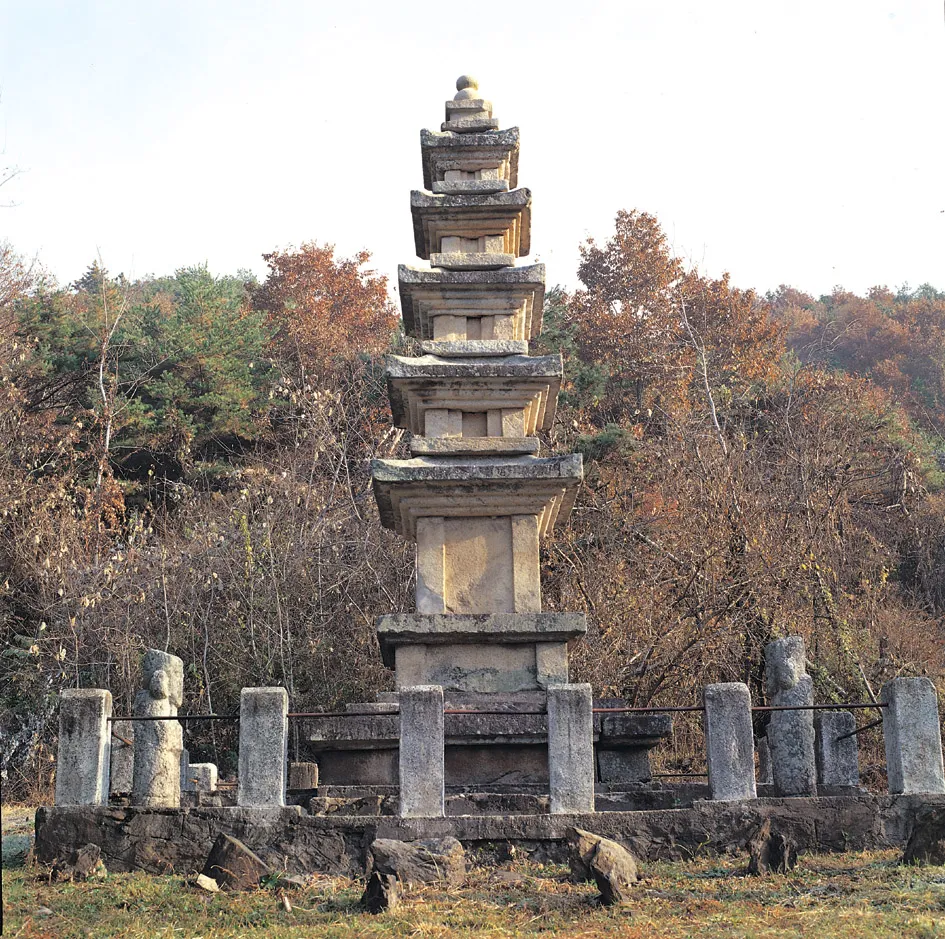
Gagokri Five-story Stone Pagoda, Gokseong
谷城 柯谷里 五層石塔
전라남도 곡성군
Basic information
- Designation
- Treasure No.1322
- Category
- Sites & Pagodas
- Era
- 고려시대
- Designated year
- 2001
- Location
- 곡성군, 전라남도— 전남 곡성군 오산면 가곡리 2번지
- Coordinates
- 35.249261, 127.143478
AI Docent
Coming soonAn AI-generated, friendly retelling of this heritage site is available in Korean. An English version is on our roadmap — for now, please see the official description below.
Description
This pagoda is located on the site of a temple in the northern slope of Maebong Peak in Gagok-ri, and it stands on a two-tiered platform. Unlike the lower tier of the platform, the upper tier is inscribed with the shape of columns at the four corners. The roof stones of the body display a well-proportioned shape, with the roof stone of each tier becoming smaller and the top tier being the smallest. The body of the first tier is composed of four stones, whereas each body of the second through the top tiers consists of one stone. Each body displays the inscription of the shape of columns at the corners. The southern side of the body for the second through top tiers has the shape of a rectangular niche. The bottoms of the roof stones of the first - fourth tiers of the body have three tiers, whereas the top tier consists of two tiers. The gentle slope and the very thick edges of the roof stones carry the features of stone pagodas of the Baekje Period (18 BC-660 AD). The edges of the roof stones are held up slightly. The corners of the roof stones have holes supposedly for hanging wind bells. What clearly distinguishes this pagoda from the others of its kind is the use of a stone supporting the body in each tier. Each part of the pagoda has been well-preserved except the stupa finial. The pagoda displays the features of ordinary stone pagodas and those following the Baekje (18 BC-660 AD) styles and which were mostly built in Chungcheong-do and Jeolla-do during the Goryeo Period (918-1392). In that respect, this one looks very similar to the Five-story Stone Pagoda in Namsan-ri, Damyang (Treasure No. 506). The style of expression made in the body and roof stones and the existence of a stone supporting the body in each tier are those found in stone pagodas typical of the Goryeo Period. Overall, it gives an impression of elegance, sophistication, and stability. It is a piece carrying high historical, academic, and artistic values as one found in an area associated with the Baekje Dynasty, although it was built in the Goryeo Period.
Location
지도를 불러오는 중…
Have you visited this place?
Log in and verify your visit on-site via GPS to record a stamp in My Journey. (QR verification coming later.)
Images: KOGL (khs.go.kr) · Data source: Korea Heritage Service Open API (khs.go.kr)