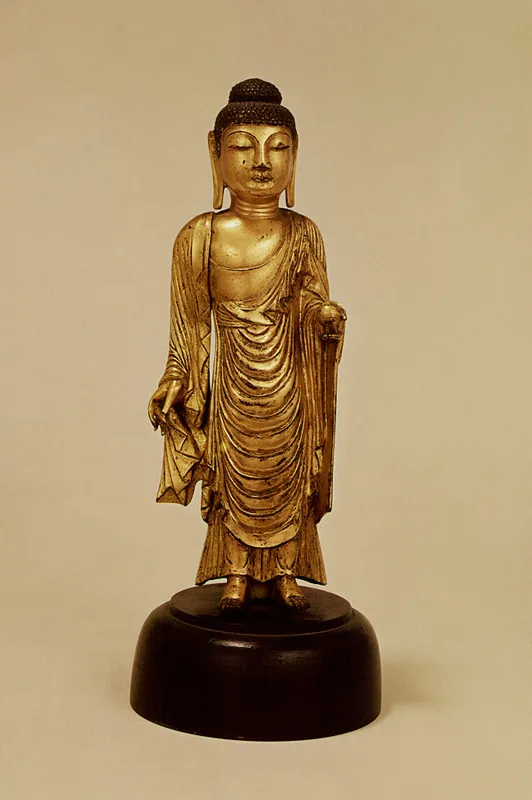
Gilt-bronze Standing Bhaisajyaguru Buddha
金銅藥師如來立像
서울특별시 용산구
Basic information
- Designation
- Treasure No.328
- Category
- Sculpture
- Era
- 통일신라시대
- Designated year
- 1963
- Location
- 용산구, 서울특별시— 서울특별시 용산구 서빙고로 137 (용산동6가, 국립중앙박물관)
- Coordinates
- 37.524041, 126.980350
AI Docent
Coming soonAn AI-generated, friendly retelling of this heritage site is available in Korean. An English version is on our roadmap — for now, please see the official description below.
Description
This is a small gilt-bronze statue, 29 centimeters high, preserved in the National Museum of Korea. The mandorla (Buddhist halo of light) and pedestal are gone, but this standing gilt-bronze Bhaisajyaguru Buddha is in relatively good condition. The Bhaisajyaguru Buddha is the Buddha who saves humankind from all diseases, and it is always holding a medicine jar. The hair is done in a curly nabal style (i.e. twirled up and around in a seashell-shaped fashion) and usnisa (a protuberance symbolizing supreme wisdom), shaped like a topknot, is large and tall. The plump face is not smiling but serious. The eyes, nose, and mouth are clear and cleverly sculpted. The ears are long enough to almost reach the shoulders and samdo, i.e. the three wrinkles on the neck are apparent. The right hand is held beneath the waist, with the thumb touching the middle finger. The left hand is holding a medicine jar, which is characteristic for a Bhaisajyaguru Buddha. The beobui (sacerdotal robe) covers both shoulders, with zigzagging and 'U' shaped folds on the front. This heavily sagging robe seems to weaken the impression of the dignified and healthy body. Although the pedestal is missing, two sharp points of stakes that had been attached to it remain beneath the feet. There are holes in the back of the statue that were used in its casting. The tall usnisa and the facial expression are similar to those of the Standing Gilt-bronze Bhaisajyaguru Buddha of Baeknyulsa Temple (National Treasure No. 28). That is why this statue is believed to have been made about the eighth century.
Location
지도를 불러오는 중…
Have you visited this place?
Log in and verify your visit on-site via GPS to record a stamp in My Journey. (QR verification coming later.)
Images: KOGL (khs.go.kr) · Data source: Korea Heritage Service Open API (khs.go.kr)