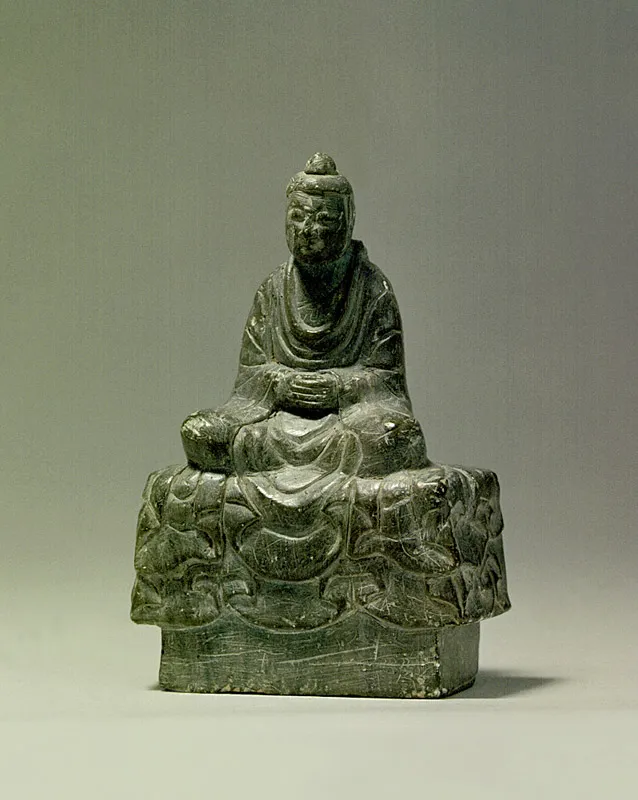
Stone Seated Buddha from Gunsu-ri, Buyeo
扶餘 軍守里 石造如來坐像
서울특별시 용산구
Basic information
- Designation
- Treasure No.329
- Category
- Sculpture
- Era
- 삼국시대
- Designated year
- 1963
- Location
- 용산구, 서울특별시— 서울특별시 용산구 서빙고로 137(용산동6가, 국립중앙박물관)
- Coordinates
- 37.538427, 126.965444
AI Docent
Coming soonAn AI-generated, friendly retelling of this heritage site is available in Korean. An English version is on our roadmap — for now, please see the official description below.
Description
This Buddha statue was found during the investigation of Baekje temple sites in Gunsu-ri, Buyeo, Chungcheongnam-do in 1936. This statue is unique to Baekje Period in that it is sitting on a tall square pedestal with its hands in the mudra of attaining Nirvana. There is a small usnisa (a protuberance symbolizing supreme wisdom) shaped like a topknot on the bald head. The square face is plump and happy-looking. The stoically closed eyes, wide nose, and smiling lips are gentle and mild. The shoulders are narrow and the hands are elegantly clasped together over the lap, which is the distinctive hand gesture. The beobui (sacerdotal robe) covering both shoulders is thick enough to conceal the curves of the body. The folds flowing from the shoulders to the knees almost cover the square pedestal. The folds in the chest part of the clothing are shaped in a ‘U’, and the hem below the knees is a symmetrical 'Ω' shape. This hem is smooth, flexible, and realistic. The body concealed in thick clothing, the narrow shoulders, and the distinctive hand gesture, are all elements of an old carving method. This statue was influenced by the Chinese style of the fourth or fifth century, but the face and body details are in the Baekje style. Therefore, it may be concluded that this is an example of the Buddha statues made in the mid sixth century Baekje period.
Location
지도를 불러오는 중…
Have you visited this place?
Log in and verify your visit on-site via GPS to record a stamp in My Journey. (QR verification coming later.)
Images: KOGL (khs.go.kr) · Data source: Korea Heritage Service Open API (khs.go.kr)