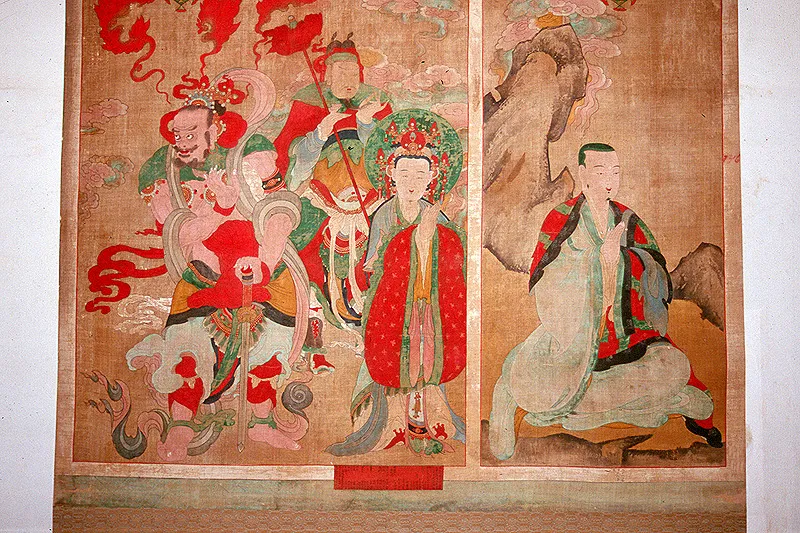
Heungguksa Sibyuknahando
興國寺 十六羅漢圖
전라남도 여수시
Basic information
- Designation
- Treasure No.1333
- Category
- Painting
- Era
- 조선 경종 3년(1723)
- Designated year
- 2002
- Location
- 여수시, 전라남도— 전남 여수시 흥국사길 160, 흥국사 (중흥동)
- Coordinates
- 34.821004, 127.700222
AI Docent
Coming soonAn AI-generated, friendly retelling of this heritage site is available in Korean. An English version is on our roadmap — for now, please see the official description below.
Description
This painting of sixteen Arhats, or saints who attained enlightenment through a process of self-discipline, is kept at Eungjindang Hall, Heungguksa Temple founded by State Preceptor Jinul in 1195 (the 25th year of the reign of King Myeongjong of Goryeo) in Yeongchisan Mountain, Yeosu. A painting portraying the scene of Shakyamuni preaching the Lotus Sutra at Vulture Peak, Gijjhakuta Hill, which was at the center, is now gone. Today, only six cuts on Arhats are left. Six Buddhist saints on the right (in three cuts) and six others on the left stand (in three cuts) facing each other, with the Lord Buddha at the center. The six cuts all display rocks and old trees showing clear contrast between light and shade on yellow background. Overall, the piece gives an impression of calmness with the use of subtle secondary colors. The first cut on the left shows Mahakasyapa (in the shape of an old monk) standing politely facing the Lord Buddha at the center and three other Buddhist saints. The second one on the left depicts four saints. The third one on the left contains a saint, Maha Brahma Deva, and those close to him. The first one on the right displays Anan (in the shape of a young monk facing the center) and three other saints. The second one on the right portrays four other saints. The third one on the right shows a young monk with the hands clasped gently as well as Sakradevanam Indra attended to by deputies. With this, Monk Uigyeom adopted the ink wash painting technique in Buddhist paintings. This one set an example for later ones containing Arhats of the late Joseon Period.
Location
지도를 불러오는 중…
Have you visited this place?
Log in and verify your visit on-site via GPS to record a stamp in My Journey. (QR verification coming later.)
Images: KOGL (khs.go.kr) · Data source: Korea Heritage Service Open API (khs.go.kr)