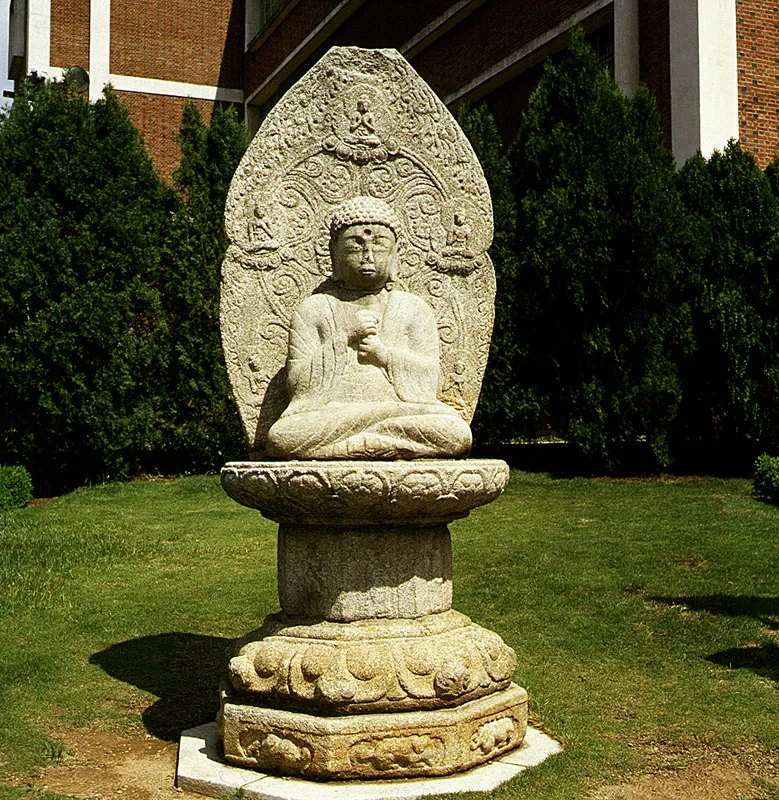
Stone Seated Vairocana Buddha
石造毘盧遮那佛坐像
대구광역시 북구
Basic information
- Designation
- Treasure No.335
- Category
- Sculpture
- Era
- 통일신라시대
- Designated year
- 1963
- Location
- 북구, 대구광역시— 대구 북구 대학로 80, 경북대학교박물관 (산격동,경북대학교)
- Coordinates
- 35.888767, 128.613755
AI Docent
Coming soonAn AI-generated, friendly retelling of this heritage site is available in Korean. An English version is on our roadmap — for now, please see the official description below.
Description
This is a stone seated Vairocana Buddha kept in the Kyungpook National University Museum. It is a good example of the Vairocana Buddha statue that was popular during the late Unified Silla Dynasty. The hair is curly, and the head is large and round compared to the body. Although other Vairocana Buddha statues of the time have stiff, neat expressions, this statue has a plump face with a trace of a smile on its lips. The shoulders are narrow and the body is remarkably dwarfish. It is sitting cross-legged with the feet on top of the knees with the soles of the feet facing the sky. The hands are in the formal Vairocana Buddha position, the jigwonin (the mudra symbolizing Buddha and the multitude are one), where the right hand is covering the left index finger. The clothing covering the shoulders is thick and the folds are formal. The mandorla (Buddhist halo of light), which gives form to the light coming from Buddha's body, is shaped like a boat and is much larger than the body. There are five Buddhas, with hands together at the chest, inscribed in the mandorla and detailed spark patterns on the edge of the mandorla. There are elegant flower patterns and animal images on the octagonal pedestal, though it appears formal. The narrow shoulders, flat chest, small body, and shape of the clothing are typical characteristics of the common form of Vairocana Buddha statues of the time. It seems to have been made at the same time as the Stone Seated Vairocana Buddha of Donghwasa Temple (Treasure No. 244) which was made in 863, the third year of the reign of King Gyeongmun of Silla.
Location
지도를 불러오는 중…
Have you visited this place?
Log in and verify your visit on-site via GPS to record a stamp in My Journey. (QR verification coming later.)
Images: KOGL (khs.go.kr) · Data source: Korea Heritage Service Open API (khs.go.kr)