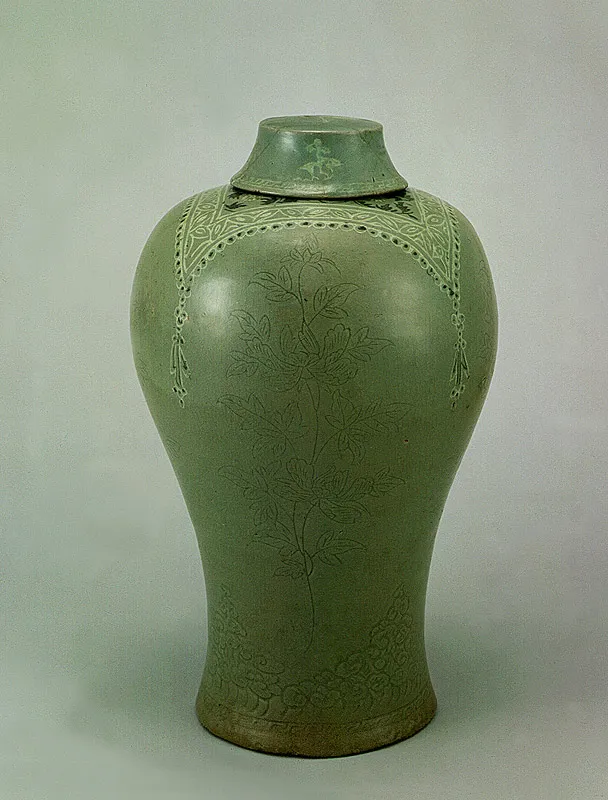
Celadon Lidded Prunus Vase with Incised Peony Design and Inlaid Wrapping Cloth Design
靑磁 陰刻牡丹 象嵌襆紗文 有蓋梅甁
서울특별시 용산구
Basic information
- Designation
- Treasure No.342
- Category
- Craft
- Era
- 미상
- Designated year
- 1963
- Location
- 용산구, 서울특별시— 서울특별시 용산구 서빙고로 137 (용산동6가, 국립중앙박물관)
- Coordinates
- 37.524041, 126.980350
AI Docent
Coming soonAn AI-generated, friendly retelling of this heritage site is available in Korean. An English version is on our roadmap — for now, please see the official description below.
Description
This vase, 35.4 cm high and 22.1 cm in diameter, is a good example of the Goryeo prunus vase. Prunus vases were originally made in China and were apparently introduced into Goryeo in the latter half of the 11th century. They made progress in beauty and formative sense in Goryeo, and developed in a style independent and different from the Chinese vases. Though can be seen to have many ornaments, the overall appearance is simple. In particular, the inlaid ornament at the top, and the intaglio pattern of the body and the lower part divides the whole design into two parts. The shoulder of the jar is plump, and a chrysanthemum vine pattern is inlaid with black and white around the mouth. An ornament looking like a square silk wrapping cloth hanging down around the shoulder is outstanding. The continuous bead pattern gives a delicate feeling of splendor. The four surfaces of the body are engraved with a peony blossom and leaf, and the surface of lower part is engraved with a cloud pattern like a wave. The mouth is engirded with a white inlaid lightning band pattern, and an engraved lightning band pattern decorates the base. The base clay is clean and comparatively soft in texture. It has a slight crack on the front and a blue-gray luster. It is unusual for a peony pattern to be applied vertically. Intaglio and inlay techniques have been observed together on a fragment from a celadon kiln at Yucheon-ri, Boan-myeon, Buan-gun, Jeollabuk-do.
Location
지도를 불러오는 중…
Have you visited this place?
Log in and verify your visit on-site via GPS to record a stamp in My Journey. (QR verification coming later.)
Images: KOGL (khs.go.kr) · Data source: Korea Heritage Service Open API (khs.go.kr)