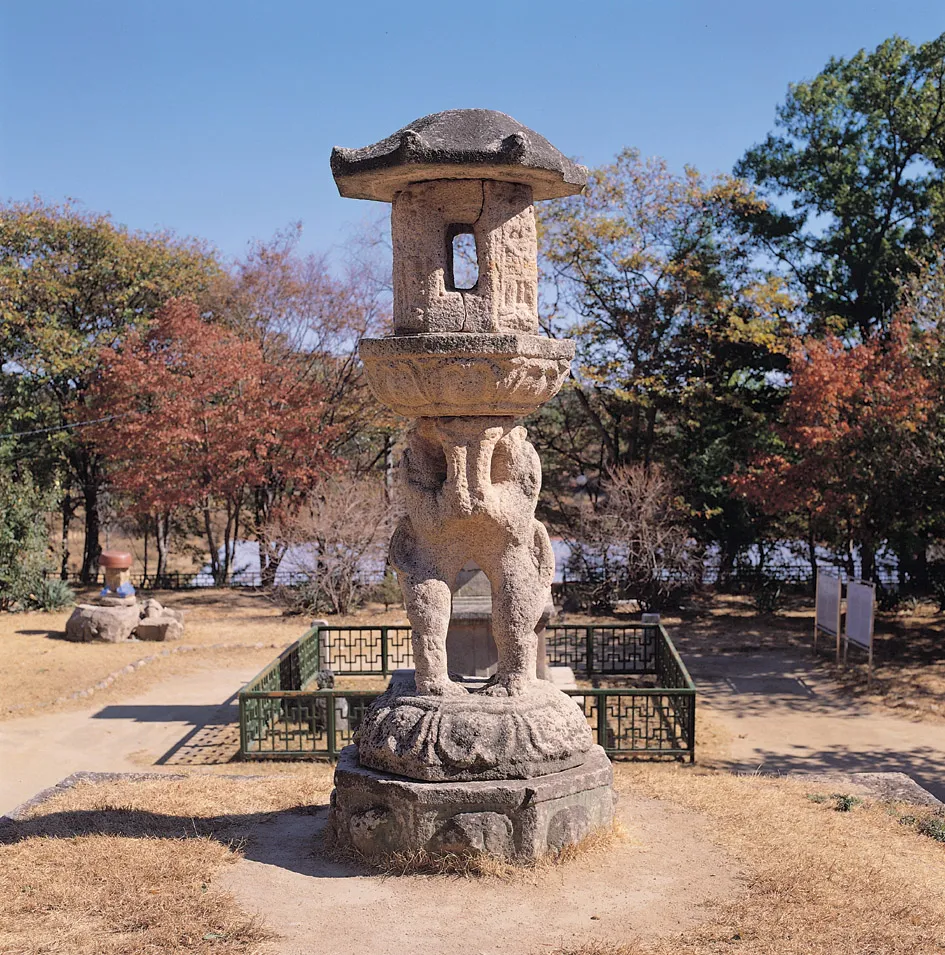
Twin Lion Stone Lantern at Yeongamsa Temple Site, Hapcheon
陜川 靈岩寺址 雙獅子 石燈
경상남도 합천군
Basic information
- Designation
- Treasure No.353
- Category
- Sites & Pagodas
- Era
- 통일신라시대
- Designated year
- 1963
- Location
- 합천군, 경상남도— 경상남도 합천군 가회면 둔내리 1659
- Coordinates
- 35.474308, 128.002736
AI Docent
Coming soonAn AI-generated, friendly retelling of this heritage site is available in Korean. An English version is on our roadmap — for now, please see the official description below.
Description
This stone lantern was erected on the site of Yeongamsa Temple in the Unified Silla Period. In 1933, the Japanese tried to take it away, but the people in the village resisted, kept it from them, and preserved it in the myeon (township) office. It was moved to its present location in 1959, after a hermitage was built at the temple site. The light chamber is set in the middle of the lantern, with a three-tiered base below and a capstone above. It is octagonal in shape, a typical style of the Unified Silla Period, except for the middle of base of the twin lion stone statue. A lotus design is engraved on the bottom base stone on which stands the statue of two lions with their chests together. Their back claws are stepping on the bottom base stone, while the front claws hold up the upper stone with their heads facing upwards. The manes, tails and muscles look very realistic. The light chamber has windows on four sides, while images of the Four Guardian Kings are engraved on the other four sides. These Four Guardian Kings were believed to be the deities that protected the Buddhist law from evil forces, thereby becoming a symbol of patriotism. An octagonal shaped capstone is thin and level, and a small floral statue rises from every corner. It is assumed that the lantern was made in the ninth century, the late Unified Silla Period, judging from that its style and the statue became rather formalized compared to those of the golden age of the Unified Silla. It is a masterpiece ranking with the Twin Lion Stone Lantern of Beopjusa Temple, Boeun (National Treasure No. 5).
Location
지도를 불러오는 중…
Have you visited this place?
Log in and verify your visit on-site via GPS to record a stamp in My Journey. (QR verification coming later.)
Images: KOGL (khs.go.kr) · Data source: Korea Heritage Service Open API (khs.go.kr)