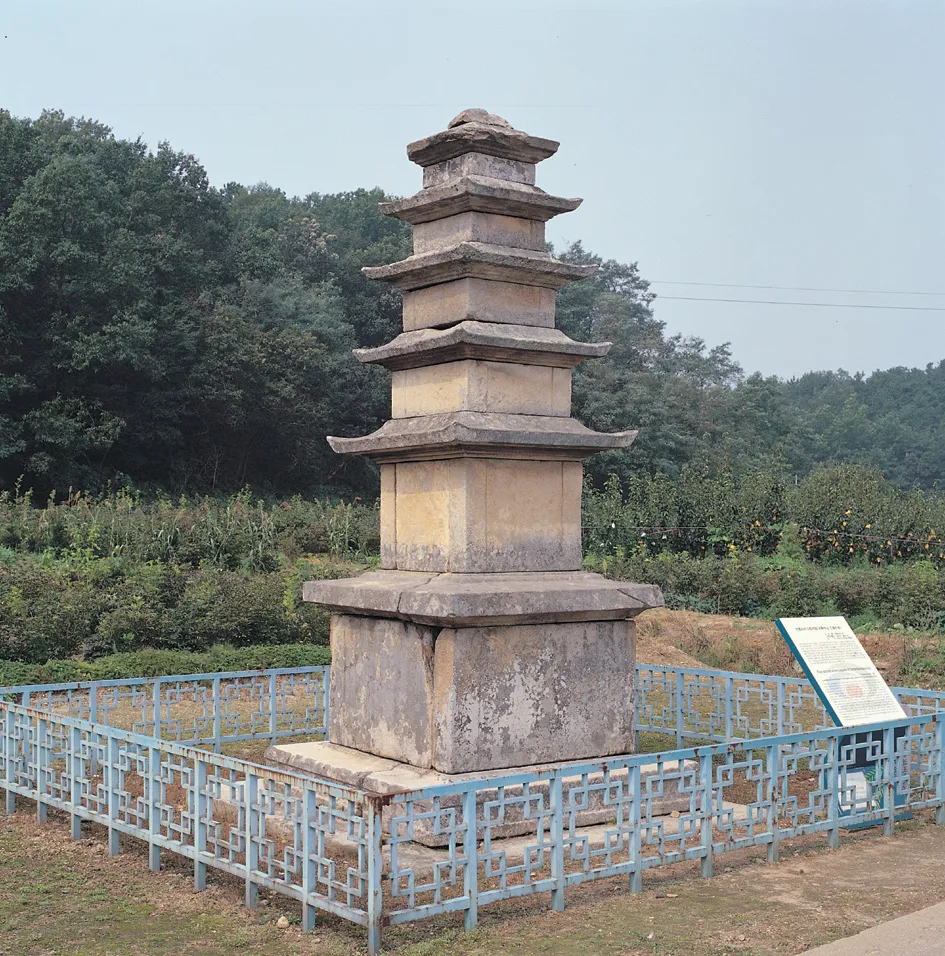
Five-story Stone Pagoda at Cheonheungsa Temple Site, Cheonan
天安 天興寺址 五層石塔
충청남도 천안시
Basic information
- Designation
- Treasure No.354
- Category
- Sites & Pagodas
- Era
- 고려시대
- Designated year
- 1963
- Location
- 천안시, 충청남도— 충남 천안시 서북구 성거읍 천흥리 190-2번지
- Coordinates
- 36.870138, 127.213157
AI Docent
Coming soonAn AI-generated, friendly retelling of this heritage site is available in Korean. An English version is on our roadmap — for now, please see the official description below.
Description
Located on the site of Cheonheungsa Temple, this stone pagoda was built in the Goryeo Dynasty. Cheonheungsa was built at a location under Seonggeosan Mountain, and named by King Taejo of Goryeo in the 4th year of his reign (921). The five-story pagoda stands on a two-story stylobate. It well represents the typical style of stone pagoda which was becoming bigger in the early days of the Goryeo Dynasty. The lower stylobate is so low that the two-story stylobate, supporting the body of the pagoda, looks like a single story. On each of the four sides of the lower stylobate, seven symbolic images of the elephant’s eyes are closely engraved. On the four sides of the upper stylobate, pillar patterns are engraved at each edge. The main stones and the roof stones of the body of the pagoda is each engraved in one stone. The main stones, on which pillar designs are engraved, gently get gradually smaller as they go up. The roof stones are thin and short, with a thin three-tiered base respectively. The incline of the roof stones is steep, but soon it becomes level. Therefore, the upward turn of the roofline looks rather significant, and the angled eaves appear to be buoyant. Overall, the pagoda looks grand and elegant, and the stones are well arranged. In particular, the gradual taper of the pagoda gives a gentle and solemn impression. On the temple site, as well as the pagoda the Flagpole Supports (Treasure No. 99) remain, while the Bronze Bell has been moved to the National Museum of Korea. It is believed that this pagoda was built at the same period as the bell, in the first year of the reign of King Hyeonjong (1010) of Goryeo.
Location
지도를 불러오는 중…
Have you visited this place?
Log in and verify your visit on-site via GPS to record a stamp in My Journey. (QR verification coming later.)
Images: KOGL (khs.go.kr) · Data source: Korea Heritage Service Open API (khs.go.kr)