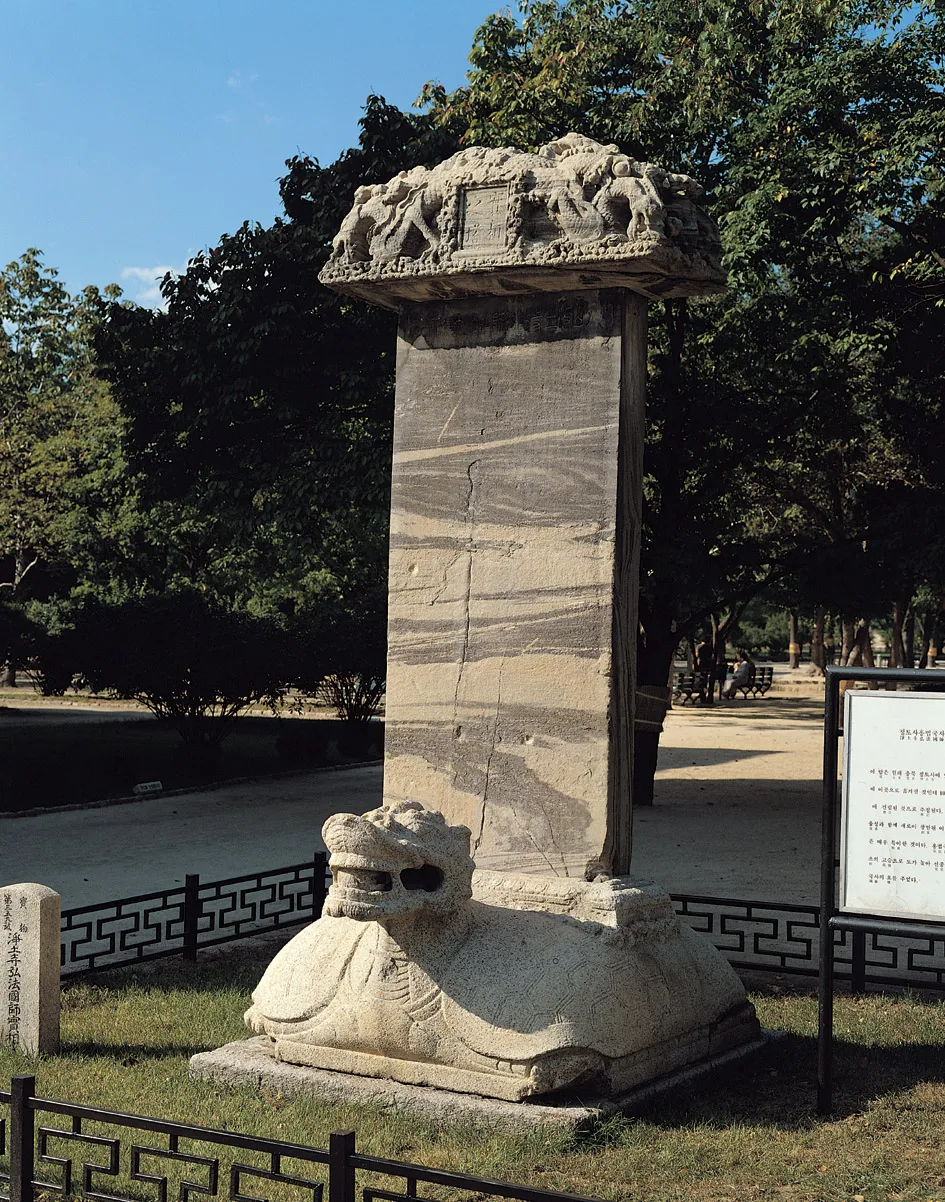
Stele of State Preceptor Hongbeop from Jeongtosa Temple Site, Chungju
忠州 淨土寺址 弘法國師塔碑
서울특별시 용산구
Basic information
- Designation
- Treasure No.359
- Category
- Books & Records
- Era
- 현종8년(1017)
- Designated year
- 1963
- Location
- 용산구, 서울특별시— 서울 용산구 서빙고로 137, 국립중앙박물관 (용산동6가)
- Coordinates
- 37.523423, 126.981360
AI Docent
Coming soonAn AI-generated, friendly retelling of this heritage site is available in Korean. An English version is on our roadmap — for now, please see the official description below.
Description
Jeongtosa Temple, originally located on Gaecheonsan Mountain in Hacheon-ri, Dongnyang-myeon, Chungju, Chungcheongbuk-do, is presumed to have been built between the late Unified Silla and early Goryeo periods, although the precise construction date has not been determined. This was a great temple where State Preceptor Hongbeop educated his pupils after Buddhist Monk Beobgyeong, named Hyeonhwi, who was granted as State Receptor by King Taejo of Goryeo, had stayed as its chief monk. This stele for State Preceptor Hongbeop, placed at the Jeongtosa Temple site, was moved to its present location, Gyeongbokgung Palace, in 1915 along with the Stupa of State Preceptor Hongbeop. It recorded the lives of Hongbeop, who was born in the reign of King Sindeok (912~917) of Unified Silla and became a Buddhist monk when he was 12. He made Zen Buddhism popular after returning from Tang Dynasty China. After he entered Nirvana in Jeongtosa Temple, King Mokjong of Goryeo granted the name of the stele ‘Jadeung’ and ordered Son Mong-ju to write an epitaph on it. His achievements were recorded on the front, while the names of his pupils were on the back, but now these are not legible since the surface of the memorial stone has worn off. It was written in the Ouyang Xun style in regular script, and was well presented. This stele consisted of three parts, the pedestal, the body and the capstone. Pedestals were usually made in a tortoise shape. However, this stone followed the style of the late Unified Silla and the early Goryeo period in that the head of memorial stone changed from a tortoise to a dragon. The dragon on this stone has a strong and well-defined appearance compared to ones on other pedestals. It is worthy of note that a twisting dragon is engraved on the ornamental top. This stele was erected in the 8th year of the reign of King Hyeonjong (1017) of Goryeo.
Location
지도를 불러오는 중…
Have you visited this place?
Log in and verify your visit on-site via GPS to record a stamp in My Journey. (QR verification coming later.)
Images: KOGL (khs.go.kr) · Data source: Korea Heritage Service Open API (khs.go.kr)