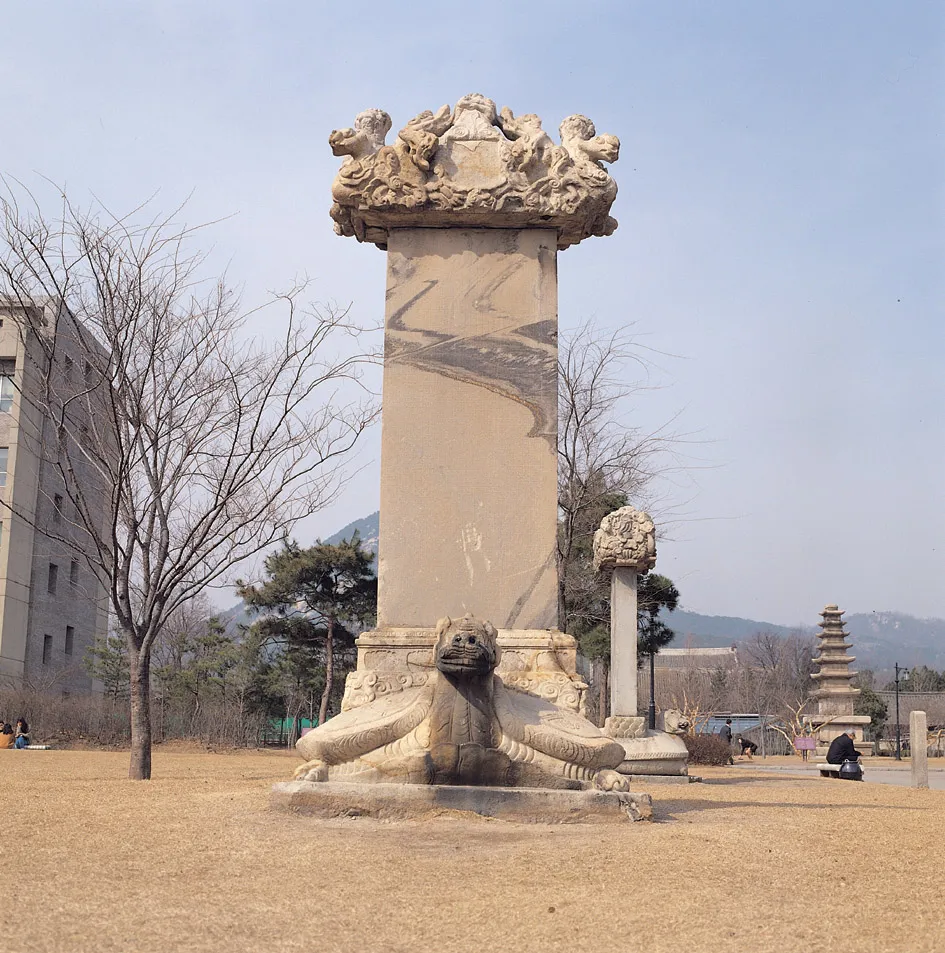
Stele of Master Wonrang from Wolgwangsa Temple Site, Jecheon
堤川 月光寺址 圓朗禪師塔碑
서울특별시 용산구
Basic information
- Designation
- Treasure No.360
- Category
- Books & Records
- Era
- 통일신라시대
- Designated year
- 1963
- Location
- 용산구, 서울특별시— 서울 용산구 서빙고로 137, 국립중앙박물관 (용산동6가)
- Coordinates
- 37.524041, 126.980350
AI Docent
Coming soonAn AI-generated, friendly retelling of this heritage site is available in Korean. An English version is on our roadmap — for now, please see the official description below.
Description
Originally located at the Wolgwangsa Temple site in Dongchang-ri, Hansu-myeon, Jecheon-gun, Chungcheongbuk-do, this stele was moved to Gyeongbokgung Palace in 1922, and now it stands in the National Museum of Korea. It records the achievements of Master Wonrang (?~866), a monk of the late Unified Silla Dynasty. He travelled to Tang Dynasty China in the 18th year of the reign of King Munseong (856), and stayed in Wolgwangsa Temple after making a tour of noted mountains over 11 years. After Wollang entered Nirvana at the age of 68, King Heongang ordered the erection of a memorial stone and called it ‘Daebogwangseon’. He also ordered Kim Yeong to compose the epitaph, and Sunmong inscribed the letters in the Ouyang Xun style in regular script. This stele consists of three parts, the pedestal, the body and the capstone. Pedestals were generally made in the form of a tortoise, while a hornless dragon was engraved on the capstone. It was the style of late Unified Silla that the tortoise shaped pedestal had quite small feet and a stretched out head and neck. The statue on the ornamental top looks quite realistic. Overall, the capstone, body and pedestal are so balanced that the stele gives a simple and stable impression. It was erected in 890, the 4th year of the reign of Queen Jinseong, after Wollang passed away.
Location
지도를 불러오는 중…
Have you visited this place?
Log in and verify your visit on-site via GPS to record a stamp in My Journey. (QR verification coming later.)
Images: KOGL (khs.go.kr) · Data source: Korea Heritage Service Open API (khs.go.kr)