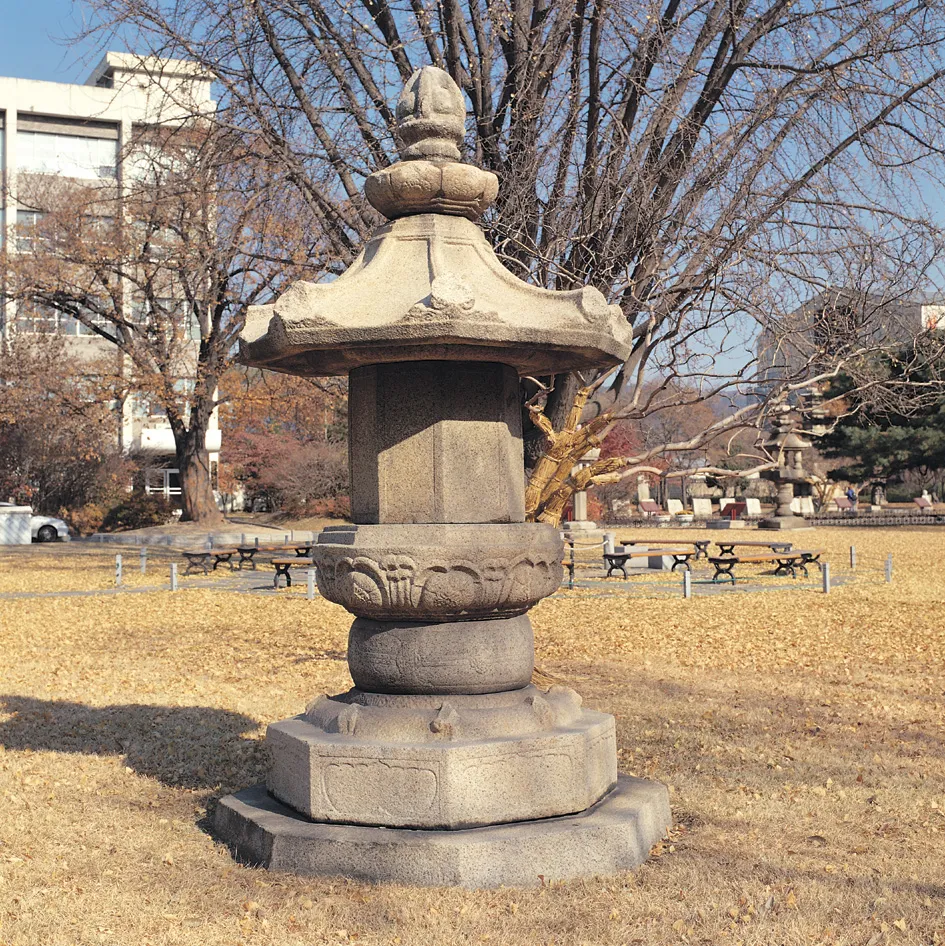
Stupa of Buddhist Monk Jingyeong from Bongnimsa Temple Site, Changwon
昌原 鳳林寺址 眞鏡大師塔
서울특별시 용산구
Basic information
- Designation
- Treasure No.362
- Category
- Sites & Pagodas
- Era
- 통일신라시대
- Designated year
- 1963
- Location
- 용산구, 서울특별시— 서울 용산구 서빙고로 137, 국립중앙박물관 (용산동6가)
- Coordinates
- 37.523508, 126.980713
AI Docent
Coming soonAn AI-generated, friendly retelling of this heritage site is available in Korean. An English version is on our roadmap — for now, please see the official description below.
Description
The Stupa of Jingyeong, who was a Buddhist monk during the late Unified Silla Period, was first located at Bongnimsa Temple site together with his stele, but was moved to Gyeongbokgung Palace in 1919. Now it stands in the National Museum of Korea. It is a typical octagonal stone stupa. However, sculptures on the surface are so few that it gives a neat impression along with the simple stone color. The lower stylobate, which is laid on a wide octagonal base stone, is also octagonal, and the symbolic images of the elephant’s eyes are engraved on the side. In particular, the bottom line of the pattern rises in the middle like a form of flames, which represents the characteristic of the period. The middle stylobate is in the shape of a drum, and blossoms are engraved on all sides of the center. It is also connected with a prominent band decoration. Eight lotus blossoms are engraved on the upper stylobate. A pillar design is engraved on the each corner in the body of the stupa. The roof stones are rather high and broad, while their eaves are level. On the roof edges, the thick octagonal roofline continues from the top to the bottom, but the floral decoration attached to the tip is broken. On the top of the roof stone, a lotus flower pattern ornament and a lotus flower bud ornament are raised, made from one stone. It is estimated that the stupa was built in the 7th year of the reign of King Gyeongmyeong in the Silla period (923), the year when Jingyeong entered Nirvana. The symbolic images of the elephant’s eyes in the lower stylobate show the typical style of the Goryeo Dynasty. It seems unbalanced in that the middle stylobate is low and small and the roof stone is excessively big while the body of the stupa is long and slender. The sculpture technique is not strong, and all the shapes have a tendency to get longer, so that it represents the transition from the Unified Silla period style into a new style.
Location
지도를 불러오는 중…
Have you visited this place?
Log in and verify your visit on-site via GPS to record a stamp in My Journey. (QR verification coming later.)
Images: KOGL (khs.go.kr) · Data source: Korea Heritage Service Open API (khs.go.kr)