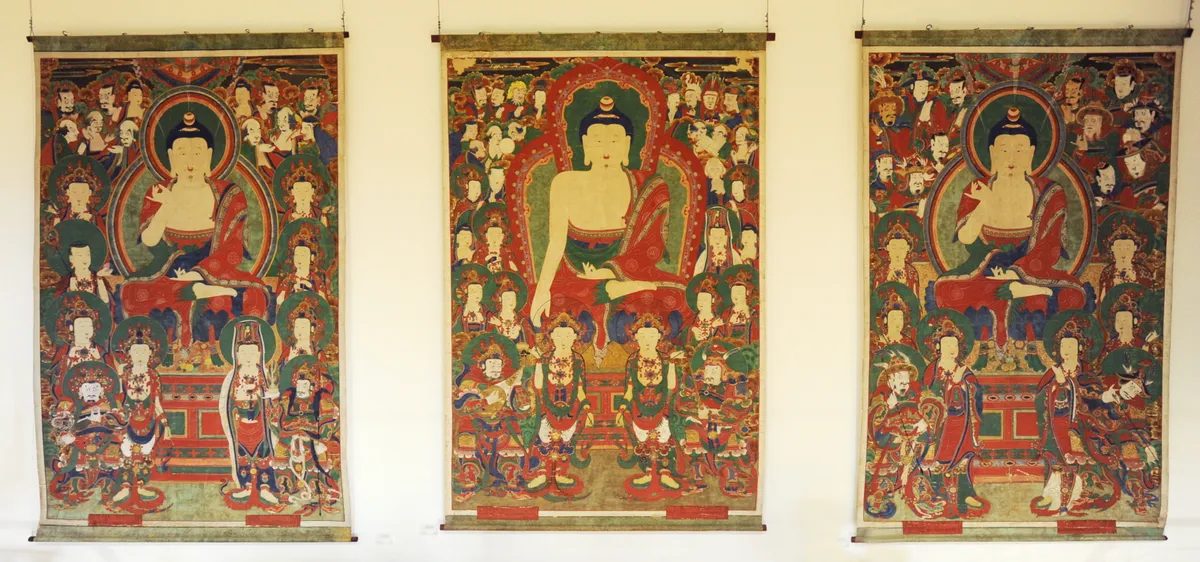
Ssanggyesa Daeungjeon Samse Buddhist Painting
雙磎寺 大雄殿 三世佛幀
경상남도 하동군
Basic information
- Designation
- Treasure No.1364
- Category
- Painting
- Era
- 조선 정조 5년(1781)
- Designated year
- 2003
- Location
- 하동군, 경상남도— 경남 하동군 화개면 쌍계사길 59, 쌍계사 (운수리)
- Coordinates
- 35.233117, 127.649786
AI Docent
Coming soonAn AI-generated, friendly retelling of this heritage site is available in Korean. An English version is on our roadmap — for now, please see the official description below.
Description
In this painting of the Buddha triad, which is kept at the Main Hall (Treasure No. 500) of Ssanggyesa Temple, Shakyamuni Buddha is at the center flanked by the Medicine Buddha and Amitabha Buddha. The image of Shakyamuni Buddha is made large. He is symmetrically surrounded by the eight leading bodhisattvas including Manjusri Bodhisattva and Samantadhadra Bodhisattva, Indra, Brahma, two Buddhas, ten disciples including Mahakasyapa and Ananda, sea king and his daughter, and two of the Four Guardian Kings. The main Buddha has the fingers of one hand pointing to the bottom, with the other hand placed on the lap, palm facing up; a mandorla is set behind him. Usnisa (a protuberance symbolizing supreme wisdom) is at the top of the head, with large-sized beads placed at the top of the head and near the forehead. The facial features look neat. The body is shaped like a square, giving a sense of rigidity often found in the Buddhist paintings of the late 18th Century. The Medicine Buddha makes a hand sign like the Amida hand sign. He is symmetrically flanked by the six leading bodhisattvas, two of the Four Guardian Kings, and twelve supernatural guardians. Overall, the look of the figure and the colors and expressions used for this figure are similar to those for Shakyamuni Buddha next to it, but the composition of this one and Amitabha Buddha feels rather loose compared to that of Shakyamuni Buddha. Amitabha Buddha is surrounded by the eight leading bodhisattvas including Avalokitesvara and Mahasthamaprapta Bodhisattva, two of the Four Guardian Kings, two Buddhas, and ten leading disciples that look like Arhats. This piece is an important material for those studying monk painters ranging from Uigyeom, who carried out conspicuous activities in Jeolla-do in the early 18th Century, to Seungyun of the 1780s. As a large-sized painting of the late 18th Century displaying exquisite brush strokes and creating a flamboyant yet subdued atmosphere, it is a noteworthy work.
Location
지도를 불러오는 중…
Have you visited this place?
Log in and verify your visit on-site via GPS to record a stamp in My Journey. (QR verification coming later.)
Images: KOGL (khs.go.kr) · Data source: Korea Heritage Service Open API (khs.go.kr)