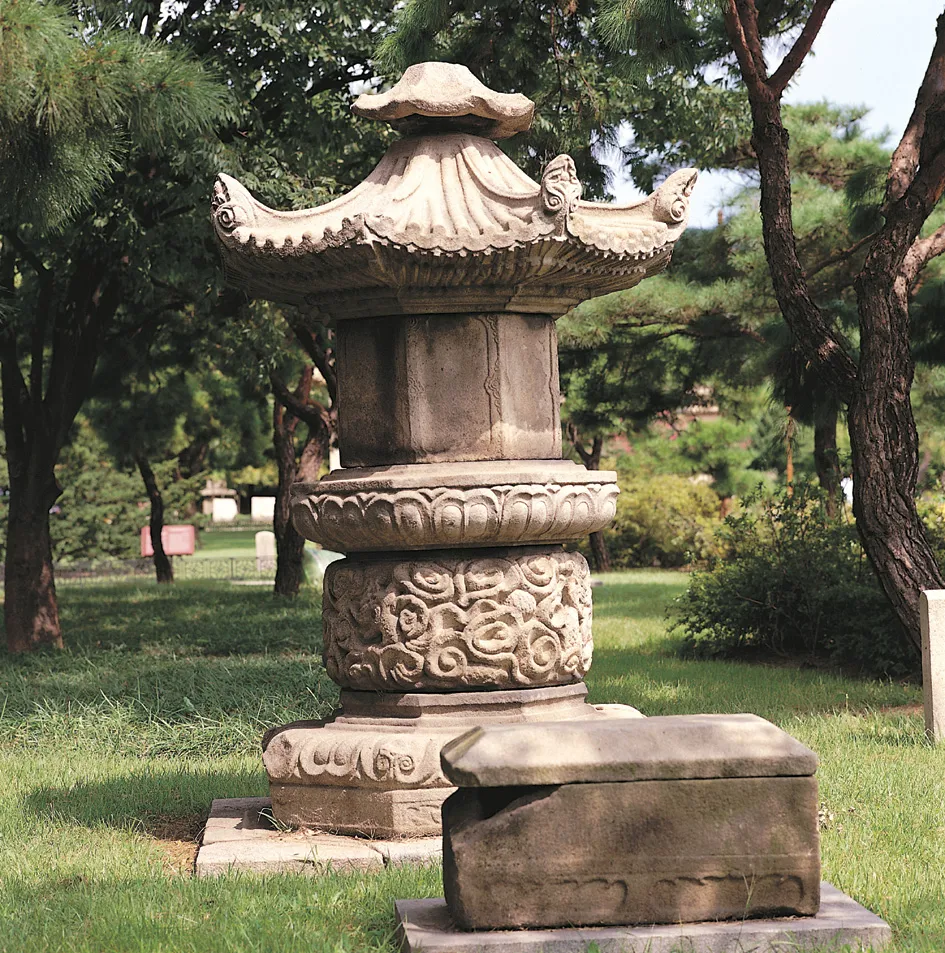
Stupa of Buddhist Monk Jingong and Stone Casket from Heungbeopsa Temple Site, Wonju
原州 興法寺址 眞空大師塔 및 石棺
서울특별시 용산구
Basic information
- Designation
- Treasure No.365
- Category
- Sites & Pagodas
- Era
- 고려시대
- Designated year
- 1963
- Location
- 용산구, 서울특별시— 서울 용산구 서빙고로 137, 국립중앙박물관 (용산동6가)
- Coordinates
- 37.523482, 126.981148
AI Docent
Coming soonAn AI-generated, friendly retelling of this heritage site is available in Korean. An English version is on our roadmap — for now, please see the official description below.
Description
This stupa, made of stone, preserves the sarira of Jingong, a Buddhist monk in the late Unified Silla and early Goryeo periods. It was originally located at the Heungbeopsa Temple site in Wonju, Gangwon-do, but was moved to Gyeongbokgung Palace in 1931. It was removed again and rebuilt in the garden of the National Museum of Korea. Jingong had studied abroad in Tang Dynasty China and come back to Silla to become a teacher of King Sindeok. He was especially respected by King Taejo of the Goryeo Dynasty. The stupa has a basic octagonal shape. Lotus flowers are engraved on the upper and lower pedestal and the body of a dragon, tangled with magnificent clouds, is vividly engraved in the middle pedestal. The body of the stupa is unique, since every pillar of the main stone is decorated with a floral design at the edge. The image of a lock in a door is engraved on the both front and rear sides. The roof stone above the body has three-tiered base and double rafters underneath. On the roof edges, the thick octagonal rooflines slop gently and a sculpture of a flower rising high hangs on each tip of the roof edges. The inclined roof looks like the tiled roof in that the furrows are represented realistically and the roof-end tiles are also engraved at the edges of the eaves. This shows a typical feature of a wooden structure of the period, along with the rafter placed under the roof. There is a bogae, a finial ornament, in the form of a small octagonal roof at the top of the stupa. At the left side of the stupa, a stone casket is laid in which Buddhist scriptures and the relics related were kept. This is especially valuable since its lid remained perfectly intact. The stone casket is composed of a lid stone, which looks like a hipped roof of which the upper part was horizontally cut, and a chest in shape of a long box. It has remained in perfect condition, and so is extremely valuable. It is not known for certain when the stupa and the stone casket were made but, with reference to the History of Goryeo, they are estimated to have been made in the 23rd year of the reign of King Taejo (940) of the Goryeo Dynasty.
Location
지도를 불러오는 중…
Have you visited this place?
Log in and verify your visit on-site via GPS to record a stamp in My Journey. (QR verification coming later.)
Images: KOGL (khs.go.kr) · Data source: Korea Heritage Service Open API (khs.go.kr)