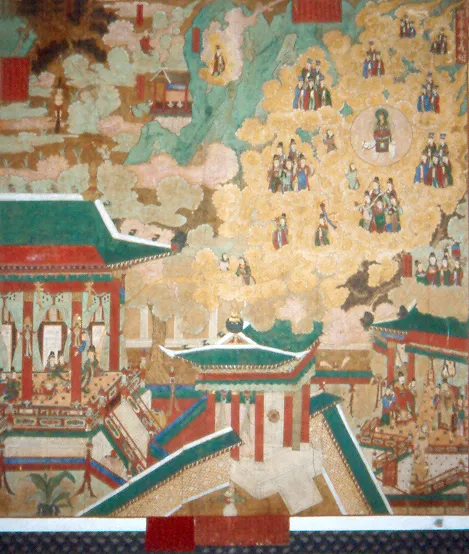
Ssanggyesa Palsangjeon Palsangtaeng
雙磎寺 八相殿 八相幀
경상남도 하동군
Basic information
- Designation
- Treasure No.1365
- Category
- Painting
- Era
- 조선 영조 4년(1728)
- Designated year
- 2003
- Location
- 하동군, 경상남도— 경남 하동군 화개면 쌍계사길 59, 쌍계사 (운수리)
- Coordinates
- 35.233117, 127.649786
AI Docent
Coming soonAn AI-generated, friendly retelling of this heritage site is available in Korean. An English version is on our roadmap — for now, please see the official description below.
Description
This is a painting of eight scenes of Shakyamuni Buddha’s life, kept at Palsangjeon Hall (Gyeongsangnam-do Tangible Cultural Heritage No. 87) of Ssanggyesa Temple. The eight scenes include the following: a scene of Shakyamuni Buddha descending to this world from Tusita heaven on an elephant; a scene of him born of Queen Maya from her side at Lumbini Park; a scene of Prince Siddartha feeling the evanescence of life from the suffering people outside the Royal castle; a scene of him becoming a monk despite his parents’ opposition; a scene of him practicing austerity in snow mountains along with mountain deities; a scene of him withstanding temptations and threats while practicing austerity; a scene of him giving the first sermon in Sarnath (Deer Park); and a scene of him entering nirvana under the twin sala trees. Each scene of the eight-cut piece is divided with buildings, clouds, trees, or mountains and accompanied by the relevant explanation; thus making it easy to understand. Trees portrayed in all scenes are not stereotypically made. They look very natural and realistic. Each cut contains remarks about the painting at the bottom. These remarks state that the painting was made by eight monk painters, including Ilseon, in 1728 (the 6th year of the reign of Emperor Yongzheng of the Qing Dynasty of China). Each cut, arranged in the form of a panel, shows only the major content. This one is presumed to have been made based on the same original as its cousin kept at Songgwangsa Temple in Suncheon (made in 1725), since the two display quite similar images even though the colors used are different. As for the period of its production, this piece, along with the one kept at Yongmunsa in Yecheon (made in 1709), was made earlier than others of its kind. This one carries a unique sense of space as well as well-harmonized colors. The calm, composed layout of things and the natural and realistic expressions of trees as shown in this piece are those that often occur in similar paintings or paintings of Amrarta of the early 18th Century. Thus, this piece is a valuable material, one that enables researchers to infer the relationships between this one and the ordinary paintings of its time or preceding periods.
Location
지도를 불러오는 중…
Have you visited this place?
Log in and verify your visit on-site via GPS to record a stamp in My Journey. (QR verification coming later.)
Images: KOGL (khs.go.kr) · Data source: Korea Heritage Service Open API (khs.go.kr)