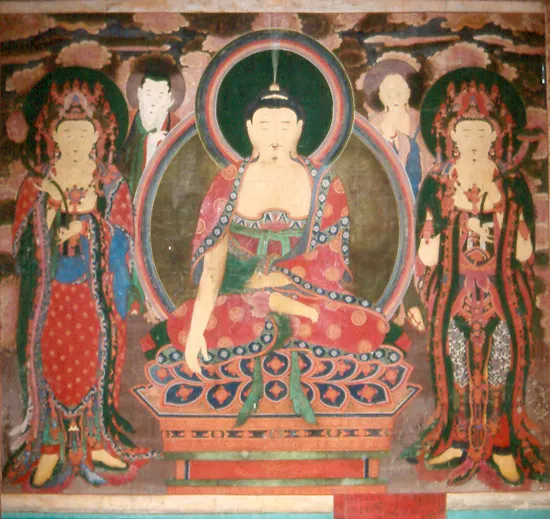
Songgwangsa Eungjindang Seokgamoni Hubultaeng·sibyuknahantaeng
松廣寺 應眞堂 釋迦牟尼 後佛幀.十六羅漢幀
전라남도 순천시
Basic information
- Designation
- Treasure No.1367
- Category
- Painting
- Era
- 1724년,1725년
- Designated year
- 2003
- Location
- 순천시, 전라남도— 전남 순천시 송광면 송광사안길 100, 송광사 (신평리)
- Coordinates
- 35.002169, 127.275655
AI Docent
Coming soonAn AI-generated, friendly retelling of this heritage site is available in Korean. An English version is on our roadmap — for now, please see the official description below.
Description
These paintings, kept at Eungjindang Hall (Jeollanam-do Tangible Cultural Heritage No. 254) of Songgwangsa Temple, include a piece about Shakyamuni preaching at Vulture Peak, Gijjhakuta Hill and eight others on 16 Arhats, Indra, and Brahma (four on the right and four on the left of Shakyamuni at the center). In the piece about Shakyamuni preaching at Vulture Peak, Gijjhakuta Hill, Shakyamuni is flanked by Manjusri Bodhisattva, Samantadhadra Bodhisattva, Mahakasyapa, and Ananda. Red and yellow soil as the main colors and blue and red as ancillary colors give a sense of splendor. Set behind the Buddha’s round face is a round head disc. The facial features are made small. The robe hung on both shoulders is decorated with very exquisite, luxurious floral pattern. Manjusri Bodhisattva and Samantadhadra Bodhisattva standing next to him wear a gorgeous-looking crown and a robe adorned with diverse floral patterns, holding up a lotus flower. The two disciples between the two bodhisattvas and the Buddha appear to assume a natural stance with the upper body slightly bent forward. Seen through the transparent mandorla are propitious-looking clouds that fill up the background. This piece, which was made in 1724, carries the features of a painting of the early 18th Century such as neat facial features, skillful brush strokes in light Indian ink color, and exquisite decorations and colors. The piece about sixteen Arhats shows them sitting facing the main Buddha at the center, with grotesque-looking rocks and clouds as the backdrop. The contrast between crimson, green, and black colors and the changes in light and shade create a pleasant atmosphere. The name is marked on each image of Arhat. The images of Indra and Brahma, placed at the extreme left and right, respectively, each used red and blue on yellow-soil colored background, displaying dynamic vitality. The piece is an academically and artistically valuable material. It is also important for those studying paintings about Arhats.
Location
지도를 불러오는 중…
Have you visited this place?
Log in and verify your visit on-site via GPS to record a stamp in My Journey. (QR verification coming later.)
Images: KOGL (khs.go.kr) · Data source: Korea Heritage Service Open API (khs.go.kr)