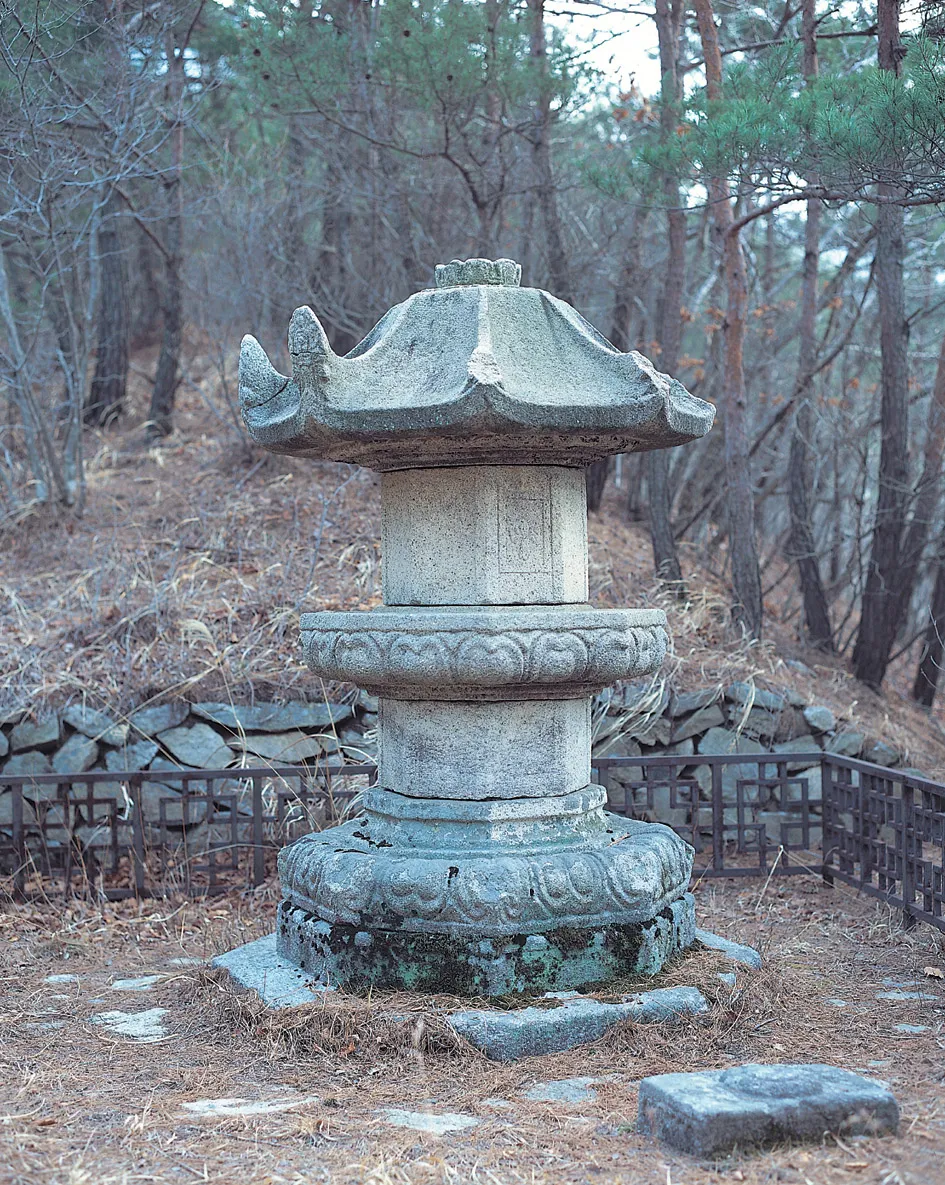
Gagyeonsa Tongildaesatap, Goesan
槐山 覺淵寺 通一大師塔
충청북도 괴산군
Basic information
- Designation
- Treasure No.1370
- Category
- Sites & Pagodas
- Era
- 고려시대
- Designated year
- 2003
- Location
- 괴산군, 충청북도— 충북 괴산군 칠성면 각연길 451 (태성리)
- Coordinates
- 36.751485, 127.927509
AI Docent
Coming soonAn AI-generated, friendly retelling of this heritage site is available in Korean. An English version is on our roadmap — for now, please see the official description below.
Description
Gagyeonsa is a Buddhist temple located on a southern slope of Chilbosan Mountain. The Stele for Buddhist Monk Tongil (Treasure No. 1295) is located at about 1km southeast of the temple, and the Stupa of Buddhist Monk Tongil, located at about 30 minutes’ distance from here, on foot, toward the main peak of Bogaesan Mountain, stands on a ridge of the middle peak. The stupa was found in several pieces, when it was discovered in 1965, and was restored to the current appearance by Goesan-gun County, between June and July 1982, by rejoining the parts scattered across the site. The stupa is a typical stone stupa mounted on an octagonal pedestal, composed of a base, main section and a finial, and it stands 2.3m tall. The base section consists of four tiers of stone platforms. The stupa is complete with no missing elements. The bottom tier and the stone support for the tier immediately above are made from a single stone block. Whilst the bottom tier is plain, the second from the bottom tier has parenthesis-like eye motifs sculpted on both ends of its left and right sides. The top stone of the second from the bottom tier and the support for the third from the bottom tier are also made in a single stone block. The top base stone is carved with lotus flowers with two rows of sixteen petals, placed on the each of its eight facets. Corner floral designs added to the tips of the lotus petals have been mostly broken off, leaving only faint traces. The middle stone is mounted on a stone support with a foot-shaped wedge placed above it. Of the side stone slabs surrounding the middle stone, only those in the four corners have column-like sculpted details. The top tier is made in a single stone block, and the three-tier polygonal support is decorated on the lateral side with sixteen upward-facing lotus petals with two rows of petals. The lotus petal motifs are present only on those of the eight facets that are in the center and in the corners, in that similar to the top stone of the second from the bottom tier. The top surface of the top tier was carved to create a low-rising platform upon which the main section of the stupa is placed. The body and roof of the main section of the stupa are each made with a single stone block. All four corner edges of the body of the stupa have column-shaped vertical sculpted details. On the front and back sides, sculpted designs are placed inside a rectangular frame created by incised lines, giving them the appearance of a memorial stone. The area immediately below the roof stone is carved to create three levels, and thirty-two upward-turned lotus petals in two rows of petals are added below the eaves of the roof stone, one at each corner and three in the rest of areas. The roof slopes are steeply pitched, and the eaves are thick. The roof tiles are rendered thick with blunt edges. A floral ornament is added at the end of each roof ridge, but four of them are missing, and the other four have been broken off and glued back. The summit of the roof is adorned with a band of sixteen down-facing lotus petals with a single row of petals. The finial is missing with only the base still remaining. The finial base is made in the same block of stone as the roof. The lateral side of the finial base has sixteen sculpted upward-facing lotus petals with a single row of petals, and there is a hole in the middle, at the top, into which the finial was inserted. The Stupa of Buddhist Monk Tongil at Gagyeonsa Temple is an outstanding piece of sculptural work and is complete, even though it was found dismantled and disassembled, with all major pieces preserved intact. This stupa, faithfully following the octagonal stupa style perfected during the Unified Silla period, shows affinities to early Goryeo stone stupa. Meanwhile, given the fact that the Stele for Buddhist Monk Tongil was erected sometime between 858 and 960 (between the eighth lunar month of the 9th year of King Gwangjong’s reign and the third lunar month of the 11th year of the same reign during the Goryeo Dynasty), and that there is firm evidence that this stupa is dedicated to the monk Tongil, the stupa appears to have been made around the same time as the stele. Most surviving stone stupas are situated at a less visible corner of temple precincts with their associated stele also located near them. This stupa, meanwhile, is located on a mountain flank at some distance from the temple, and quite far away from the associated stele. The location of the stupa is along the access road to Gagyeonsa Temple, providing a good view of the temple. There are a handful of cases in which a monk’s stupa is separated from the stele dedicated to him by a great distance. The Stupa at Ssanggyesa Temple, the Stupa of Buddhist Monk Nangwon at Bohyeonsa Temple and the Stupa of Buddhist Monk Jeongjin at Bongamsa Temple are the only three known examples. Placing a monk’s stupa at a location offering a good view of the surrounding environment or the Buddhist temple appears to be a philosophically-informed decision, much like the practice of erecting a stone stupa at the summit of a mountain, seen during the 9th century and thereafter, based on the idea that stupas can provide a beneficial energy to the surrounding natural environment.
Location
지도를 불러오는 중…
Have you visited this place?
Log in and verify your visit on-site via GPS to record a stamp in My Journey. (QR verification coming later.)
Images: KOGL (khs.go.kr) · Data source: Korea Heritage Service Open API (khs.go.kr)