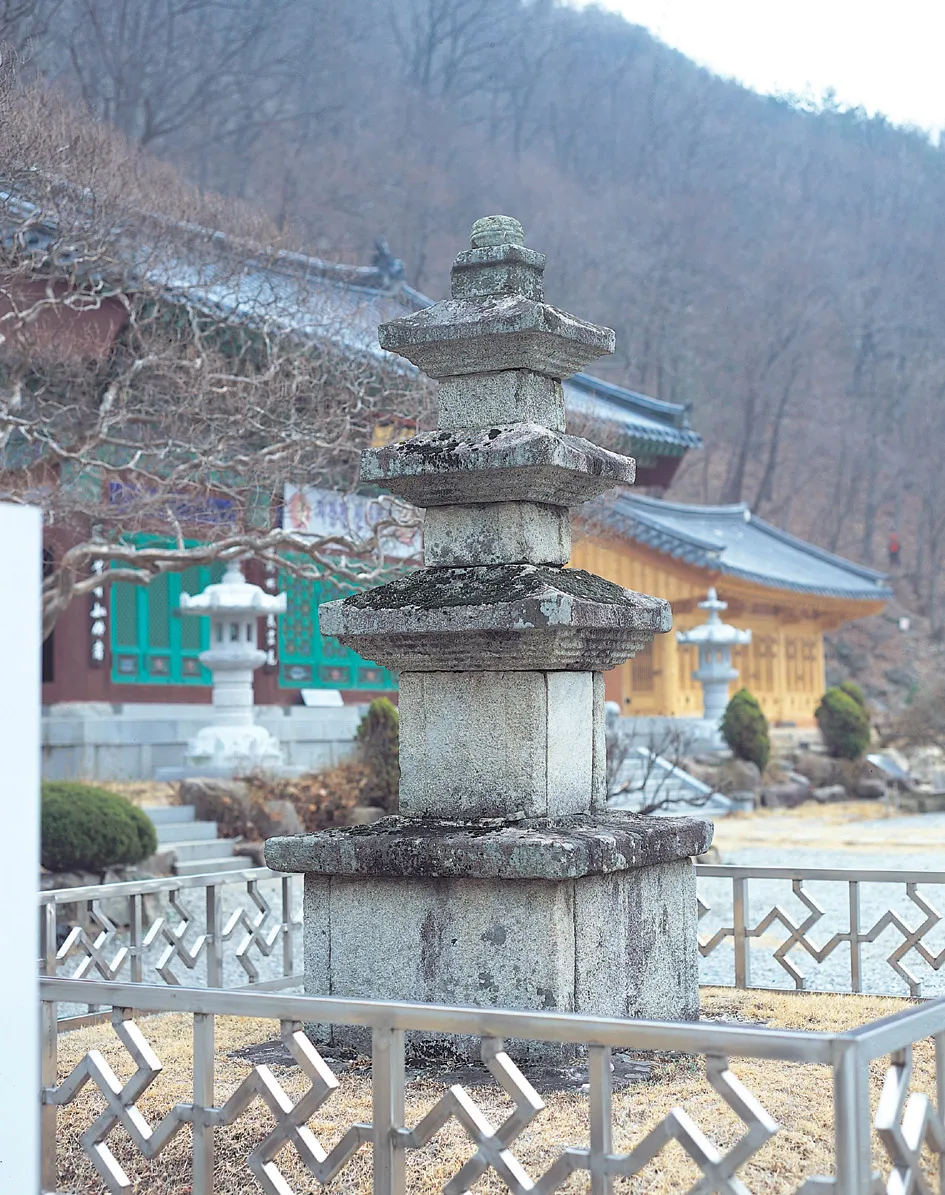
Banyasa Three-story Stone Pagoda, Yeongdong
永同 般若寺 三層石塔
충청북도 영동군
Basic information
- Designation
- Treasure No.1371
- Category
- Sites & Pagodas
- Era
- 고려시대
- Designated year
- 2003
- Location
- 영동군, 충청북도— 충북 영동군 황간면 백화산로 652 (우매리)
- Coordinates
- 36.280700, 127.909120
AI Docent
Coming soonAn AI-generated, friendly retelling of this heritage site is available in Korean. An English version is on our roadmap — for now, please see the official description below.
Description
This pagoda (height: 335cm) reportedly used to be in Seokcheon Valley north of Banyasa Temple but was relocated to its current location in 1950. The three-tiered body was set up on the single-tier base on the foundation, which is embedded in soil. Overall, the structure has been preserved well. The foundation consists of six flat stones and features a 3cm-deep square hole to accommodate the base of the body. The base of the body is composed of four flat stones, each of which displays the inscription of column-shaped figures on both corners and at the center. The top of the base is made of a stone with a 3cm-deep square hole to accommodate the first tier of the body. The first tier of the body is composed of four flat stones, with the corner of each one inscribed with the shape of a column. The second and third tiers of the body are each composed of a stone. The corner columns for the second tier of the body display an entasis technique. Each roof stone consists of a stone and has a short, sharp slope. As for the bottoms of roof stones, the bottom for the first-tier roof stone is five-tiered, whereas that for the second- and third-tier roof stones is four-tiered. Roof stone edges are made thick. Unlike the trend of adopting a straight line for roof stone edges of that time, this one has round lines. The top of each roof stone provides a square bottom for the upper-tier body. The bottom support and bokbal (overturned bowl) are left at the stupa finial. The pagoda is presumed to have been set up in the early Goryeo Period (918-1392) based on its overall style. The technique used to combine the first-tier body with the upper body seems to inherit the tradition of stone pagodas of the Silla Period (57 BC- 935 AD). The hole made on the top of the base to accommodate the first tier of the body appears to follow the style of stone pagodas of the Baekje Period (18 BC-660 AD) in Chungcheong-do and Jeolla-do. The pagoda displays the characteristics of stone pagodas built in the Goryeo Period, following the styles of those of the Baekje and Silla Periods.
Location
지도를 불러오는 중…
Have you visited this place?
Log in and verify your visit on-site via GPS to record a stamp in My Journey. (QR verification coming later.)
Images: KOGL (khs.go.kr) · Data source: Korea Heritage Service Open API (khs.go.kr)