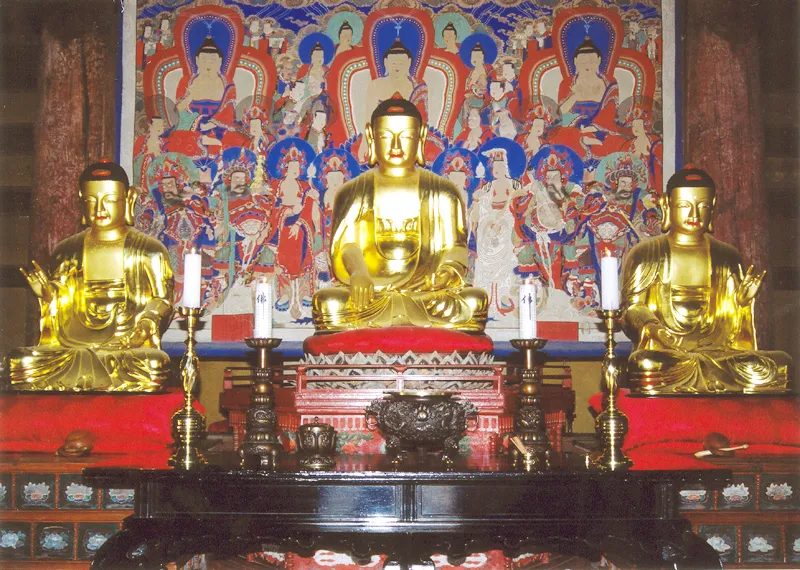
Sudeoksa Mokjoseokgayeoraesambuljwasang Mit Reliquary Objects, Yesan
禮山 修德寺 木造釋迦如來三佛坐像 및 腹藏遺物
충청남도 예산군
Basic information
- Designation
- Treasure No.1381
- Category
- Sculpture
- Era
- 조선 인조 17년(1639)
- Designated year
- 2003
- Location
- 예산군, 충청남도— 충남 예산군 덕산면 사천리 20번지 수덕사
- Coordinates
- 36.663198, 126.620812
AI Docent
Coming soonAn AI-generated, friendly retelling of this heritage site is available in Korean. An English version is on our roadmap — for now, please see the official description below.
Description
The Buddha triad kept at the Main Hall (National Treasure no. 49) of Sudeoksa Temple is said to have been taken to its current location by Monk Mangong, who played a leading role in the revival of Sudeoksa, from Gwijeongsa Temple in Manhaengsan, Namwon. The image of Shakyamuni Buddha is at the center, flanked by that of the Medicine Buddha and Amitabha Buddha. The image of Shakyamuni Buddha assumes a stance of looking down from a high position. He has imposing shoulders and looks stable with widely placed laps. Beads are displayed on top of the head and near the forehead. The square face wears a benevolent smile, with the long ears almost reaching the shoulders. The thin neck has three lines. The robe is hung on both shoulders, and the right arm is revealed under the robe as a typical style displayed by Buddha images made in the early 17th Century. The fingers of one hand point to the bottom, with the other hand placed on the lap, palm facing up (gesture of subjugating demons). The images of the Medicine Buddha and Amitabha Buddha are similar to the image of the Lord Buddha in terms of the head, the facial features, and the realistically depicted hands and robe wrinkles, etc. The Medicine Buddha holds up his left hand, with the right hand -- which is holding a medicine bowl -- held down. The Amitabha Buddha’s hands do the reverse of what the Medicine Buddha’s hands do minus the medicine bowl. The relevant records found from the inside of the images say that the images were made by seven monk artists, including Suyeon, in 1639 (the 17th year of King Injo’s reign). Shumidan Altar on which Shakyamuni Buddha sits has a similarity to the table in the Main Hall, Simwonsa dating back to the Goryeo Period (918-1392) in terms of decoration techniques. Decorative carvings of vajra, flower vase, peony, cloud waves, etc., show features of the Buddhist table of the Goryeo period. The altar is presumed to have been made simultaneously with the Main Hall where it is placed in 1308. The altar is regarded as an interesting material for those studying the history of handicrafts due to its use of rectangular and hexagonal shapes. Relics found from the Buddha images include printed materials, huryeongtong (container containing gems, grains, incense, medicinal herbs, etc., attached to a Buddha image or painting), five-colored thread, and robe accessories. Printed materials include: written prayer, copy of Lotus Sutra, Dharani sutra in gold on indigo paper, Avalokiteshvara Sutra, and Dharani Sutra (woodblock edition printed in the early 17th Century). Items kept in huryeongtong have been preserved well and are consequently precious materials for those studying the textiles and dyeing of the mid- Joseon Period (1392-1910).
Location
지도를 불러오는 중…
Have you visited this place?
Log in and verify your visit on-site via GPS to record a stamp in My Journey. (QR verification coming later.)
Images: KOGL (khs.go.kr) · Data source: Korea Heritage Service Open API (khs.go.kr)