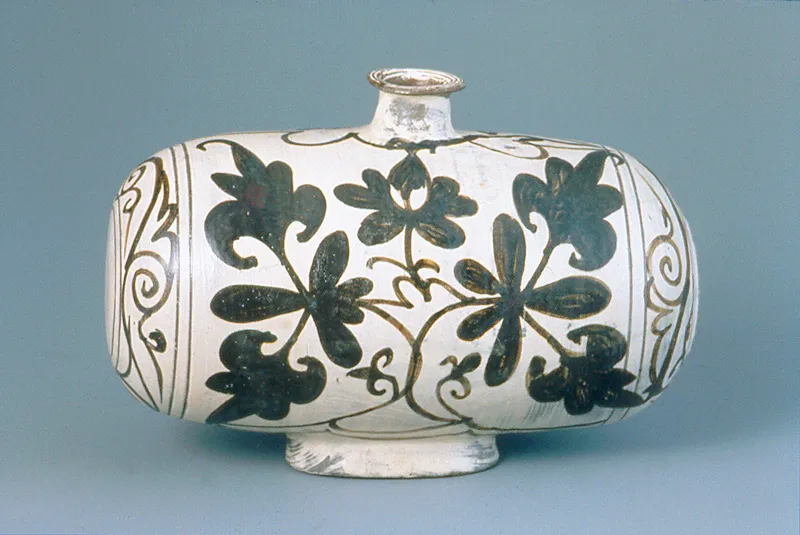
Buncheong Ware Cheolhwamoranmun Janggun
粉靑沙器 鐵畵牡丹文 獐本
서울특별시 용산구
Basic information
- Designation
- Treasure No.1387
- Category
- Craft
- Era
- 조선시대(15세기)
- Designated year
- 2003
- Location
- 용산구, 서울특별시— 서울 용산구 이태원로55길 60-16, 삼성미술관 리움 (한남동)
- Coordinates
- 37.536528, 126.996187
AI Docent
Coming soonAn AI-generated, friendly retelling of this heritage site is available in Korean. An English version is on our roadmap — for now, please see the official description below.
Description
This buncheong rice bale-shaped ceramic bottle is among the largest of its kind. Its surface is covered with black iron-oxide design motifs painted in thick, bold brushstrokes. Except for one end of the cylindrical body, which was carved into a foot-like appearance during the shaping of the bottle, and the inside of the tall and wide actual foot, the entire surface is covered with a rather thick layer of white slip, applied with a brush. In areas where the slip layer is thinner, brush marks are very apparent. The wide body has a small peony flower in the center, and the dense foliage on either side almost completely fills up the entire surface. Near the left and right edges, there are two lines in sgraffito, revealing the base clay beneath the white slip, and the two convex ends, delineated by the two sgraffito lines, are adorned with a simple scroll design. The area of the shoulder, immediately around the neck, has a scalloped line in the shape of a floral frame. Although the peony flower and the foliage are mostly contained within the vertical sgraffito lines on either side, some of the leaves, too large, extend beyond the lines, while some others are too small, leaving a big empty space. Such unevenness, the result of a free and spontaneous brushwork, does not take away from the charm of this boldly-decorated bottle. The dark gray base clay with a brownish hue contains fine sand particles, and the surface is even in tone with a rich glow. The glaze layer is rather thin, and there are some areas where the glaze is not fully melted. But, the quality of glazing is fine overall, and the surface has a soft luster.
Location
지도를 불러오는 중…
Have you visited this place?
Log in and verify your visit on-site via GPS to record a stamp in My Journey. (QR verification coming later.)
Images: KOGL (khs.go.kr) · Data source: Korea Heritage Service Open API (khs.go.kr)