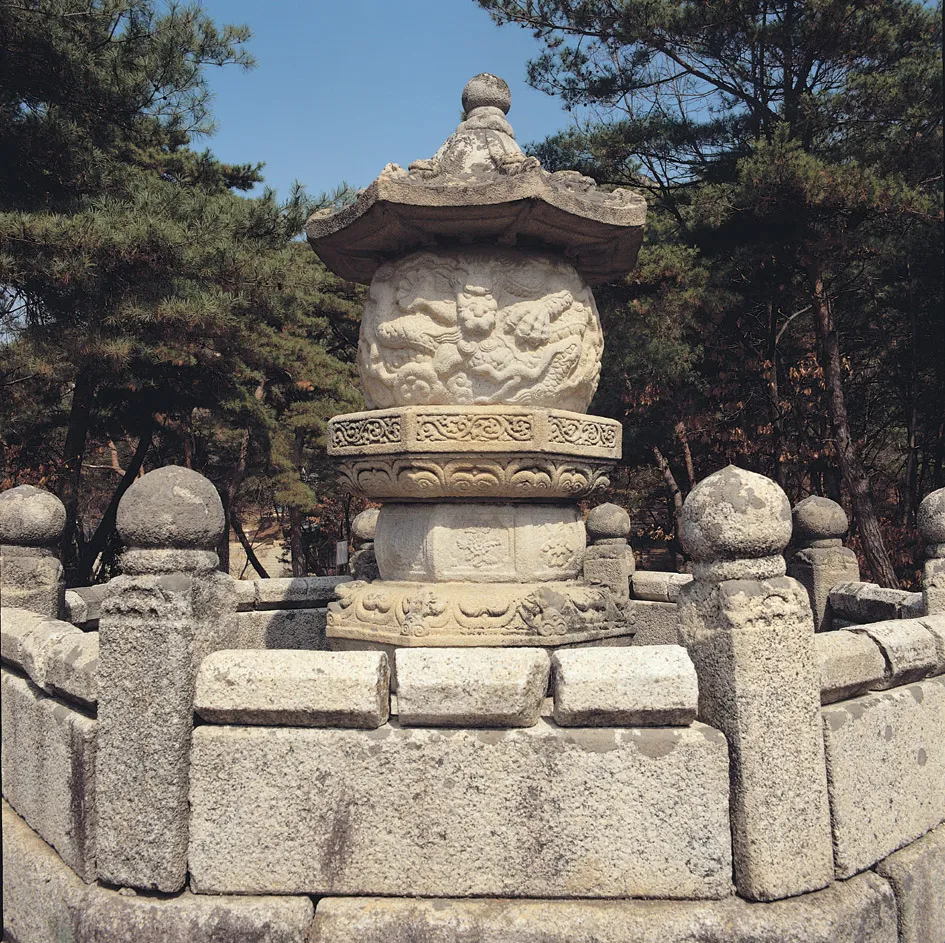
Stupa of Buddhist Monk Muhak at Hoeamsa Temple Site, Yangju
楊州 檜巖寺址 無學大師塔
경기도 양주시
Basic information
- Designation
- Treasure No.388
- Category
- Sites & Pagodas
- Era
- 조선시대
- Designated year
- 1963
- Location
- 양주시, 경기도— 경기 양주시 회암동 산8-1번지 회암사
- Coordinates
- 37.849816, 127.108037
AI Docent
Coming soonAn AI-generated, friendly retelling of this heritage site is available in Korean. An English version is on our roadmap — for now, please see the official description below.
Description
Hoeamsa Temple was constructed by Buddhist monk Jigong in 1328, during the reign of King Chungsuk of the Goryeo Dynasty, and closed during the 1800s, in the reign of King Sunjo of Joseon. It was patronized by the royal family during the early Joseon Dynasty and is famous as the place where Yi Seong-gye (the first king of the Dynasty) underwent monastic discipline after his abdication from the throne. This stupa, standing beside the stupas of Jigong and Naong at the north of the temple site, is for the great monk, Muhak, who used to be the head monk of the temple. He was active during the late Goryeo and early Joseon Dynasties and became famous for his relationship with Yi Seong-gye. There is an especially famous story that by interpreting a dream of Yi Seong-gye, Muhak predicted that he would become the king of a new dynasty, and he is also connected with the transfer of the capital of Joseon. The stupa is made up of an octagonal base stone engraved with a cloud pattern, the stylobate, a body and the finial. The lower and upper stone of the stylobate are in the shape of a lotus flower and the middle stylobate is a bulky octagon, each side of which has various flower carvings. The round main stone is full of eye-catching carvings of dragons and clouds. The head, the body and the scales of the dragon are depicted in such a vivid way as to make it seem alive, and the pattern of clouds deepens the impression of movement. The angled rafter of the steeply slanting octagonal roof stone has carvings that imitate the style of wooden constructions, and the eaves are slightly raised at the tip. Decoration on the top of the roof is simple, with just a single round stone. This stupa is constructed on a large scale and with its neat shape, it a good example of the style of the early Joseon Dynasty. According to the inscription on the tombstone of Muhak, it was constructed in 1407.
Location
지도를 불러오는 중…
Have you visited this place?
Log in and verify your visit on-site via GPS to record a stamp in My Journey. (QR verification coming later.)
Images: KOGL (khs.go.kr) · Data source: Korea Heritage Service Open API (khs.go.kr)