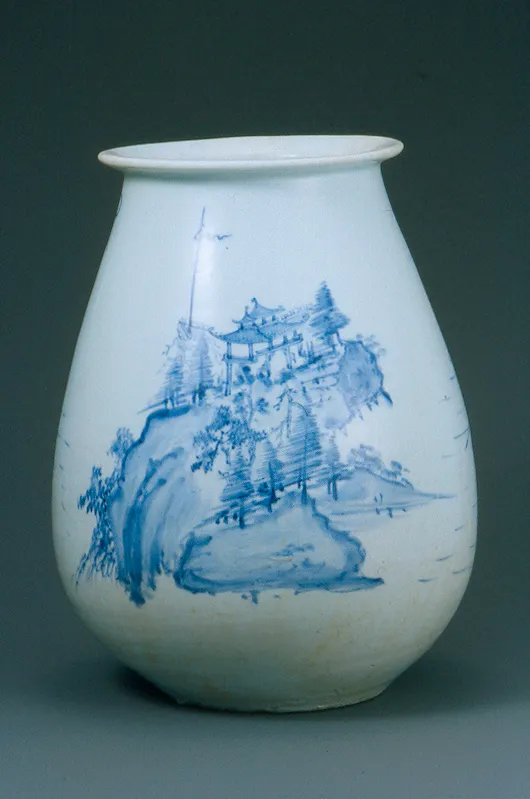
White Porcelain Cheonghwadongjeongchuwolmun Jar
白磁 靑畵洞庭秋月文 壺
서울특별시 용산구
Basic information
- Designation
- Treasure No.1390
- Category
- Craft
- Era
- 조선시대(18세기)
- Designated year
- 2003
- Location
- 용산구, 서울특별시— 서울특별시 용산구 서빙고로 137 (용산동6가, 국립중앙박물관)
- Coordinates
- 37.536528, 126.996187
AI Docent
Coming soonAn AI-generated, friendly retelling of this heritage site is available in Korean. An English version is on our roadmap — for now, please see the official description below.
Description
This jar has a generously-sized cylindrical body with a wide mouth. Reminiscent in shape of a mallet head; hence, it is also known by its nickname tteongmebyeong, literally meaning “rice dough mallet.” The jar appears to have been used as a flower vase. Few flower vases have survived from the Joseon Dynasty, although they were manufactured albeit in moderate quantities. On the surface of the vase, an elegant landscape, painted with a cobalt pigment of an excellent blue shade, is deployed. The landscape features, on one side, a pavilion atop a rock cliff with a flag, and a full moon is visible in the sky to the left with a mountain with three peaks at a distance. Meanwhile, in the foreground, a riverside village is depicted with people enjoying boating in the river. Landscapes of this type were widely popular as underglaze decorations, especially in white porcelains produced in the government kiln in Gwangju, Gyeonggi-do. In the case of this particular vase, this landscape appears to be the work of a court painter, judging from the experienced brushwork and sophisticated composition. The surface is coated with a clear white porcelain glaze with a slight blue hue. This type of translucent blue glaze is a telltale sign of late 18th century white porcelains. The foot was carved from the inside, neatly, to create a thin round rim. The foot is glazed on the inside as well. The underside shows traces of fine sand over which the vase was rested for firing. This spectacular piece of ceramic art impresses with its graceful silhouette and the beauty of the underglaze landscape.
Location
지도를 불러오는 중…
Have you visited this place?
Log in and verify your visit on-site via GPS to record a stamp in My Journey. (QR verification coming later.)
Images: KOGL (khs.go.kr) · Data source: Korea Heritage Service Open API (khs.go.kr)