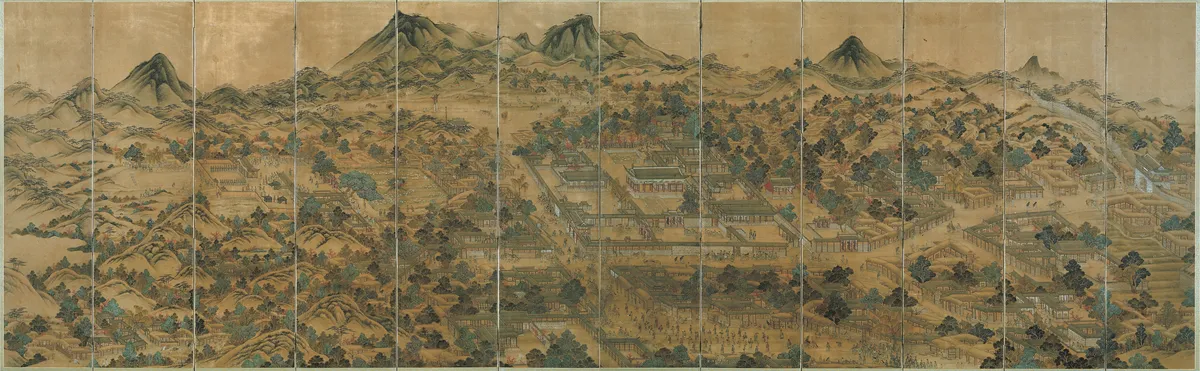
Gyeonggigamyeongdo Folding Screen
京畿監營圖 屛風
서울특별시 용산구
Basic information
- Designation
- Treasure No.1394
- Category
- Painting
- Era
- 조선시대(19세기)
- Designated year
- 2003
- Location
- 용산구, 서울특별시— 서울 용산구 이태원로55길 60-16, 삼성미술관 리움 (한남동)
- Coordinates
- 37.538427, 126.965444
AI Docent
Coming soonAn AI-generated, friendly retelling of this heritage site is available in Korean. An English version is on our roadmap — for now, please see the official description below.
Description
This 12-cut folding screen contains sceneries outside the Gyeonggi Provincial Office near Seodaemun Gate of Hanyang (present-day Seoul) in Yeonbong Plain near Inwangsan Mountain. The bird’s eye view method was adopted in making the piece. Buildings are portrayed in an angular, parallel perspective by an observer on a higher place on the right. This piece adopts the perspective technique in portraying faraway mountain peaks or trees, but that does not apply to the colors used. Faraway mountain peaks and other sceneries are portrayed in clear-cut colors. Many trees are contained in this painting. Pine trees are in rows along the ridges in faraway mountains. Diverse types of trees appear colorfully on nearby low hills and between houses. Such trend of including many trees was also followed in some documentary paintings of the 19th Century. The cut on the extreme right displays “敦義門” (pronounced Donuimun/West Gate) and “守門將廳” (pronounced Sumunjangjeong/ Guard Commander’s Office). The fourth cut from the right shows “圻營” (pronounced Giyeong/ Gyeonggi Provincial Office) on a tall gate. The large building at the center of the sixth cut is the governor’s office. The upper side of the eighth cut displays “慕華館” (pronounced Mohwagwan/ guesthouse where a welcome party was held for envoys sent by the emperor of the Ming Dynasty of China) and “迎恩門” (pronounced Yeongeunmun/ gate to Mohwagwan). The eighth and ninth cuts contain lotus ponds, with the tenth cut showing “大峴” (pronounced Daehyeon/High Pass), “小峴” (pronounced Sohyeon/Low Pass), and 揖升亭 (pronounced Eupseupjeong/an archery range). The 12th cut displays 射亭 (pronounced Sajeong/ archers’ pavilion). The piece contains even unimportant buildings like toilet attached to a government building, barn, roof-tiled or thatched houses of ordinary people, medicinal herb store, shoe store, rice store, pub, etc. The scenes of people engaging in everyday lives, portrayed here and there in this painting, add to its vitality. The most important thing among the everyday scenes is the procession of the governor contained in the third ~ sixth cuts from the right. The figure on horseback, presumed to be the governor, has his facial details like the eyes, nose, and mouth depicted, unlike the other people; thus indicating his importance. The band and attendants following the procession are portrayed realistically. The portrayal of the building courtyard, thoroughfares, back alleys, and people assuming various poses indicates a typical instance of a genre painting. It also depicts scholars wearing hats while taking a rest under a tree, police officers chatting with each other, horses waiting in front of a government office, women carrying jars on their head, scholar on horseback accompanied by an errand boy, yeot (candy) seller, people carrying an A-shaped wooden carrier on their back, farmers working in rice paddies and field, housewives carrying on their head lunch for their husbands working in the field, and dog running on a ridge between rice paddies.
Location
지도를 불러오는 중…
Have you visited this place?
Log in and verify your visit on-site via GPS to record a stamp in My Journey. (QR verification coming later.)
Images: KOGL (khs.go.kr) · Data source: Korea Heritage Service Open API (khs.go.kr)