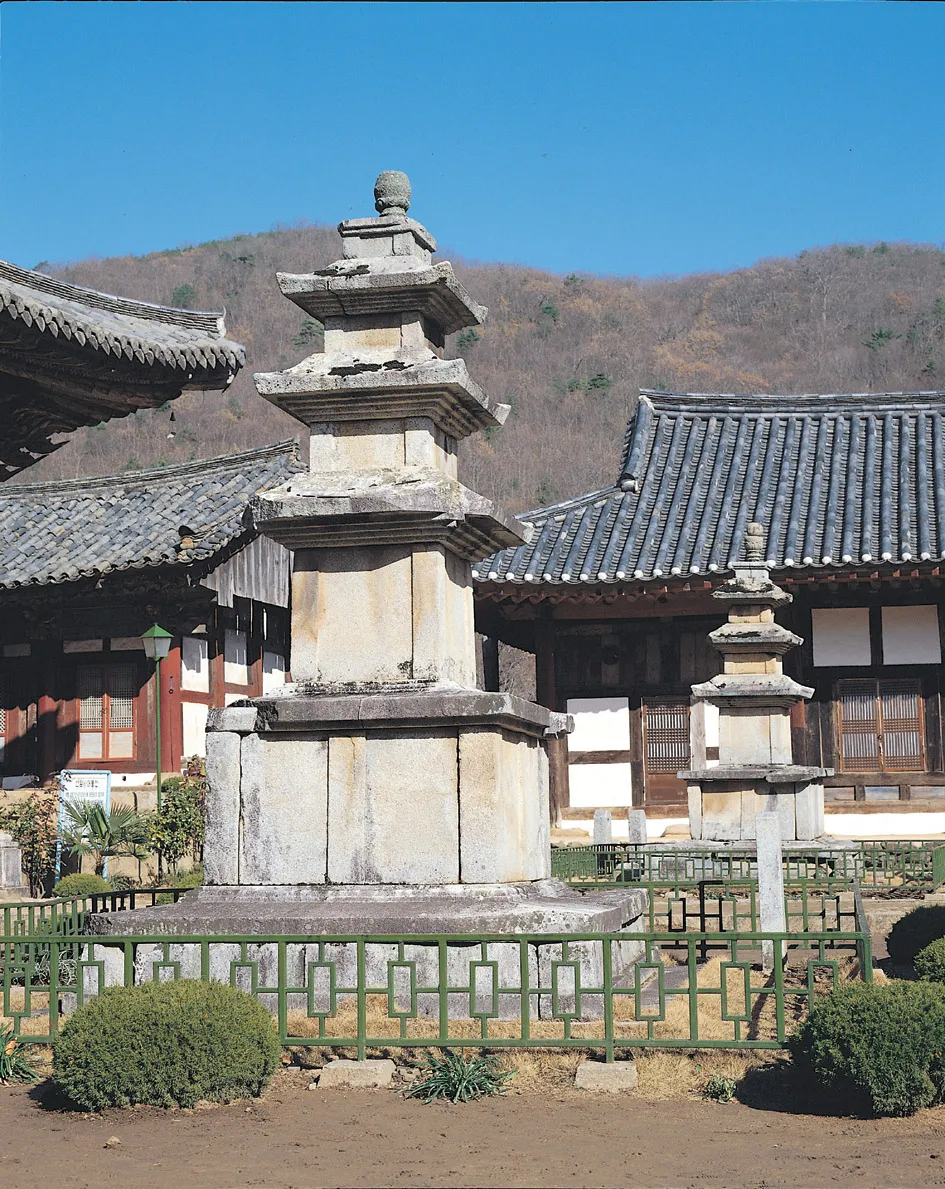
East and West Three-story Stone Pagodas of Seonamsa Temple, Suncheon
順天 仙巖寺 東·西 三層石塔
전라남도 순천시
Basic information
- Designation
- Treasure No.395
- Category
- Sites & Pagodas
- Era
- 통일신라시대
- Designated year
- 1963
- Location
- 순천시, 전라남도— 전남 순천시 승주읍 선암사길 450 (죽학리) / (지번)전남 순천시 승주읍 죽학리 802
- Coordinates
- 34.996427, 127.331204
AI Docent
✨ AI-generated# East and West Three-story Stone Pagodas of Seonamsa Temple Welcome to Seonamsa Temple, nestled in the mountains of Suncheon. When you cross Seungseongyo Bridge and enter the front yard, you'll encounter something truly striking: two identical three-story stone pagodas standing side by side before the main hall. These aren't just any pagodas—they were crafted by the same artisan at the same time, as shown by their matching scale and style. Built in the 9th century during Korea's Unified Silla period, they showcase the elegant proportions and carved pillars characteristic of that era. Every detail reveals masterful stonework: single-stone bodies, precisely tiered supports, and those distinctive double struts topping the eaves. The temple itself dates to either 542 or 875, depending on which account you follow. Its name, "Seonam" (Immortals Rock), comes from a massive flat rock rising to the west—legend says immortals once played baduk, an ancient board game, there. Though centuries old and somewhat weathered, these pagodas remain in remarkably good condition, standing as silent witnesses to over 1,100 years of Korean Buddhist history.
⚠ This is an AI-generated retelling of the official description. For accuracy, refer to the official description below.
Description
There are two stories about the construction of Seonamsa Temple. One is that it was constructed by Buddhist Monk Ado of the Silla Dynasty, in the 3rd year of the reign of King Jinpyeong (542) and the other, which is more authorized, is that State Preceptor Doseon constructed and named it in the 5th year of the reign of King Heongang (875). The name Seonam (‘Immortals Rock’) is said to come from the huge, flat and rock that soars up to the west of the temple, and which was a place where immortals come to play the chess-like game baduk. When you cross Seungseongyo Bridge into the temple and arrive in the front yard, you see two three-story pagodas standing side by side in front of the main hall. The pagodas are of the typical style of the Silla period with a two-story stylobate, and they appear to have been made by the same person at the same time judging from their identical scale and style. Each of the corners and middles of the two stories of the stylobate is decorated with the carving of a pillar, and a 3-tiered flat stone is set on each story to support the upper stone. The main stone and the roof stone of the body are each made up of a single stone and the main stone also has a carving of a pillar at each corner. With a 4-tiered strut, the eaves of roof are horizontal and the 2-tiered strut at the top of the roof is most unusual. On the top, only the final base remains, supporting the finial with small stones placed on it. These two pagodas in the same style are somewhat damaged but still in fairly good condition. Maintaining the style of the Silla stone pagoda, they show appropriate and elegant proportions of the upper and lower parts. On the basis of the style in which the pillars are carved, they are judged to be works of the 9th century, later than the middle Silla era.
Location
지도를 불러오는 중…
Have you visited this place?
Log in and verify your visit on-site via GPS to record a stamp in My Journey. (QR verification coming later.)
Images: KOGL (khs.go.kr) · Data source: Korea Heritage Service Open API (khs.go.kr)