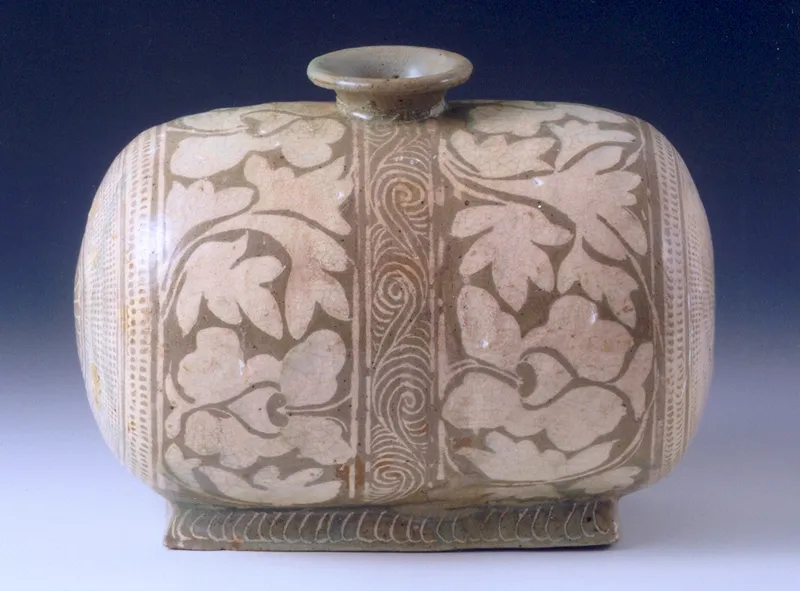
Buncheong Ware Sanggammorandangchomun Janggun
粉靑沙器 象嵌牡丹唐草文 獐本
대구광역시 수성구
Basic information
- Designation
- Treasure No.1400
- Category
- Craft
- Era
- 조선시대(15세기)
- Designated year
- 2004
- Location
- 수성구, 대구광역시— 대구광역시 수성구
- Coordinates
- 35.858175, 128.630635
AI Docent
Coming soonAn AI-generated, friendly retelling of this heritage site is available in Korean. An English version is on our roadmap — for now, please see the official description below.
Description
This object is shaped like a wine barrel, but its side looks like a rectangle, and its sidelines are almost straight. Overall, it looks voluminous and massive. The mouth is wide and thick. The bottom -- made separately and attached to the body -- is a wide rectangle. Its front side is inscribed with peony scroll design with thick lines, densely stamped design, and thin inlaid lines. The patterns display the combination between the strong and the weak by making large shapes thick and rendering small shapes exquisite and delicate. The center of the body has vertical scrolling vine patterns with inlaid lines, dividing the body into two from the mouth to the bottom. Wide leaves and peony blossoms depicted with neat lines are symmetrically placed on both sides of the vertical line with the space inlaying technique. Both round ends are densely inscribed with stamped and inlaid designs. The inside of the bottom shows two or three lines with depressed engraving, which is a trace of the white inlaying done after attaching the bottom to the body. Although a flawless work, it has netlike cracks on the surface. Part of the bottom carries a trace of thickly applied glaze to prevent cracks on the source soil. This grayish-blue-powdered celadon is covered with peony and scroll patterns using the line and space inlaying technique. With the glaze applied even to the inside of the bottom, it displays near-perfect workmanship along with graceful outward shape and beautiful ornaments. It has stable and imposing appearance, boldly arranged patterns, exquisite stamped design, etc. Thus, it is representative of objects of its kind made in the 15th century as well as an important material for those studying the trend of porcelain production.
Location
지도를 불러오는 중…
Have you visited this place?
Log in and verify your visit on-site via GPS to record a stamp in My Journey. (QR verification coming later.)
Images: KOGL (khs.go.kr) · Data source: Korea Heritage Service Open API (khs.go.kr)