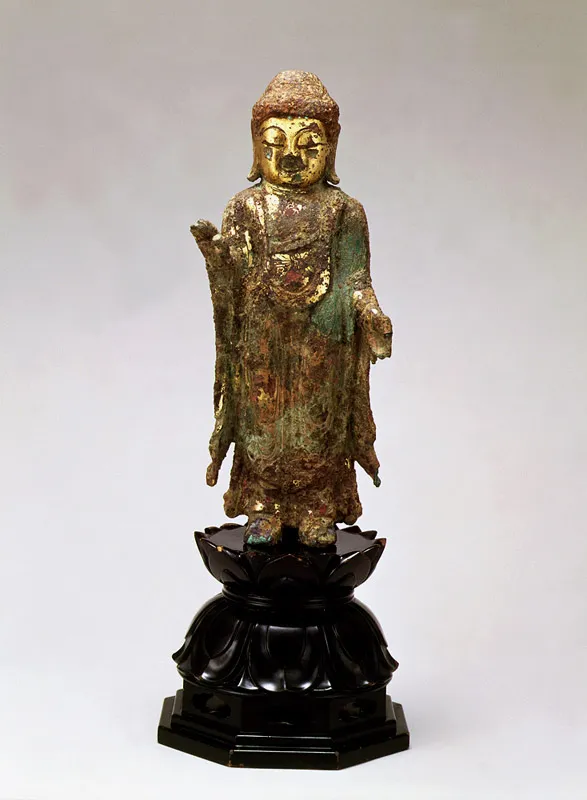
Gilt-bronze Standing Buddha
金銅如來立像(1964)
서울특별시 용산구
Basic information
- Designation
- Treasure No.401
- Category
- Sculpture
- Era
- 통일신라시대 후기
- Designated year
- 1964
- Location
- 용산구, 서울특별시— 서울특별시 용산구 서빙고로 137 (용산동6가, 국립중앙박물관)
- Coordinates
- 37.577542, 127.008137Kakao address conversion
AI Docent
Coming soonAn AI-generated, friendly retelling of this heritage site is available in Korean. An English version is on our roadmap — for now, please see the official description below.
Description
This is a standing Buddha statue 32.3 centimeters high without a pedestal or mandorla (Buddhist halo of light). It is fairly large for something in the keeping of a private citizen. Where it was first made or how it was found is still unknown. However, it is said that it was acquired from a Japanese person during the Japanese Occupation. There are signs of plating, and there is blue rust all over it. There is a large topknot shaped usnisa (a protuberance symbolizing supreme wisdom) around the crown of the curly hair, but it is not tall. The face is square, the eyes are elongated sideways, the nose and mouth are small, and the cheeks are plump. The face is voluminous but flat, resembling the carving styles of the Unified Silla period. The neck is short with three wrinkles, which makes the Buddha look oppressed and fat. The right hand is held up with the palm upward and the left hand is held below the waist with the palm showing. The beobui (sacerdotal robe) hangs on both broad shoulders with "U" shaped folds that cover the entire body. There are undergarments and knotted bands on the chest, which is also a characteristic of standing Buddha statues from the Unified Silla period. On the back of the statue, there are large holes on the head and the body which were used in the casting of gilt-bronze statues in Unified Silla. Overall the head is large compared to the body and looks fat and short, and the beobui reduces the animation and volume. The carving itself is flat and stiff with the folds in the clothing carved in the formal style of the late Unified Silla period.
Location
지도를 불러오는 중…
Have you visited this place?
Log in and verify your visit on-site via GPS to record a stamp in My Journey. (QR verification coming later.)
Images: KOGL (khs.go.kr) · Data source: Korea Heritage Service Open API (khs.go.kr)