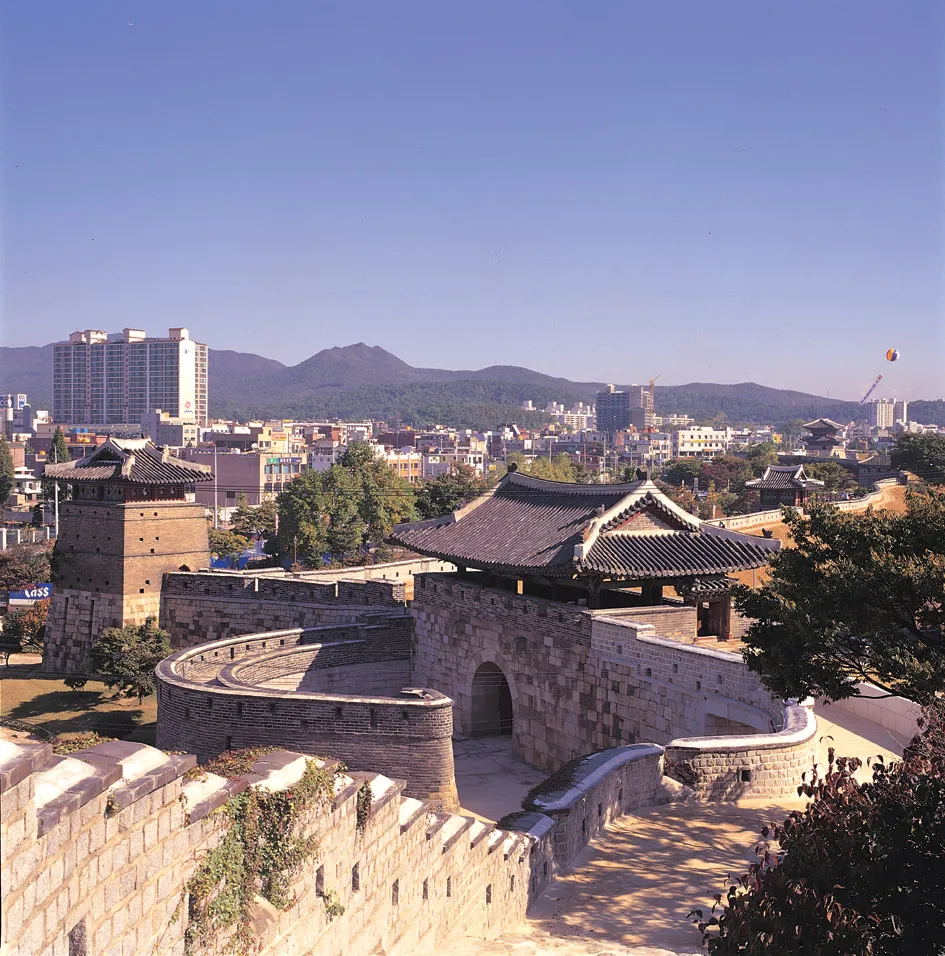
Hwaseomun Gate, Suwon
水原 華西門
경기도 수원시
Basic information
- Designation
- Treasure No.403
- Category
- Architecture
- Era
- 조선 정조 20년(1796)
- Designated year
- 1964
- Location
- 수원시, 경기도— 경기 수원시 팔달구 장안동 334번지
- Coordinates
- 37.285489, 127.009693
AI Docent
Coming soonAn AI-generated, friendly retelling of this heritage site is available in Korean. An English version is on our roadmap — for now, please see the official description below.
Description
The construction of Suwonseong Fortress started in 1794, the 18th year of the reign of King Jeongjo when the royal mausoleum of Prince Sado, father of King Jeongjo, was moved from Yangju to Suwon. It was completed two years later. The style of its architecture was borrowed from that of Chinese fortress walls, but because it was built in a scientific way, it is more advanced. It is an outstanding cultural asset representing the Korean fortress. Hwaseomun Gate is the west gate of Suwonseong Fortress, and its size and equipment are almost the same as those of Changnyongmun Gate in the east. The one-story building is built on an embankment with big quadrilateral stones and it has a hip and gable roof called paljakjibung. There is an arched gate in the center of the embankment and the semicircular barbican constructed of brick in front of the gate. The barbican served to protect and guard the gate so it functioned as a second line of defense. The gate tower comprises three kan (a unit of measurement referring to the distance between two columns) in the front and two kan at the side, but their spaces are opened to the outside. However it is actually protected because the low walls surrounding the gate have holes through which to shoot with firearms or bows. Gongsimdon, guard turrets, were also linked with this gate a short distance away along the fortress walls to the north. Soldiers could go up and down the stairs inside and shoot through holes with firearms or bows. This is a unique style of building in Korean architecture and its structure is also impressive. Also, with its beauty, it graces the scenery around it.
Location
지도를 불러오는 중…
Have you visited this place?
Log in and verify your visit on-site via GPS to record a stamp in My Journey. (QR verification coming later.)
Images: KOGL (khs.go.kr) · Data source: Korea Heritage Service Open API (khs.go.kr)