Bongsajoseonchanghwasigwon
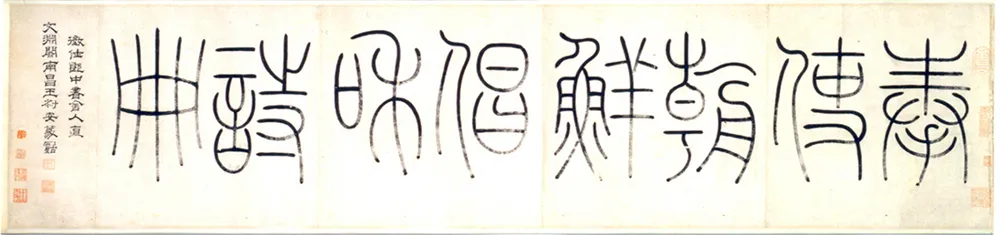
奉使朝鮮倡和詩卷
서울특별시 용산구
Basic information
- Designation
- Treasure No.1404
- Category
- Books & Records
- Era
- 조선 세종 32년(1450)
- Designated year
- 2004
- Location
- 용산구, 서울특별시— 서울특별시 용산구 서빙고로 137 (용산동6가, 국립중앙박물관)
- Coordinates
- 37.524041, 126.980350
AI Docent
Coming soonAn AI-generated, friendly retelling of this heritage site is available in Korean. An English version is on our roadmap — for now, please see the official description below.
Description
This anthology is composed of three parts: the title handwritten by Wang Shuan (an official at Wenuanan Hall of the Qing Dynasty of China); changhwasi (changheshi in Chinese) (poetry and prose exchanged between two parties), and; epilogues written by Tang Hanti and Luo Zhenyu of the Qing Dynasty. The anthology contains poems exchanged between Seong Sam-mun, Sin Suk-ju, and Jeong In-ji, who were scholars of Jiphyeonjeon (Hall of Worthies) of the Joseon Dynasty, and Niqian, an emissary from the Ming Dynasty of China. Ni Qian, a lecturer of the royal literary institute of the Ming Dynasty of China, came to Joseon, bearing a royal message about Emperor Jingtai’s (r. 1450-1457) accession to the throne, in 1450 (the 32nd year of King Sejong’s reign). He stayed in Joseon for about one month. It was during this time that he exchanged these poems with the three scholars of Joseon, who were government officials responsible for greeting Chinese emissaries. This anthology contains 37 selected poems. The seals of the poems’ authors and the people who previously had possession of this collection are stamped on the anthology. Among the seals of the poems’ authors, Ni Qian has the most (seven), with Jeong In-ji and Sin Suk-ju having two each and Seong Sammun having only one. The seals of the people who used to keep the book tell us that the album had been kept by Ni Quan’s descendants and later handed over to Chen Jizhong, Tang Hanti, and Luo Zhenyu. In his epilogue written at the end of the anthology in 1905 (the 9th year of the reign of Emperor Gwangmu of the Korean Empire), Luo Zhenyu says that he obtained this book from Tang of Jiaxing (supposedly referring to Tang Hanti). The anthology contains another page about the appraisal of the book made by six leading experts, including Kim Sang-gi (pen-name: Dongbin), in 1958; thus telling us that the book was introduced to Korea in or before 1958. It was kept by Im Chang-sun and later donated to the National Museum of Korea. It is regarded as a valuable material containing vivid records of the country’s diplomacy toward the Ming Dynasty of China and information on calligraphy in the early Joseon Period.
Location
지도를 불러오는 중…
Have you visited this place?
Log in and verify your visit on-site via GPS to record a stamp in My Journey. (QR verification coming later.)
Images: KOGL (khs.go.kr) · Data source: Korea Heritage Service Open API (khs.go.kr)