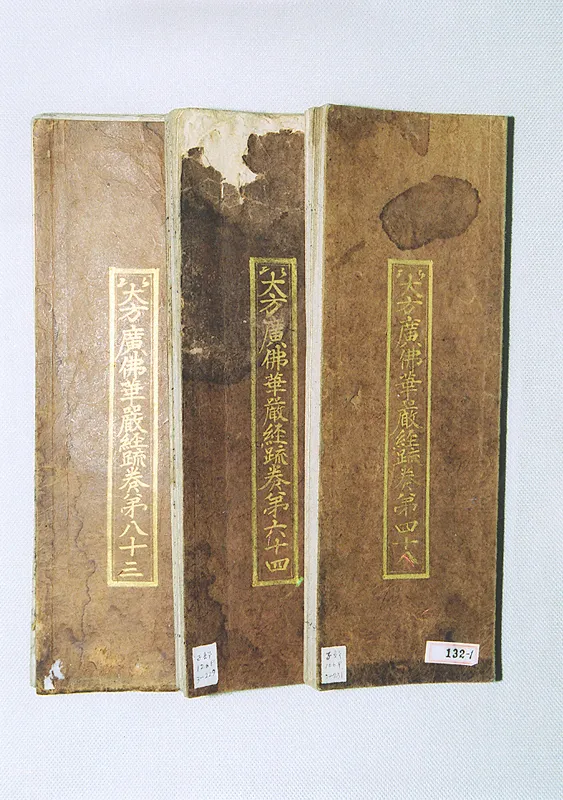
Daebanggwangbulhwaeomgyeongso Gwon48, 64, 83
大方廣佛華嚴經疏 卷四十八, 六十四, 八十三
충청북도 청주시
Basic information
- Designation
- Treasure No.1409
- Category
- Books & Records
- Era
- 고려시대 후기
- Designated year
- 2004
- Location
- 청주시, 충청북도— 충북 청주시 흥덕구 직지대로 713, 청주고인쇄박물관 (운천동,청주고인쇄박물관)
- Coordinates
- 36.644045, 127.471437
AI Docent
Coming soonAn AI-generated, friendly retelling of this heritage site is available in Korean. An English version is on our roadmap — for now, please see the official description below.
Description
These are interpretational texts written by Jingyuan of the Song Dynasty of China based on Hwaeomgyeong (Avatamsaka Sutra), one of the scriptures of Mahayana Buddhism. They contain the explanatory notes written by Chengguan of the Tang Dynasty of China. The central concept of Daebanggwangbul hwaeomgyeong (more commonly known as Hwaeomgyeong) is that all living beings and Buddha are not separate but one. Hwaeomgyeong is the main Sutra of the Avatamsaka Order in Korea; together with the Myobeopyeonhwagyeong (Saddharma-Pundarika Sutra), it has had significant influence on the establishment of Buddhism in Korea. These books were printed from the wood-printing blocks sent by Jingyuan to Monk Uicheon via a merchant named Seo Jeon. They are Vols. 48, 64, and 83 among the 120 volumes of interpretational texts of Hwaeomgyeong printed, and they have been preserved well. The cover is made of paper dyed with oak tree sap. The titles on the cover and inside are written in gold powder. There is a single border at the top and bottom of the page, with boundary lines dividing the columns each of which has 15 characters. Each page is folded five times; printed at the folded places are the title of the book, volume, and chapter, apparently to allow for the more efficient management of the books. The paper is made of mulberry and is high-quality Korean paper that underwent a special process called dochim (smoothing layers of paper that have been pasted by beating them on a fulling block) to add luster and prevent the ink from spreading on the paper. At the end of Vol. 83 is an inscription that reads “the 49th year of the sexagenary cycle, the 31st year of Emperor Jiajing of the Ming Dynasty of China (i.e. 1552)…” which appears to be a record of ownership since it could hardly be the date of printing. The characters are in the calligraphic style of famous Chinese calligrapher Ouyang Xun, which was very popular in woodblock prints of the Song Dynasty of China. The strokes of the Chinese characters are clear and distinct, indicating that the books were printed in a relatively early period. These Buddhist scriptures have significant historical value since they provide valuable information regarding Uicheon’s collection of Buddhist literature and the cultural exchanges between the Song Dynasty of China, Goryeo Dynasty, and Japan.
Location
지도를 불러오는 중…
Have you visited this place?
Log in and verify your visit on-site via GPS to record a stamp in My Journey. (QR verification coming later.)
Images: KOGL (khs.go.kr) · Data source: Korea Heritage Service Open API (khs.go.kr)