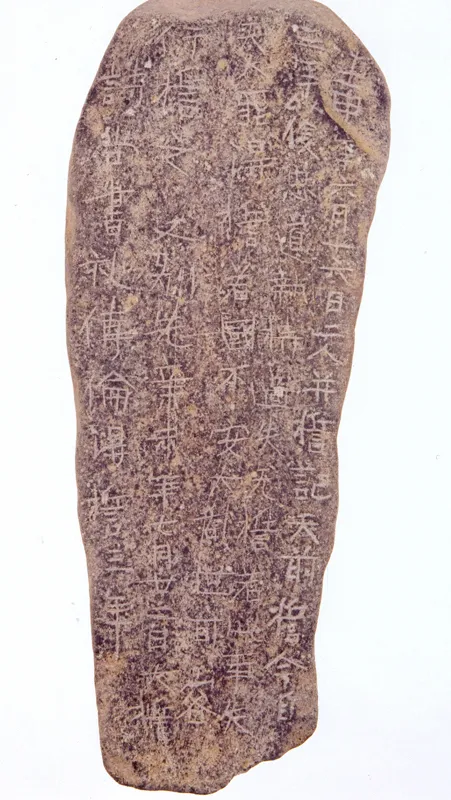
Imsinseogiseok
壬申誓記石
경상북도 경주시
Basic information
- Designation
- Treasure No.1411
- Category
- Books & Records
- Era
- 신라시대(552 또는 612년)
- Designated year
- 2004
- Location
- 경주시, 경상북도— 경북 경주시 일정로 186, 국립경주박물관 (인왕동,국립경주박물관)
- Coordinates
- 35.829387, 129.227912
AI Docent
Coming soonAn AI-generated, friendly retelling of this heritage site is available in Korean. An English version is on our roadmap — for now, please see the official description below.
Description
This Clay-slate Stone Monument is a long piece of stone that is wide at the top but becomes gradually narrower toward the bottom. A total of 74 characters are carved in 5 vertical lines on the tablet. The stone tablet is called “Imsin seogi myeongseok (Stone tablet with inscription of an oath to observe the code of loyalty made in the year of Imsin)” since the first words inscribed are “Imsin (the 9th year of the sexagenary cycle)” and the writing is mainly related to an oath made to observe the code of loyalty. The details of the inscription are as follows: “On June 16 in the year of Imsin, we, two members of Hwarang (elite youth corps of the Silla Dynasty), swear, before God, to observe the code of loyalty three years from this day. If we violate this oath, it shall mean that we have committed a grave sin against God. If there is disturbance in the country, we swear to act by the code of loyalty.” Another oath was made prior to this on 22 July in the year of Sinmi (8th year of the sexagenary cycle) to complete the reading of the classic texts of Confucianism, Shijing (Classics of Poetry), Shangshu (Documents of the Elder), Liji (Classics of Rites), and Chunqiu (Spring and Autumn Annals) in the next three years. The inscription on the stone tablet is historically significant since it is the only extant epigraph that provides evidence of the existence of writings in hunseok (easier rendition of Chinese characters) other than writings in Chinese characters and in hyangchal (Korean words written using the pronunciation and meaning of Chinese characters). Moreover, it represents the devotion of the youth of Silla to living by the principle of “Friendship should be based on loyalty to one another,” one of the five secular injunctions to be honored by the members of Hwarang, also revealing an aspect of the ancient religious beliefs in a divine being. The year Imsin as inscribed on the tablet presumably refers either to the 13th year of the reign of King Jinheung (552) or to the 34th year of the reign of King Jinpyeong (612), both of Silla. This is an invaluable relic since it provides valuable information regarding the calligraphic styles and inscription styles of epigraphs of the Silla Period in the 6th century.
Location
지도를 불러오는 중…
Have you visited this place?
Log in and verify your visit on-site via GPS to record a stamp in My Journey. (QR verification coming later.)
Images: KOGL (khs.go.kr) · Data source: Korea Heritage Service Open API (khs.go.kr)