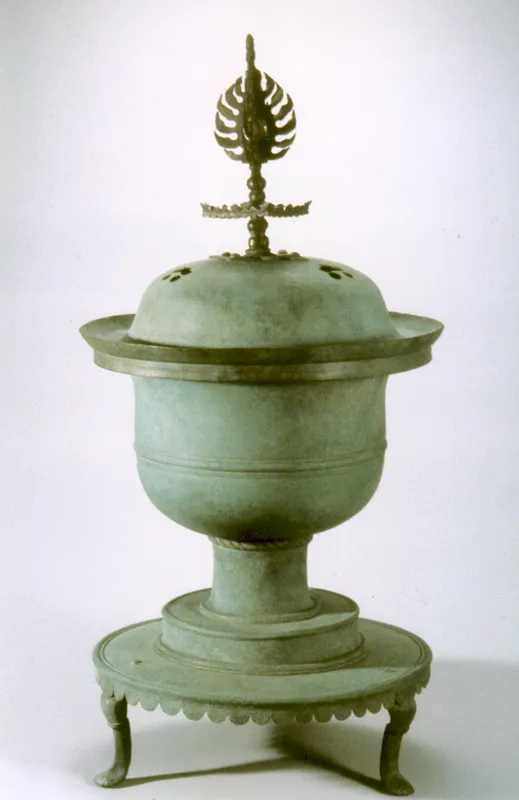
Bongeopsamyeong Cheongdong Incense Burner
奉業寺銘 靑銅 香爐
서울특별시 용산구
Basic information
- Designation
- Treasure No.1414
- Category
- Craft
- Era
- 고려시대(13세기)
- Designated year
- 2004
- Location
- 용산구, 서울특별시— 서울특별시 용산구 서빙고로 137 (용산동6가, 국립중앙박물관)
- Coordinates
- 37.524702, 126.977740Kakao address conversion
AI Docent
Coming soonAn AI-generated, friendly retelling of this heritage site is available in Korean. An English version is on our roadmap — for now, please see the official description below.
Description
This large incense burner was discovered at the former site of Bongeopsa Temple, which existed during the Goryeo Dynasty, in Anseong, Gyeonggi-do. It consists of the nosin (body) and gaebu (lid), and a pedestal with three legs to support the body. It is unique in that there is no broad projecting rim, a characteristic feature of most incense burners of the Goryeo Dynasty. However, the body of the incense burner closely resembles the shape of hyangwan (bowl-shaped incense burners) of the Goryeo Dynasty. The boju (finial) on top of the lid and the round pedestal with three legs add overall balance and proportion to the structure, as well as a dignified beauty. The lid is decorated with an elaborate boju, which appears to have been gilded. It is in the shape of a stylized flame, much like the ones found in sarira reliquaries. The words “Buddhist Monk Wonjun, Bongeopsa Temple” are inscribed on the lid, suggesting that production of the Incense Burner was commissioned by Monk Wonjun of Bongeopsa Temple, rather than Wonjun having produced it by himself. Another inscription on the pedestal indicates that 15.6 kg of copper went into the casting of the incense burner. According to the inscriptions, it is assumed that the incense burner was produced in the 13th century at Bongeopsa Temple, which existed during the early Goryeo Dynasty.
Location
지도를 불러오는 중…
Have you visited this place?
Log in and verify your visit on-site via GPS to record a stamp in My Journey. (QR verification coming later.)
Images: KOGL (khs.go.kr) · Data source: Korea Heritage Service Open API (khs.go.kr)